Robert Gascoyne-Cecil, 5th Marquess Of Salisbury
| Name | Robert Gascoyne-Cecil, 5th Marquess Of Salisbury |
| Title | British Conservative politician (1893–1972) |
| Gender | Male |
| Birthday | 1893-08-27 |
| nationality | United Kingdom |
| Source | https://www.wikidata.org/wiki/Q333205 |
| pptrace | View Family Tree |
| LastUpdate | 2025-11-26T23:30:30.929Z |
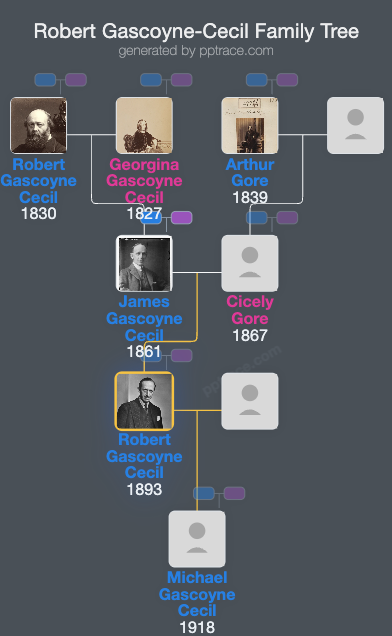
Family Tree
Tap  to expand more relatives
Introduction
Robert Arthur James Gascoyne-Cecil, the 5th Marquess of Salisbury, was born on 27 August 1893 and died on 23 February 1972. He was known as Viscount Cranborne from 1903 until 1947. Salisbury was a member of the British Conservative Party and held various governmental positions throughout his career.
He was the eldest son of James Gascoyne-Cecil, the 4th Marquess of Salisbury, and Lady Cicely Gore, daughter of the 5th Earl of Arran. His grandfather was the 3rd Marquess of Salisbury, who served as Prime Minister from 1895 to 1902. Salisbury received education at Eton College and Christ Church, Oxford. In 1951, he was awarded an honorary Doctorate of Civil Laws.
During the First World War, Salisbury served in the British Army. He was commissioned as a Lieutenant in the Grenadier Guards (Special Reserve) in 1915 and served until the end of the war. He was awarded the Croix de Guerre and was made a Chevalier of the Order of the Crown of Belgium. After the war, he worked at Westminster Bank. In 1928, Salisbury was appointed a director of Westminster Bank and became a member of the Royal Commission on Historical Manuscripts, later serving as its chairman in 1957.
He was elected as a Conservative Member of Parliament for South Dorset in 1929. In 1934, during Ramsay MacDonald's National Government, Salisbury was appointed Parliamentary Secretary to the Lord Privy Seal. From 1935 to 1938, he served as Joint Parliamentary Under-Secretary of State for Foreign Affairs. In May 1940, Winston Churchill appointed him Paymaster General during the Battle of Britain. Subsequently, he served as Secretary of State for Dominion Affairs from 1940 to 1942 and again from 1943 to 1945, and as Secretary of State for the Colonies from February to November 1942.
In 1941, Salisbury was summoned to the House of Lords through a writ of acceleration in his father’s title as Baron Cecil of Essendon. He also held the role of Lord Privy Seal between 1942 and 1943, Leader of the House of Lords from 1942 to 1945, and served as President of the English-Speaking Union in 1943. He was president of University College of the South West, now the University of Exeter, for ten years.
Salisbury was appointed a Knight of the Order of the Garter in 1947. That same year, he succeeded his father as the 5th Marquess of Salisbury. He also held the position of High Steward of Hertfordshire in 1947 before the office was abolished.
During the 1950s, Salisbury served under Prime Ministers Churchill, Eden, and Macmillan, as Lord Privy Seal (1951–1952), Leader of the House of Lords (1951–1957), Secretary of State for Commonwealth Relations in 1952, and Lord President of the Council from December 1952 to 1957. In 1952, he was acting Foreign Secretary during the health issues of Anthony Eden.
He was involved in several political and diplomatic issues concerning the British Empire. As Secretary of State for Commonwealth Relations in 1952, he sought to uphold the exile of Seretse Khama in Bechuanaland due to intermarriage with a white British woman.
In the 1960s, Salisbury maintained a stance supportive of white minority governments in South Africa and Southern Rhodesia. He was awarded the Freedom of the City of Salisbury in 1956, a city named after his grandfather. Salisbury opposed reforms to the House of Lords and proposed the Salisbury Convention, which limits the House of Lords from opposing certain government legislation.
In January 1957, Salisbury advised the Queen on the appointment of Harold Macmillan as Prime Minister, following the resignation of Anthony Eden. Salisbury resigned from his role as Leader of the House of Lords in opposition to the government's decision to release Archbishop Makarios of Cyprus from detention.
He was the first president of the Conservative Monday Club, assuming this role in 1962 and holding it until his death in 1972. Salisbury was also a Fellow of the Royal Academy of Arts and served as a Trustee of the National Gallery between 1960 and 1966.
He served as Chancellor of the University of Liverpool from 1951 to 1971. His tenure included controversy in 1970 when students opposed his support for apartheid; they staged an occupation to demand his removal from the university.
In his personal life, Salisbury married Elizabeth Vere Cavendish on 8 December 1915. She was the daughter of Lord Richard Cavendish and Lady Moyra de Vere Beauclerk. They had three sons: Robert Edward Peter Gascoyne-Cecil, who became the 6th Marquess of Salisbury; Michael Charles James Gascoyne-Cecil, who died young; and Richard Hugh Vere Gascoyne-Cecil, who was killed in action during World War II. Salisbury died in February 1972 at age 78. His wife died on 5 June 1982.
He was honored as a Knight of the Garter on 3 December 1946.