William Wyndham Grenville, 1st Baron Grenville
| Name | William Wyndham Grenville, 1st Baron Grenville |
| Title | British Prime Minister, politician (1759-1834) |
| Gender | Male |
| Birthday | 1759-10-25 |
| nationality | Great Britain |
| Source | https://www.wikidata.org/wiki/Q312596 |
| pptrace | View Family Tree |
| LastUpdate | 2025-11-26T23:23:12.050Z |
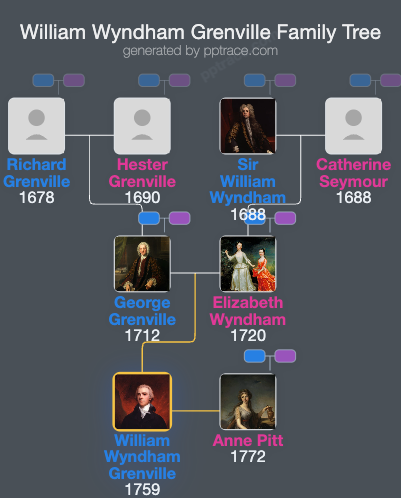
Family Tree
Tap  to expand more relatives
Introduction
William Wyndham Grenville, 1st Baron Grenville (25 October 1759 – 12 January 1834), was a British politician who served as Prime Minister of the United Kingdom from 1806 to 1807. He was associated with the Pittite Tory faction but maintained support for the Whigs during the Napoleonic Wars.
Born into a prominent political family, Grenville was the son of George Grenville, who served as a Whig Prime Minister. His mother was Elizabeth Wyndham, daughter of Sir William Wyndham, 3rd Baronet, a Tory statesman. He had two elder brothers, Thomas and George, making him uncle to the 1st Duke of Buckingham and Chandos. Through family ties, he was related to the Pitt family; William Pitt, 1st Earl of Chatham, was married to his father's sister, Hester Grenville, establishing a close familial connection to William Pitt the Younger, who was his first cousin.
Grenville received education at Eton College, Christ Church, Oxford, and Lincoln's Inn. He was the maternal great-grandson of Charles Seymour, 6th Duke of Somerset, and a descendant of Lady Katherine Grey, a great-granddaughter of King Henry VII and Elizabeth of York.
His political career began when he entered the House of Commons in February 1782 as the member for Buckingham. Early in his career, he served as secretary to the Lord Lieutenant of Ireland, his brother George Grenville. From 1784 to 1789, he was Paymaster of the Forces. During Pitt the Younger's ministry, Grenville held various positions, including Paymaster, and in 1791, he succeeded Francis Osborne as Foreign Secretary, a role he maintained during the French Revolutionary Wars.
As Foreign Secretary, Grenville advocated a vigorous military response to the French Revolution and supported alliances aimed at countering revolutionary France. His stance was closely aligned with King George III, favoring continued war unless the Bourbon monarchy was restored in France. His tenure was marked by complex diplomatic negotiations and disagreements within the government on peace strategies, notably with William Pitt the Younger.
Grenville left office in 1801 following the dispute over Catholic emancipation. He subsequently sided with opposition forces under Charles James Fox and did not participate in Pitt's return to government in 1804.
In 1806, following Pitt's death, Grenville became Prime Minister heading the "Ministry of All the Talents," a coalition government comprising Grenville's supporters, Whigs, and others. His government was short-lived, dissolving in 1807, and is chiefly credited with the abolition of the slave trade in 1807. The administration was unable to secure peace with France or pass Catholic emancipation.
After his premiership, Grenville remained active in opposition politics, notably criticizing the Peninsular War and advocating for repressive measures during economic distress. He supported the Tory government of Lord Liverpool in 1815 but gradually moved closer to Tory policies over time. His political career was curtailed by a stroke in 1823.
Grenville also served as Chancellor of the University of Oxford from 1810 until his death in 1834. He resided at Dropmore House, built in the 1790s for him, which contained extensive collections of conifers, including the largest collection of conifer species in Britain.
He married Anne Pitt, daughter of Thomas Pitt, 1st Baron Camelford, in 1792. The marriage was childless.