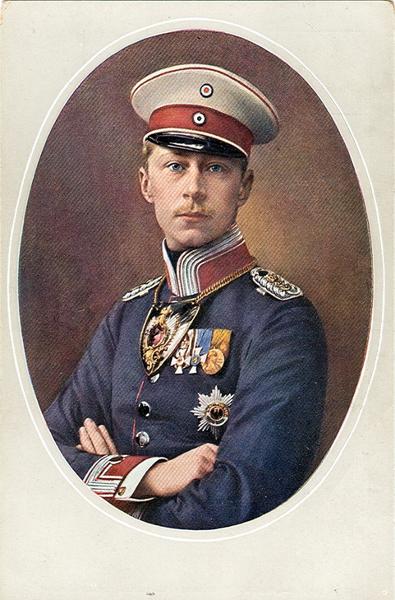
Wilhelm, German Crown Prince
| Name | Wilhelm, German Crown Prince |
| Title | German Crown Prince (1882–1951) |
| Gender | Male |
| Birthday | 1882-05-06 |
| nationality | Germany |
| Source | https://www.wikidata.org/wiki/Q57621 |
| pptrace | View Family Tree |
| LastUpdate | 2025-11-12T01:18:17.190Z |
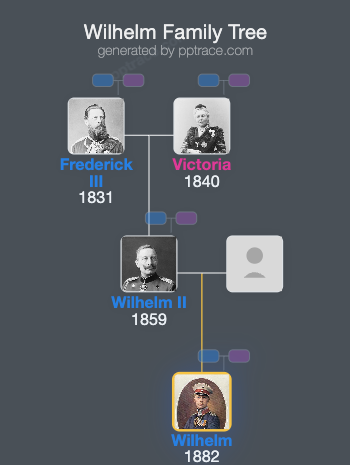
Family Tree
Tap  to expand more relatives
Introduction
Friedrich Wilhelm Victor August Ernst, known as Wilhelm, German Crown Prince, was born on 6 May 1882 in Potsdam, in the Marmorpalais of the Province of Brandenburg. He was the eldest son of Wilhelm II, the last German emperor, and Augusta Victoria of Schleswig-Holstein. His birth occurred during the reign of his great-grandfather Wilhelm I, making him third in line to the German and Prussian thrones at the time.
Wilhelm's parents experienced a contentious birth, leading to disagreements between his mother, Princess Augusta Victoria, and his grandmother, Crown Princess Victoria. Before Wilhelm's birth, his grandmother expected to be consulted for help in finding a nurse, but her son, Wilhelm II, bypassed her, enlisting the assistance of his aunt, Princess Helena. Wilhelm had five younger brothers—Prince Eitel Friedrich, Prince Adalbert, Prince August Wilhelm, Prince Oskar, and Prince Joachim—and a sister, Princess Viktoria Luise.
Following his grandfather's death in 1888 and the accession of Wilhelm II as German Emperor, Wilhelm became crown prince at the age of six. He received his education at the Prinzenhaus in Plön, Schleswig-Holstein, where he supported association football, donating a cup to the German Football Association in 1908. In 1914, the Imperial family constructed Schloss Cecilienhof in Potsdam for Wilhelm and his family; completed in 1917, it served as his primary residence temporarily.
During World War I, Wilhelm held the command of the 5th Army from 1914 to 1916 and later commanded the Army Group German Crown Prince until the end of the war. Despite his rank, his military duties relied heavily on staff officers, with most operational decisions delegated. His first public statement in October 1914 addressed the war as "stupid, senseless and unnecessary," insisting Germany did not desire conflict. In 1916, he ordered the Verdun offensive, which aimed to destroy French armies but ended in failure.
Following the German Revolution in November 1918, Wilhelm and Wilhelm II abdicated, and the monarchy was abolished. Wilhelm fled Germany, crossing into the Netherlands and was later interned near Den Helder. In 1921, he expressed interest in returning to Germany, which was permitted in 1923 after assurances he would stay out of politics. On 9 November 1923, Wilhelm returned, choosing the anniversary day of his father's abdication, which displeased his father.
In succeeding years, Wilhelm's political involvement included support for right-wing organizations such as Der Stahlhelm and participation in the Harzburg Front. He considered running for president against Paul von Hindenburg in 1932 but was dissuaded by his father. He supported Adolf Hitler's rise to power but became disillusioned when realizing Hitler lacked intentions to restore the monarchy. After his father's death in 1941, Wilhelm became head of the House of Hohenzollern.
During World War II, Wilhelm was approached by military and diplomatic figures advocating for the overthrow of Hitler, but he declined. After Hitler's assassination attempt in July 1944, Wilhelm was placed under Gestapo supervision. In January 1945, he moved to Oberstdorf for health reasons. His wife left Potsdam in early 1945 as Soviet forces advanced; he remained in residence until the end of the war when his palace, Cecilienhof, was seized by Soviets and used for the Potsdam Conference.
Post-war, Wilhelm was detained by French forces in Austria as a former war criminal and later in Germany. He lived under house arrest at Hohenzollern Castle and then in a small house in Hechingen. Wilhelm died on 20 July 1951 of a heart attack and is buried at Hohenzollern Castle.
He married Duchess Cecilie of Mecklenburg-Schwerin in 1905. The couple had several children, including Prince Wilhelm of Prussia (killed in 1940), Louis Ferdinand, Prince of Prussia, and others. Wilhelm's family included notable descendants who married into various European noble families.
Wilhelm's reputation as a military leader was subject to satire, and he received numerous honors from Germany and foreign nations during his lifetime.