Philip Stanhope, 5th Earl Stanhope
| Name | Philip Stanhope, 5th Earl Stanhope |
| Title | British politician and historian (1805–1875) |
| Gender | Male |
| Birthday | 1805-01-30 |
| nationality | United Kingdom of Great Britain and Ireland |
| Source | https://www.wikidata.org/wiki/Q286118 |
| pptrace | View Family Tree |
| LastUpdate | 2025-11-26T23:31:00.430Z |
Family Tree
Tap  to expand more relatives
Introduction
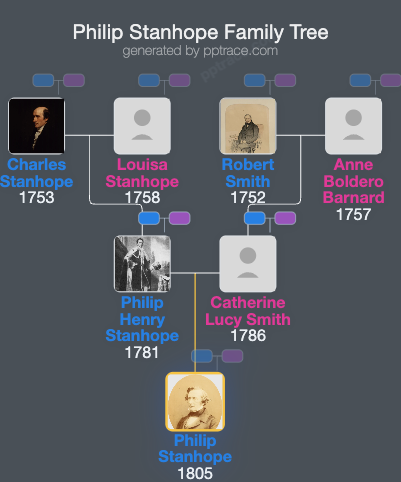
Philip Henry Stanhope, 5th Earl Stanhope, was born on 30 January 1805 at Walmer, Kent. He was the son of Philip Stanhope, 4th Earl Stanhope, and the Honorable Catherine Stanhope, daughter of Robert Smith, 1st Baron Carrington. He held the courtesy title Viscount Mahon from 1816 until he succeeded to the earldom in 1855.
He received his education at Christ Church, Oxford, where he graduated in 1827. In 1834, Stanhope married Emily Harriet Kerrison, daughter of General Sir Edward Kerrison, 1st Baronet. The couple had five children: four sons and one daughter. Their children included Arthur Stanhope, who became the 6th Earl Stanhope; Honorable Edward Stanhope; Lady Mary Catharine Stanhope; Honorable Henry Augustus Stanhope; and Philip Stanhope, 1st Baron Weardale.
Stanhope entered the British Parliament in 1830 as the representative for the rotten borough of Wootton Basset in Wiltshire. He held this seat until the borough was disenfranchised in 1832, after which he was elected as the Member of Parliament for Hertford. His political career included service under Sir Robert Peel as Under-Secretary of State for Foreign Affairs from December 1834 to April 1835, and as Secretary to the Board of Control in 1845. Although he remained an MP until 1852, he did not notably distinguish himself in politics. In 1854, he was elected as a member of the American Philosophical Society.
In 1855, he succeeded to the earldom and thus became the 5th Earl Stanhope. He was actively involved in cultural and antiquarian pursuits. Stanhope played a role in the passage of the Literary Copyright Act of 1842. He was instrumental in the establishment of the National Portrait Gallery in London in 1856, for which a sculpted bust of him was placed above the entrance, alongside Thomas Carlyle and Lord Macaulay. He was largely responsible for initiating the work of the Historical Manuscripts Commission in 1869.
As president of the Society of Antiquaries from 1846 onward, Stanhope promoted archaeological excavations in Troy. He also served as president of the Royal Literary Fund from 1863 until his death in 1875. He was a trustee of the British Museum and founded the Stanhope essay prize at the University of Oxford in 1855. In recognition of his contributions, he was elected a Fellow of the Royal Society in 1827 and an honorary associate of the Institut de France in 1872.
Stanhope's significant written works include "Life of Belisarius" (1829), "History of the War of the Succession in Spain" (1832), "History of England from the Peace of Utrecht to the Peace of Versailles, 1713–1783" (7 volumes, 1836–1853), "Life of William Pitt" (4 volumes, 1861–1862), "The Reign of Queen Anne until the Peace of Utrecht" (1870; reprinted 1908), and "Notes of Conversation with the Duke of Wellington, 1831–1851" (1886; reprinted 1998). He also authored "The Forty-Five," a narrative of the Jacobite rising of 1745, based on his historical writings, with a new edition published in 1869.
Stanhope edited the correspondence of his distant relative, Philip Stanhope, 4th Earl of Chesterfield, which was published between 1845 and 1853. His access to manuscript sources provided valuable insights into the lives of William Pitt and the Duke of Wellington. His records of Wellington’s remarks during visits were considered of historical significance.
Philip Henry Stanhope died on 24 December 1875 at Merivale, Bournemouth, Hampshire, at the age of 70. He was succeeded in the earldom by his eldest son, Arthur.