John Humphrey Noyes
| Name | John Humphrey Noyes |
| Title | American utopian community founder (1811–1886) |
| Gender | Male |
| Birthday | 1811-09-03 |
| nationality | United States of America |
| Source | https://www.wikidata.org/wiki/Q544632 |
| pptrace | View Family Tree |
| LastUpdate | 2025-11-17T06:40:47.621Z |
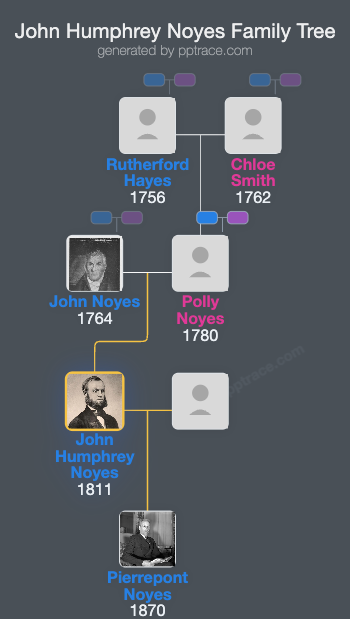
Family Tree
Tap  to expand more relatives
Introduction
John Humphrey Noyes (September 3, 1811 – April 13, 1886) was an American religious leader, philosopher, and social reformer known for founding multiple intentional communities and for his development of the concept of "complex marriage." His activities centered around religious perfectionism and utopian socialism.
Born in Brattleboro, Vermont, Noyes was the son of John Noyes, a minister, teacher, and politician who served as a member of the United States House of Representatives, and Polly Noyes (née Hayes), who was related to Rutherford B. Hayes, the 19th president of the United States. In 1831, Noyes experienced a religious conversion influenced by Charles Grandison Finney, a prominent figure in the Second Great Awakening. He graduated from Dartmouth College shortly afterward and initially planned to study law but subsequently enrolled at Andover Theological Seminary to pursue Christian ministry.
In the fall of 1832, Noyes transferred to Yale Theological Seminary to dedicate more time to biblical studies. During his time at Yale, he engaged in early political activism, including organizing one of the first Anti-Slavery Societies in the United States in New Haven. He made a theological discovery regarding the second coming of Christ, concluding that Christ had returned in 70 AD, ushering in a new age for humanity. This belief contributed to his focus on salvation and perfection.
Noyes married Harriet Holton in 1838. The marriage initially followed conventional Christian practices, and the couple had five children within the first six years, four of whom were born prematurely and did not survive. These personal experiences prompted Noyes to explore sexuality within marriage. In 1846, he advocated for and initiated the practice of complex marriage, a form of communal marriage involving multiple partners, after forming a relationship with the wife of George Cragin, an early convert. Noyes and the Cragins established a shared household, and Noyes extended the practice to include female converts, including widows and young women, leading to legal charges for "adulterous fornication" in 1847. Following his indictment, Noyes fled to New York, where he established the Oneida Community in 1848.
Charles Grandison Finney’s doctrine of Christian perfectionism influenced Noyes, emphasizing the possibility of being free from sin during one's lifetime. Noyes believed that because he had surrendered his will to God, his choices were inherently perfect. He argued that the human will was divine and that spiritual direction was necessary to control moral behavior. On February 20, 1834, he declared himself perfect and without sin, an act that resulted in the revocation of his license to preach after his expulsion from Yale.
Noyes returned to Putney, Vermont, where he continued preaching and developing community practices. The Putney community, originating as the Putney Bible School in 1836, became a formal utopian community in 1844, practicing complex marriage, male continence, and striving for perfection amidst internal disagreements. A notable resident was Almira Edson, who was expelled upon her marriage, which was not sanctioned by Noyes.
In October 1847, Noyes was arrested for adultery but was released pending trial. Under legal pressure, the community relocated to Oneida, New York, where they established the Oneida Community in 1848. The community remained active until 1881, with a membership exceeding 300 members and branches in Brooklyn, Wallingford, and Newark. Their economy was diverse, including industries such as animal trap manufacturing, silk thread production, fruit and vegetable canning, leather goods, palm-leaf hats, and notably, silverware.
The Oneida Community’s social philosophy emphasized the relationship of the individual to God, advocating for a form of "kingdom of God" on earth, and embraced sexual morality based on conceptions of spiritual and physical separation. Noyes developed a theory of male continence, which distinguished between the propagative and amative functions of sexual organs, advocating for sexual abstinence except for procreation. The community’s sexual practices were communal and consensual, with sexual relationships considered spiritual acts. Noyes and a select group of men practiced sexual intercourse with women within the community under regulated and documented conditions.
Throughout his life, Noyes remained committed to his principles of perfectionism, communal living, and sexual ethics, which significantly influenced the development and identity of the Oneida Community.