Pierrepont Noyes
| Name | Pierrepont Noyes |
| Title | American businessman and writer |
| Gender | Male |
| Birthday | 1870-08-18 |
| nationality | United States of America |
| Source | https://www.wikidata.org/wiki/Q7192551 |
| pptrace | View Family Tree |
| LastUpdate | 2025-11-17T06:40:50.136Z |
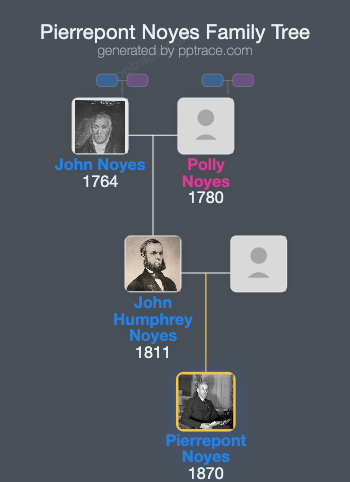
Family Tree
Tap  to expand more relatives
Introduction
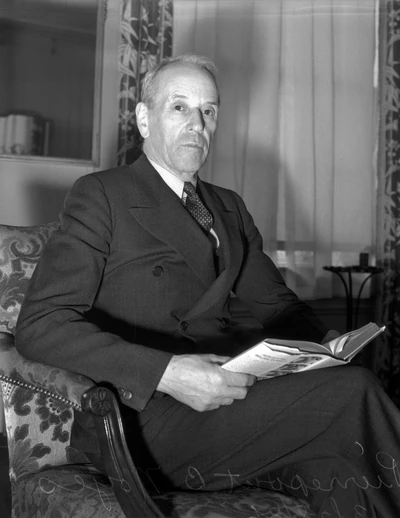
Pierrepont Burt Noyes (August 18, 1870 – April 15, 1959) was an American businessman and writer. He was born in the Oneida Community, a religious utopian communal group that existed in New York State from 1848 to 1880. The community was led by Noyes' father, John Humphrey Noyes. During the early years of the community, members practiced birth control and engaged in a eugenics experiment called "stirpiculture," aimed at selectively breeding individuals presumed to possess strong religious and spiritual qualities. Between 1869 and 1879, forty-five children, known as "stirpicults," were born from this practice.
Pierrepont Noyes was the son of John Humphrey Noyes and Harriet Maria Worden. He was a first cousin once removed of U.S. President Rutherford B. Hayes through his father's family. Raised in the children's wing of the community's communal home, Noyes visited his mother occasionally and described feeling closer to her than to his father. He noted in his autobiography that he owed more to his mother for his character development and perceived his father as distant.
Following the disbandment of the Oneida Community in 1880, Noyes lived with his mother. He pursued higher education at Colgate University, followed by studies at Harvard University. He later joined Oneida Limited, the cutlery manufacturing company that originated from the community after his father's death. Noyes served as the company's president for many years, focusing on the production of silverware and stainless steel cutlery. Under his leadership, the company developed a corporate ideology emphasizing fair wages and employee welfare.
In 1894, Noyes married Corinna Ackley Kinsley, who was also identified as a stirpicult and his half-niece. They had three children together. Noyes advocated for equitable wages and supported the development of the town of Sherrill, New York, as a community for employees, offering bonuses for home construction and funding local amenities, including athletic clubs, a golf course, and educational institutions.
During World War I, Noyes resigned from his role as general manager of Oneida Limited and served as an Assistant Fuel Administrator for the federal government. He represented the Fuel Administration on the requirements division and the priorities board of the War Industries Board. After the war, he was stationed in France selling cutlery. In April 1919, Noyes was appointed as the American Commissioner on the Inter-Allied Rhineland High Commission, a position he held until May 1920. His experiences in Europe led him to write "While Europe Waits for Peace," in which he voiced opposition to the punitive measures of the Treaty of Versailles, believing they would incite further conflict.
Noyes returned to his company in 1921 but later took on a largely ceremonial role. In the 1930s, at the suggestion of Bernard Baruch, he joined a six-member commission appointed by the New York State Legislature to develop a new spa at Saratoga Springs, serving on the commission until 1950.
Throughout his life, Noyes wrote extensively. His publications include the 1927 science fiction novel "The Pallid Giant," which reflected concerns about war and destructive weapons; he envisioned a superweapon capable of ending all war by destroying humanity. The novel was re-issued as "Gentlemen, You are Mad!" in 1945 after the atomic bombings of Hiroshima and Nagasaki. He also authored two memoirs: "My Father's House: An Oneida Boyhood" and "Goodly Heritage," a history of Oneida Limited.
**Selected Bibliography**
- While Europe Waits for Peace (1921)
- The Pallid Giant: A Tale of Yesterday and Tomorrow (1927)
- My Father's House: An Oneida Boyhood (1937)
- Goodly Heritage (1958)