Cyril Argentine Alington
| Name | Cyril Argentine Alington |
| Title | English scholar, cleric and author |
| Gender | Male |
| Birthday | 1872-10-22 |
| nationality | United Kingdom |
| Source | https://www.wikidata.org/wiki/Q5200615 |
| pptrace | View Family Tree |
| LastUpdate | 2025-11-26T23:33:27.267Z |
Family Tree
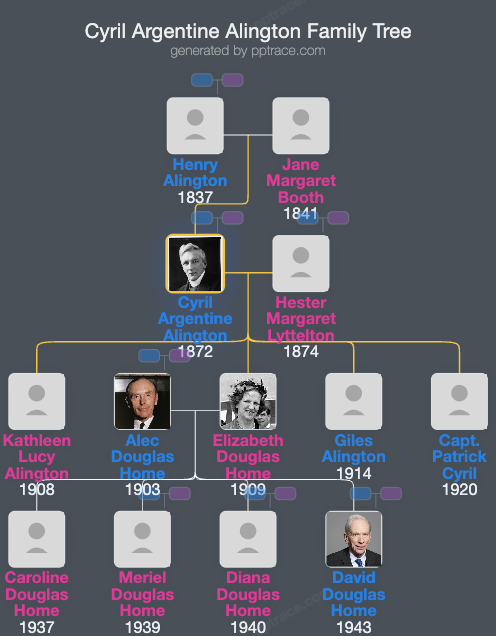
Tap  to expand more relatives
Introduction
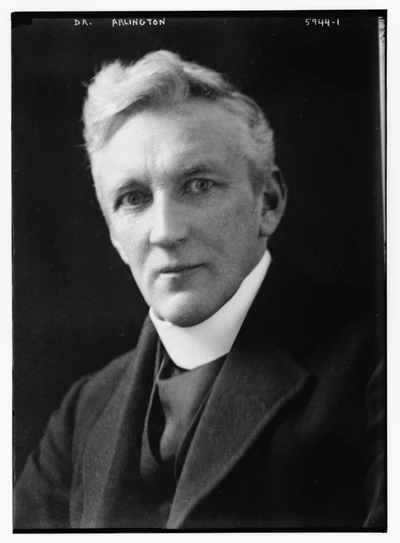
Cyril Argentine Alington was born on 22 October 1872 and died on 16 May 1955. He was an English educationalist, scholar, cleric, and author. Throughout his career, Alington served as headmaster of Shrewsbury School and Eton College, and held the positions of chaplain to King George V and Dean of Durham.
Early Life and Education:
Alington was the second son of Reverend Henry Giles Alington, an inspector of schools, and Jane Margaret Booth, daughter of Reverend Thomas Willingham Booth. His familial background traces to the Alington family of Little Barford Manor House in St Neots, Huntingdonshire, and includes lineage from the Alingtons of Horseheath in Cambridgeshire. His father belonged to a clerical and landed gentry family, with notable connections to the Barons Alington.
Alington was educated at Marlborough College and subsequently attended Trinity College, Oxford. He earned a First in Classical Moderations (Latin and Greek) in 1893 and a First in Literae Humaniores (Philosophy and Ancient History) in 1895. In 1896, he was elected a Fellow of All Souls College, Oxford. He was ordained as an Anglican priest in 1901 and received his Doctor of Divinity degree from Oxford in 1917.
Career:
Alington began his teaching career as a sixth-form master at Marlborough College in 1896. In 1899, he moved to Eton College. In 1908, he was appointed headmaster of Shrewsbury School. He returned to Eton in 1917 as headmaster, succeeding his brother-in-law, Edward Lyttelton, a position he held until 1933.
He served as chairman of the Headmasters' Conference during 1924–25. During his tenure at Eton, a building housing the English department was named after him. Similarly, Shrewsbury School named its school hall in his honor. From 1933 to 1951, Alington served as the Dean of Durham, a role in which he was succeeded by others after his retirement.
Honors and Recognitions:
Alington became a Doctor of Divinity in 1917. He held the position of chaplain to King George V from 1921 until 1933. In 1926, he was made an Honorary Fellow of Trinity College, Oxford. Durham University conferred upon him an honorary Doctor of Civil Law in 1937. He was awarded the freedom of the City of Durham in 1949. Notably, he appeared on the cover of Time magazine on 29 June 1931.
Marriage and Family:
In 1904, Alington married Hester Margaret Lyttelton, who was awarded the Commander of the Order of the British Empire (CBE) and was the youngest daughter of George Lyttelton, 4th Baron Lyttelton. They had six children: four daughters and two sons.
Their daughters included Kathleen Lucy Alington (1908–1938), Elizabeth Hester Alington (1909–1990, married to Alec Douglas-Home, later Prime Minister), Lavinia Sybil Alington (1911–1994, married Sir Roger Mynors), and Joan Argentine Alington (1916–2000). Their sons included Giles Alington (1914–1956), who served as Dean and Senior Tutor of University College, Oxford, and Patrick Cyril Waynflete Alington (1920–1943), who was killed during World War II at Salerno.
Death:
Cyril Alington died aged 82 and was buried at Durham Cathedral, where there is a memorial in the north transept.
Literary Contributions:
Alington authored over 50 books covering subjects such as religion, biography, history, poetry, and detective fiction. He composed several hymns, including "Good Christian Men, Rejoice and Sing," "Ye that know The Lord is gracious," and "The Lord of Hosts Our King Shall Be," which is used as an epigraph in Nevil Shute's novel *In the Wet* (Shute was a pupil at Shrewsbury).
His fiction works include titles such as *Mr Evans – A Cricket-Detective Story* (1922), *Through the Shadows* (1922), and *The Nabob's Jewel* (1953). His non-fiction works include *A Schoolmaster’s Apology* (1914), *Virgil Aeneid IV–VI* (1922, translation), *Why We Read the Old Testament* (1924), *Christian Outlines: An Introduction to Religion* (1932), and *Durham Cathedral: The Story of a Thousand Years* (1948).
Alington also wrote poetry, with examples including "To C. A. L." circa 1916 and "The King: A Psalm of Thanksgiving" (1929).