James Stuart-Wortley, 1st Baron Wharncliffe
| Name | James Stuart-Wortley, 1st Baron Wharncliffe |
| Title | British soldier and politician |
| Gender | Male |
| Birthday | 1776-10-06 |
| nationality | United Kingdom of Great Britain and Ireland |
| Source | https://www.wikidata.org/wiki/Q6143797 |
| pptrace | View Family Tree |
| LastUpdate | 2025-11-26T23:22:55.068Z |
Family Tree
Tap  to expand more relatives
Introduction
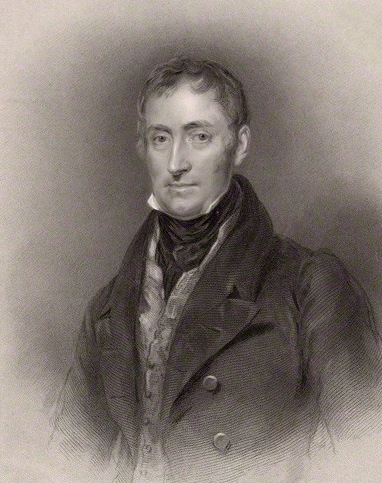
Colonel James Archibald Stuart-Wortley-Mackenzie, 1st Baron Wharncliffe, PC, was born on October 6, 1776, and died on December 19, 1845. He was a British soldier and politician. He was a grandson of John Stuart, 3rd Earl of Bute, who served as Prime Minister of Great Britain.
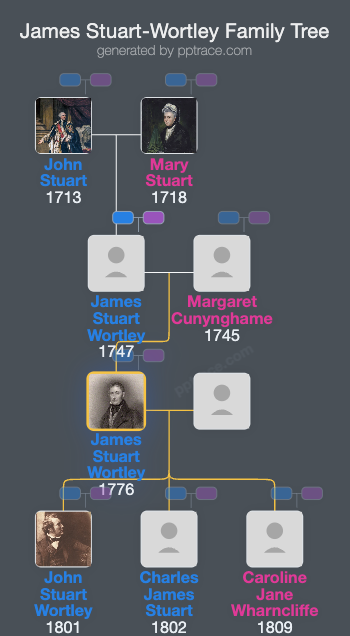
His parents were Colonel James Stuart-Wortley-Mackenzie and Mary Wortley-Montagu, Baroness Mountstuart. His father adopted the surname Wortley after inheriting from his mother, and later added Mackenzie, which was later discarded by his son. His maternal grandparents were Edward Wortley Montagu and Lady Mary Pierrepont; his maternal grandmother was also a baroness in her own right. His maternal great-grandfather was Lieutenant-General Sir David Cunynghame, 3rd Baronet.
Stuart-Wortley was educated at Charterhouse School.
In his military career, he was commissioned into the 48th Foot in 1790, transferred to the 7th Foot in 1791, and purchased a captaincy in the 72nd Foot in 1793. He was promoted to lieutenant-colonel in 1797 and became colonel of the 12th Foot six months later. In 1797, he transferred to the Grenadier Guards but resigned his commission in 1801.
His political career began with his election as a Tory Member of Parliament for the borough of Bossiney in Cornwall, serving from 1802 until 1818. In 1818, he was elected as MP for Yorkshire. Over time, his political views became more liberal, and his support for Catholic Emancipation led to his losing his seat in 1826. Subsequently, he was elevated to the peerage as Baron Wharncliffe, of Wortley in the County of York, recognizing his parliamentary activity and social standing.
In 1831, during heightened political tensions concerning reform, he facilitated communication between the government and opposition factions. A diary entry from Greville on November 19, 1831, describes him as a moderate and honorable country gentleman whose influence was based on his moderation and integrity, leading ministers to trust him despite lacking wealth or popularity.
Initially opposed to the Reform Bill of 1832, Wharncliffe eventually distanced himself from the Tories, joining the group known as "the Waverers," and contributed to modifications of the bill, although his proposed amendments did not satisfy either side.
He served as Lord Privy Seal under Sir Robert Peel's short ministry from 1834 to 1835 and was sworn into the Privy Council in 1834. He returned to government as Lord President of the Council from 1841 to 1845.
In 1837, he published an edition of the writings of Lady Mary Wortley Montagu, his ancestress. A steam locomotive named Lord Wharncliffe, which operated on the Dundee and Newtyle Railway, was named after him; he was a director of this railway.
Regarding his family, Lord Wharncliffe married Lady Elizabeth Caroline Mary Crichton, daughter of John Crichton, 1st Earl Erne, and Lady Mary Hervey, on March 30, 1799. They had five children: John Stuart-Wortley-Mackenzie, who succeeded him as the 2nd Baron Wharncliffe; Hon. Charles Stuart-Wortley-Mackenzie; Hon. Caroline Mary Stuart-Wortley; Hon. James Archibald Stuart-Wortley; and Hon. Caroline Jane Stuart-Wortley-Mackenzie.
He died in December 1845 at the age of 69, and his eldest son succeeded him as the 2nd Baron Wharncliffe. His grandson Edward became the 3rd Baron Wharncliffe and was later created Earl of Wharncliffe in 1876. Lady Wharncliffe died in April 1856.