Thomas Pitt Of Boconnoc
| Name | Thomas Pitt Of Boconnoc |
| Title | politician (1705-1761) |
| Gender | Male |
| Birthday | 1700-01-01 |
| nationality | — |
| Source | https://www.wikidata.org/wiki/Q16859480 |
| pptrace | View Family Tree |
| LastUpdate | 2025-11-26T12:25:55.743Z |
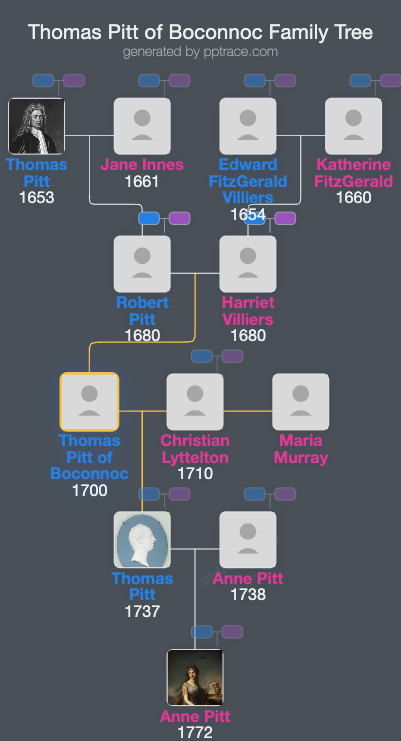
Family Tree
Tap  to expand more relatives
Introduction
Thomas Pitt (circa 1705 – 17 July 1761) was a British landowner and politician. He was affiliated with Boconnoc in Cornwall and served in the House of Commons from 1727 until 1761. Pitt held the position of Lord Warden of the Stannaries between 1742 and 1751.
He was the grandson and namesake of Thomas Pitt, and the son of Robert Pitt, who was also a Member of Parliament, and Harriet Villiers. Harriet Villiers was the daughter of Edward FitzGerald-Villiers and Katherine FitzGerald, an Irish heiress. Thomas Pitt’s brother was William Pitt the Elder.
In 1727, following the death of his father, Pitt inherited the family estates, including Boconnoc. As head of the family, he inherited his grandfather's significant fortune and control over certain parliamentary boroughs. These included Old Sarum, where he had the power to nominate both Members of Parliament (MPs), and Okehampton, where he could nominate one. He also wielded influence in the Cornish boroughs of Camelford and Grampound.
In the 1727 election, Pitt was elected as MP for Okehampton, the first after he reached the age of majority. He represented Okehampton continuously until 1754. Pitt was also elected for Old Sarum on several occasions, which allowed him flexibility in parliamentary representation. When he chose to sit for Okehampton, the Old Sarum seat was available to another candidate through a by-election.
Pitt held the office of Assay master of the Stannaries from March 1738 to February 1742. Subsequently, he served as Lord Warden of the Stannaries from February 1742 until March 1751. During this period, the Cornish Stannary Parliament convened for the last time.
His political ambitions included aligning with Frederick, Prince of Wales, and managing elections in Cornwall on the prince's behalf in 1741 and 1747. These efforts entailed considerable expenditure, especially at Grampound, where he engaged in bribery and legal actions related to voter influence. By 1751, Pitt had accumulated substantial debt, and the death of the Prince of Wales diminished his political prospects.
Subsequently, Pitt mortgaged his boroughs to the Treasury to secure a pension of £1,000 annually. This arrangement permitted the government to appoint MPs at Old Sarum and Okehampton. In 1754, after a brief term representing Old Sarum, he resigned his seat and left England.
In 1761, he returned to England and obtained permission from the government to stand for election again at Old Sarum. This was intended as a temporary measure to avoid arrest for debt, as Members of Parliament were immune from civil arrest. Pitt assured that he would resign once his financial situation improved but died a few months later in 1761 while still MP for Old Sarum.
He married Christian Lyttelton around 1731. Christian was the daughter of Sir Thomas Lyttelton, 4th Baronet, of Hagley, Worcestershire, and sister to Lord Lyttelton. Thomas Pitt and Christian had two sons and two daughters. After her death, he married Maria Murray in 1761, the daughter of General Murray.
His surviving son, the first Baron Camelford, rejected his father's arrangements regarding Old Sarum and chose to stand as MP for the borough himself when he inherited it. Thomas Pitt died on 17 July 1761.