Thomas Pitt, 1st Baron Camelford
| Name | Thomas Pitt, 1st Baron Camelford |
| Title | British politician |
| Gender | Male |
| Birthday | 1737-03-03 |
| nationality | Great Britain |
| Source | https://www.wikidata.org/wiki/Q7793177 |
| pptrace | View Family Tree |
| LastUpdate | 2025-11-26T23:24:13.975Z |
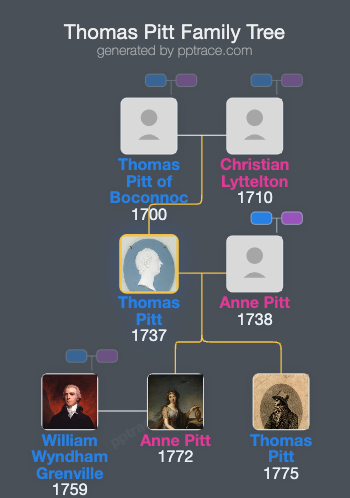
Family Tree
Tap  to expand more relatives
Introduction
Thomas Pitt, 1st Baron Camelford, was born on 3 March 1737 and died on 19 January 1793. He was a British politician and art connoisseur, who sat in the House of Commons from 1761 until 1784, after which he was elevated to the peerage as Baron Camelford.
Early life and education:
Pitt was born and baptized at Boconnoc in Cornwall. His father was Thomas Pitt of Boconnoc, who died in 1761, and his mother was Christian Lyttelton, daughter of Thomas Lyttelton, 4th Baronet of Hagley. He was the elder brother of William Pitt the Elder. Pitt was admitted as a fellow-commoner at Clare College, Cambridge, on 7 January 1754, and resided there until 1758. In 1759, he obtained the degree of Master of Arts (MA) per literas regias.
Travel and personal connections:
In January 1760, Pitt accompanied Thomas Hay, 9th Earl of Kinnoull, during his diplomatic mission to Portugal. The journey included visits to Lisbon, Spain, Genoa, and various parts of Italy. He corresponded with the poet Thomas Gray and kept a manuscript journal of his travels, which detailed experiences such as a bullfight, describing it similarly to Edward Clarke's published letters. Pitt was introduced to Sir Horace Mann in Florence, where Walpole praised his efforts in paying off his family debts and providing for his sisters. During this period, Pitt stayed with his uncle, Richard Lyttelton, and learned of his father's death on 17 July 1761.
Political career:
Following his inheritance, Pitt acquired influence in the rotten boroughs of Old Sarum and Okehampton. He served as Member of Parliament for Old Sarum from December 1761 to 1768 and again from 1774 until 1784, and as MP for Okehampton from 1768 to 1774. Initially aligned with the political faction of George Grenville, he was named a lord of the admiralty during Grenville's ministry in 1763. Pitt's politics included opposition to certain measures supported by Chatham, and he was involved in debates on electoral rights, parliamentary reform, and opposition to the North Ministry. He was known to support William Pitt the Younger, his cousin, and was suggested for high office, including the position of Secretary of State, which he declined. On 5 January 1784, he was created Baron Camelford, a promotion believed to be influenced by William Pitt the Younger.
Art and architecture interests:
Since 1762, Pitt resided at Twickenham, claiming the nickname "Palazzo Pitti" in reference to Florence. He was recognized for his interest and skill in Gothic architecture and was regarded as an amateur architect involved in projects at Stowe House and Camden House. He purchased Petersham Lodge in 1779, which was later sold to the Duke of Clarence in 1790. Pitt also built Camelford House in London and was a member of the Dilettanti Society. His architectural pursuits extended to designing the wainscoting of Carlisle Cathedral stalls and proposing projects for public museums. He was involved in the development of Plymouth porcelain and had connections with artists such as Angelica Kauffman and Mary Delany.
Later years and death:
Between 1789 and 1792, Pitt traveled extensively in Italy. He returned to England in June 1792 but soon left for Europe again. He died in Florence on 19 January 1793 and was buried at Boconnoc, where he had expanded and renovated the estate. Notable monuments include an obelisk built in 1771 in memory of his uncle, Sir Richard Lyttelton.
Attributions and publications:
Various tracts have been attributed to Pitt, including writings on parliamentary reform and commentary on the American war, though he publicly denied authorship of some these works, notably a treatise on French affairs in 1789. He was also associated with a pamphlet supporting the rights of electors and the constitutionality of parliamentary advice to the crown.
Family:
In July 1771, Pitt married Anne Wilkinson, daughter of Pinckney Wilkinson, a wealthy merchant. Anne died in London in 1803 and was buried in Boconnoc. They had children, including a son whose career affected his mother’s health. Anne Wilkinson’s sister, Mary, married Captain John Smith and was the mother of Admiral Sir Sidney Smith.