Eve Balfour
| Name | Eve Balfour |
| Title | noblewoman; 20th-century organic farming pioneer |
| Gender | Female |
| Birthday | 1898-07-16 |
| nationality | United Kingdom |
| Source | https://www.wikidata.org/wiki/Q545736 |
| pptrace | View Family Tree |
| LastUpdate | 2025-11-26T23:31:10.888Z |
Family Tree
Tap  to expand more relatives
Introduction
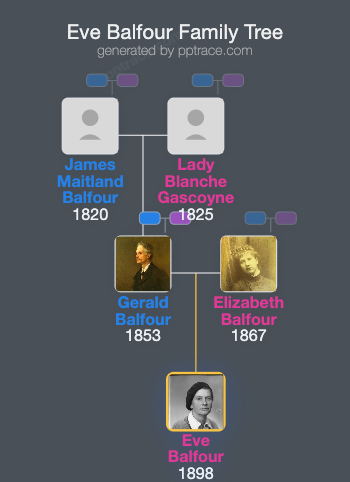
Lady Evelyn Barbara Balfour (16 July 1898 – 16 January 1990) was a British agriculturalist known for her contributions to organic farming and sustainable agriculture. She was born in Holland Park, London, as one of six children of Gerald Balfour, 2nd Earl of Balfour, and Lady Elizabeth Bulwer-Lytton, daughter of the 1st Earl of Lytton, who served as Viceroy of India. Balfour was the niece of Arthur J. Balfour, a former prime minister of the United Kingdom.
At the age of 12, Balfour expressed a desire to become a farmer. She enrolled at Reading University College at age 17, becoming one of the first women students there to study agriculture. She obtained her Diploma in Agriculture in 1917 and participated in a year of practical farming afterward, living in accommodations referred to as 'digs' at 102 Basingstoke Road, Reading. During this period, she worked at Manor Farm, engaging in activities such as ploughing fields. Subsequently, she was appointed bailiff to a farm near Newport, Wales, working under the guidance of various war committees, including the Monmouthshire Women's War Agricultural Committee chaired by Lady Mather Jackson.
In 1919, at the age of 21, Balfour and her sister Mary purchased New Bells Farm in Haughley Green, Suffolk, using inheritance funds entrusted to a trust established by their father. The purchase was made on the recommendation of William E.G. Palmer of Haughley. She became actively involved in agricultural experimentation and advocacy. In 1939, she initiated the Haughley Experiment, a pioneering long-term, scientific comparison of organic versus chemical-based farming methods.
Balfour authored "The Living Soil" in 1943, published by Faber & Faber. The book became influential within the organic movement, integrating arguments favoring organic practices with her plans for the Haughley Experiment. The publication was reprinted multiple times and is considered a foundational text in organic agriculture.
In 1946, Balfour co-founded the Soil Association and served as its first president. The organization promotes sustainable agricultural practices and became a significant advocate for organic farming in the UK. The UK government’s Agriculture Act of 1947 favored mechanized, intensive farming methods, a direction Balfour opposed due to its lack of support for organic practices. By 1952, the Soil Association's membership increased to approximately 3,000, and its journal, initially titled Mother Earth, was an important publication for the movement.
In South Africa, experiments applying Balfour’s methods were conducted by the Valley Trust in 1961 and 1962, demonstrating that organic approaches could be effective even in dry soils. These experiments indicated that chemicals were unnecessary and potentially detrimental to soil health.
Balfour lived for many years with Kathleen Carnley, a skilled dairy worker, with whom she was associated for over 50 years. She also had associations with Beryl Hearnden and Graham White. Throughout her life, she continued farming, writing, and lecturing. In 1958, she undertook a comprehensive tour of Australia and New Zealand, engaging with local organic farming pioneers.
She relocated to the Suffolk coast in 1963 and later sold the farm at Haughley in 1970 due to financial difficulties. Balfour retired from her role at the Soil Association in 1984 but remained active in gardening and agriculture until her later years. She was appointed Officer of the Order of the British Empire (OBE) in 1989.
Lady Balfour died in Scotland on 16 January 1990 at the age of 91. The day following her death, the UK government announced grants to support organic farming initiatives amidst broader policy discussions. Her publications include "The Living Soil" (1943), "Common Sense Compost Making" (1973), a revision of Maye E. Bruce's work, and "Towards a Sustainable Agriculture" (1982). She also co-authored detective novels under the pseudonym Hearnden Balfour, including "The Paper Chase" and "The Enterprising Burglar."