Takeuchi Tsuna
| Name | Takeuchi Tsuna |
| Title | Japanese businessperson (1840-1922) |
| Gender | Male |
| Birthday | 1840-01-30 |
| nationality | Japan |
| Source | https://www.wikidata.org/wiki/Q4480286 |
| pptrace | View Family Tree |
| LastUpdate | 2025-11-17T06:47:02.076Z |
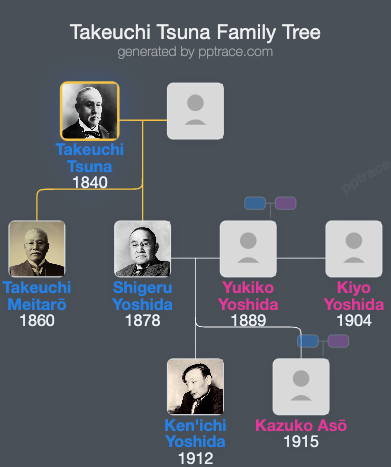
Family Tree
Tap  to expand more relatives
Introduction
Takeuchi Tsuna (born January 30, 1840, December 26, Taihō 10 – January 9, 1922, Taishō 11) was a Japanese samurai, businessman, and politician. He was the retainer of the Tosa Domain’s family elder, the Yamauchi family, and the son of Takeuchi Shōemon Yoshikura. He was born in Sukumo, Tosa Province.
In his childhood, he was raised in the household of a Tosa Domain retainer and was active as a metsubi (inspector or officer) during the late Edo period. He was involved in the construction of Sukumo Kura Yashiki (storehouse) and in financial reconstruction efforts. In Keio 2 (1866), he responded to the British warship anchored at Amanojiura, away from Sukumo. Takeuchi led two infantry platoons equipped with 200 rifles to engage with foreign ships, confirmed the purpose of maritime surveys, and gathered information on departure plans before attempting negotiations. During this incident, he was intoxicated aboard the enemy ship, leading to a failure to give orders for repel. However, he was later found to have welcomed the British warship, and he was released.
During the Boshin War, he fought alongside the main heir of the Yamauchi family, Ujinari, leading troops through Hokuriku and Ouu regions. After the Meiji Restoration, in 1870 (Meiji 3), he was supported by Zōjirō Gōtō and served as a minor official in Osaka Prefecture and as a sixth-class officer in the Ministry of Finance. Later, he left government service and turned to the business world.
In 1874 (Meiji 7), with the support of Hōrai-sha, he became involved in the management of Takashima Coal Mine, increasing coal output and profits. He subsequently initiated development of coal mines on Hashima, Ōshima, and Kōyaki. In 1878 (Meiji 11), he was arrested on suspicion of supplying rifles and ammunition to Saigo Takamori's troops during the Satsuma Rebellion. He was detained in a prison in Tokyo along with others involved, and later transferred to a regional prison.
After being released on parole in 1879 (Meiji 12), he worked to rebuild the Aikoku-sha (Patriotic Society), and supported activities of an organization reorganized as the National Diet Movement Alliance. He promoted the opening of the National Diet and the Freedom and People's Rights movement, and was involved in the founding of the Liberal Party. In 1881 (Meiji 14), he dealt with Gōtō Zōjirō’s debt issues and transferred the coal mines on Hashima, Ōshima, Kōyaki, as well as Takashima Coal Mine, to the Mitsubishi Zaibatsu led by Yanosuke Iwasaki.
As the Freedom and People’s Rights movement expanded, he was ordered to leave Tokyo due to the enactment of the Peace Preservation Ordinance in 1887 (Meiji 20). He continued his political activities afterward and ultimately became an influential politician.