Shigeru Yoshida
| Name | Shigeru Yoshida |
| Title | Prime minister of Japan (1878–1967) |
| Gender | Male |
| Birthday | 1878-09-22 |
| nationality | Japan |
| Source | https://www.wikidata.org/wiki/Q301804 |
| pptrace | View Family Tree |
| LastUpdate | 2025-11-17T06:46:57.470Z |
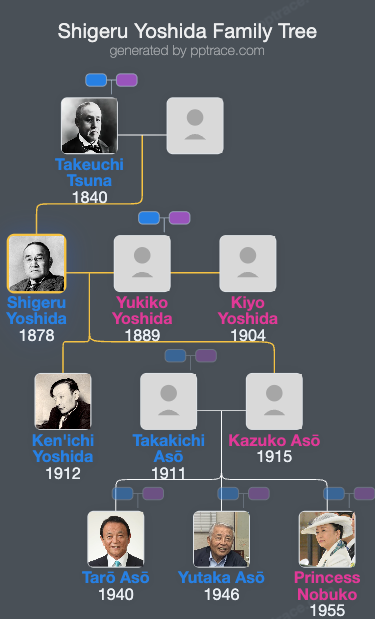
Family Tree
Tap  to expand more relatives
Introduction
Shigeru Yoshida (吉田 茂, Yoshida Shigeru) was born on 22 September 1878 in Kanda-Surugadai, Tokyo. He was the fifth son of Tsuna Takeuchi, a former samurai of the Tosa domain. His biological mother’s identity is not documented, but it is likely she was a concubine and possibly a geisha. Prior to his birth, Tsuna Takeuchi was imprisoned for anti-government activities related to the Satsuma Rebellion, and Yoshida was born at the residence of Kenzō Yoshida, a friend of his father. In August 1881, he was adopted by Kenzō Yoshida and his wife Kotoko. Kenzō Yoshida was a former samurai who traveled to England as a stowaway and became a businessman in Yokohama. Kotoko was a granddaughter of the Edo period Confucian scholar Issai Satō.
Yoshida spent his early childhood in Yokohama, where he graduated from elementary school in 1889. That year, his father, Kenzō Yoshida, died, after which Yoshida inherited a substantial fortune. His mother, Kotoko, raised him on the family estate in Ōiso. He attended Koyo Juku, a prestigious rural boarding school, for five years. In 1894, Yoshida enrolled at Nihon Gakuen in Tokyo for a year and subsequently attended Higher Commercial School, which he left due to a lack of interest. He also studied briefly at Seisoku Academy and Tokyo Physics School. After falling ill and spending a year at home in Ōiso, he returned to Tokyo in 1897 to enroll at Peers’ School, headed by Prince Atsumaro Konoe.
Yoshida advanced to the university department of Peers’ School, but after its dissolution in 1904, he transferred to Tokyo Imperial University, where he graduated with a law degree in 1906. Following graduation, he passed the Foreign Service Entry Exam and joined Japan’s diplomatic corps. His early diplomatic postings included assignments in China from 1906 to 1910, and in Italy in 1909. In 1912, he was posted to Andong in Japanese-occupied Korea, serving as secretary to the Governor General Masatake Terauchi.
Yoshida married Yukiko Makino, daughter of Nobuaki Makino, in 1909. During the 1910s, he served in various diplomatic roles, including in the United States and the United Kingdom, as well as in China. From 1928 to 1930, he was vice minister of foreign affairs. Subsequently, he served as ambassador to Italy until 1932, and later as ambassador to the United Kingdom from 1936 to 1938.
During the Pacific War, Yoshida was opposed to war with the United States and the United Kingdom, and he was active in efforts to de-escalate tensions and secure peace, although he held no official government position during most of this period. He was briefly imprisoned in April 1945 due to his association with Prince Fumimaro Konoe.
Following Japan's surrender in 1945, Yoshida was appointed as foreign minister in the cabinet of Prince Higashikuni. He served as prime minister from 1946 to 1947, and again from 1948 to 1954. As premier, Yoshida oversaw the adoption of the Constitution of Japan and negotiated the Treaty of San Francisco, which ended the Allied occupation and restored Japanese sovereignty.
His strategy, known as the Yoshida Doctrine, emphasized economic reconstruction and reliance on the United States for defense, while maintaining a close alliance with the U.S. for security. He experienced political conflict with Ichirō Hatoyama, which culminated in Yoshida being ousted in 1954. Yoshida’s influence persisted through protégés such as Hayato Ikeda and Eisaku Satō, who served as prime ministers in the 1960s and early 1970s. He died in 1967 and was accorded a state funeral. His grandson, Tarō Asō, served as Japan's prime minister from 2008 to 2009.