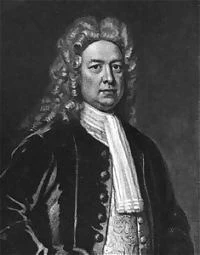
Thomas Pitt
| Name | Thomas Pitt |
| Title | English politician; (1653-1726) |
| Gender | Male |
| Birthday | 1653-07-05 |
| nationality | Kingdom of England |
| Source | https://www.wikidata.org/wiki/Q2277355 |
| pptrace | View Family Tree |
| LastUpdate | 2025-11-26T23:24:07.022Z |
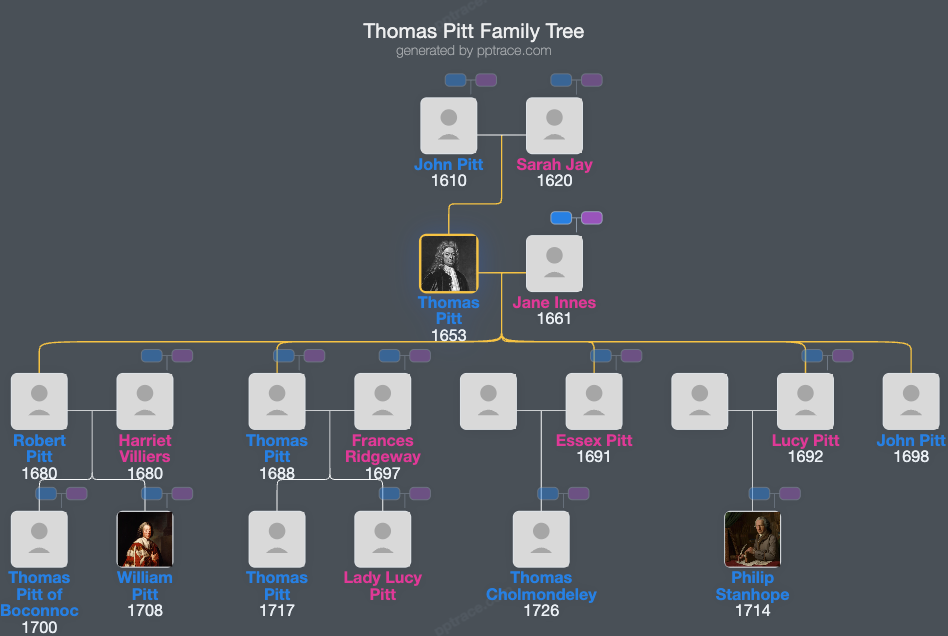
Family Tree
Tap  to expand more relatives
Introduction
Thomas Pitt was born on 5 July 1653 in Blandford Forum, Dorset, England. He was the second son of Reverend John Pitt (1610–1672), Rector of Blandford St. Mary, and his wife Sarah Jay. His family lineage traces back to John Pitt (died 1602), a mercer and Clerk of the Exchequer from Blandford Forum, and includes Sir William Pitt (circa 1559–1636), Member of Parliament for Wareham, who founded the Pitt family’s senior line of Stratfield Saye in Hampshire.
In 1674, Pitt traveled to India with the East India Company (EIC). Initially engaging in trade independently, he operated as an "interloper," challenging the EIC’s monopoly on Indian commerce. His activities led to a fine of £400 upon his return to England, although by then he had accumulated significant wealth. Subsequently, he purchased the manor of Stratford, Wiltshire, including the borough of Old Sarum, which provided him a parliamentary seat. Pitt served as the Member of Parliament for Salisbury in the Convention Parliament of 1689. The Old Sarum seat became associated with his descendants and played a role in British political history.
Pitt returned to India and rejoined the East India Company. In August 1698, he arrived at Madras (now Chennai) as President of the EIC and was responsible for negotiations to end conflicts such as the Child’s War with Mughal Emperor Aurangzeb. In August 1699, he was appointed Governor of Fort St. George, during which time he aided the Danes in defeating Tanjore and managed regional conflicts such as the siege by Daud Khan of the Carnatic in 1702. Pitt’s administration involved organizing local defense forces by recruiting Hindu warrior castes, equipping them with firearms, and deploying them under European command to secure Madras.
From 7 July 1698 to 1709, Pitt served as President of Madras, a period sometimes referred to as the "Golden Age of Madras." He fortified the city walls, conducted detailed surveys, and expanded the settlement by acquiring the Five New Towns: Tiruvatiyoor, Kathiwakam, Nungambakkam, Vyasarpady, and Sathangadu. His tenure is marked by urban development and fortification efforts.
In 1716, seeking financial recovery, Pitt resigned from his parliamentary seat in favor of becoming governor of Jamaica. This move was short-lived, as he sold a large diamond—later known as the Regent Diamond—to finance his expenses. The diamond, an uncut 410-carat stone, was purchased in Madras in 1701 from an Indian merchant named Jamchand. Pitt sent the diamond to England concealed in his son Robert’s shoe in 1702. He commissioned the jeweler Harris to cut a 141-carat brilliant from the rough stone. After attempts to sell the diamond to European monarchs, Pitt, with the assistance of John Law, sold it in 1717 to Philippe II, Duke of Orléans, the French regent, for £135,000. The stone became part of France's crown jewels as "Le Régent," displayed in the Louvre.
In 1717, Pitt acquired Boconnoc in Cornwall and other properties including Mawarden Court at Stratford, Blandford, Kynaston in Dorset, along with estates in Cornwall, Hampshire, and Berkshire. He made significant contributions to local churches, including funding the rebuilding of the tower of St Lawrence's Church in Blandford and providing furnishings.
Thomas Pitt married Jane Innes on 1 January 1679/80. She was the daughter of James Innes of Reid Hall, Moray, and niece of Matthias Vincent, a business associate. They had at least six children: Robert Pitt (1680–1727), who was the father of William Pitt, 1st Earl of Chatham; Thomas Pitt, 1st Earl of Londonderry (c. 1688–1729); William Pitt, who likely died in infancy; Col. John Pitt (1698–1754); Essex Pitt, who married Charles Cholmondeley; and Lucy Pitt, who married James Stanhope, 1st Earl Stanhope.
Thomas Pitt died on 28 April 1726 at Swallowfield Park in Berkshire. His descendants included Prime Ministers William Pitt, 1st Earl of Chatham, and William Pitt the Younger.