John Pitt
| Name | John Pitt |
| Title | British politician; (1698-1754) |
| Gender | Male |
| Birthday | 1698-00-00 |
| nationality | Great Britain |
| Source | https://www.wikidata.org/wiki/Q6252980 |
| pptrace | View Family Tree |
| LastUpdate | 2025-11-26T12:26:15.499Z |
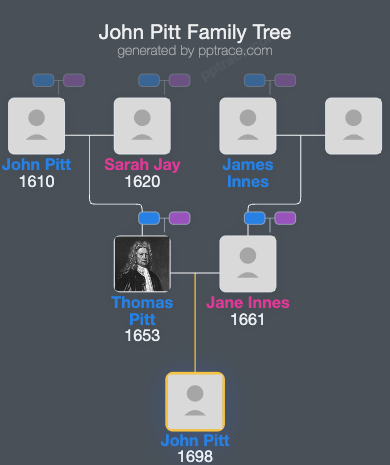
Family Tree
Tap  to expand more relatives
Introduction
John Pitt (1698–1754) was a British Army officer, colonial administrator, and politician who served in the House of Commons between 1720 and 1734. He was the youngest son of Governor Thomas Pitt, known as "Diamond Pitt," who accumulated a fortune in India before returning to Britain to establish a political family. John Pitt's education included attendance at Eton College.
Following his education, Pitt entered the military, achieving the rank of lieutenant colonel. During his military service, he held the position of aide-de-camp to King George I. His political career included representing multiple constituencies: Hindon from 1720 to 1722, Old Sarum from 1724 to 1726, and Camelford from 1727 to 1734.
In addition to his military and political roles, Pitt served as Governor of Bermuda from 1728 to 1737. His family relationships included being the brother-in-law of James Stanhope, 1st Earl Stanhope, who was the effective Prime Minister between 1717 and 1721. He was also the uncle of William Pitt, who became prominent in British politics.
John Pitt was married to Mary Belasyse, daughter of the Viscount Fauconberg. His familial arrangements led to disputes, including being excluded from his father's will following a disagreement.
References and bibliographies relevant to John Pitt include works by Jeremy Black, titled *Pitt the Elder*, published by Cambridge University Press in 1992, and Peter Douglas Brown's *William Pitt, Earl of Chatham: The Great Commoner*, published by George Allen & Unwin in 1978.