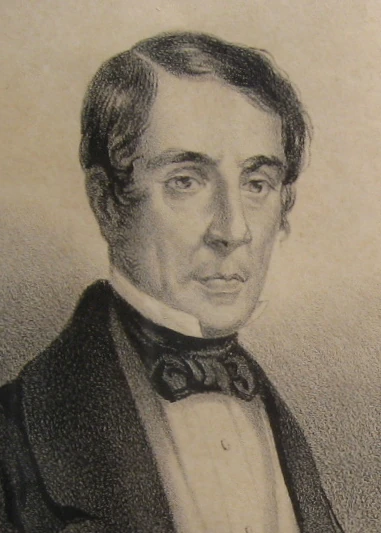
Henry Wellesley, 1st Baron Cowley
| Name | Henry Wellesley, 1st Baron Cowley |
| Title | British politician (1773-1847) |
| Gender | Male |
| Birthday | 1773-01-20 |
| nationality | United Kingdom of Great Britain and Ireland |
| Source | https://www.wikidata.org/wiki/Q334543 |
| pptrace | View Family Tree |
| LastUpdate | 2025-11-26T23:27:24.568Z |
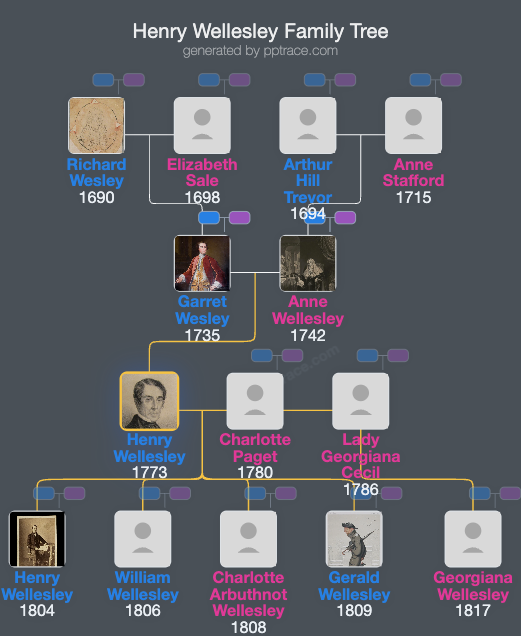
Family Tree
Tap  to expand more relatives
Introduction
Henry Wellesley, 1st Baron Cowley, GCB, was born on January 20, 1773, and died on April 27, 1847. He was of Anglo-Irish descent, the youngest son of Garret Wesley, 1st Earl of Mornington, and Anne Hill-Trevor. His siblings included Arthur Wellesley, who became the 1st Duke of Wellington; Richard Wellesley, the 1st Marquess Wellesley; and William Wellesley-Pole, the 3rd Earl of Mornington.
Wellesley was educated at Eton College and at the court of the Duke of Brunswick. In 1790, he purchased an ensigncy in the 40th Foot regiment. His diplomatic career commenced in 1791 when he was appointed attaché to the British embassy at The Hague, followed by a role as Secretary of Legation in Stockholm. In 1791, he transferred to the 1st Foot Guards and obtained a Lieutenancy in 1793.
In 1794, Wellesley was traveling from Lisbon to England with his sister Anne when he was captured by the French. He remained imprisoned during the French Revolution's height and escaped in 1795. Later that year, he served as a Member of Parliament (MP) for the constituency of Trim in the Irish House of Commons.
In the 1807 general election, Wellesley was elected as a MP for both Athlone in Ireland and Eye in England. He chose to represent Eye and held this seat until 1809, when he resigned. Between 1797 and 1802, he accompanied Lord Malmesbury as secretary during an unsuccessful diplomatic mission to Lille, France, and traveled to India in the same period, acting as a private secretary to his eldest brother, Lord Mornington, then governor-general of India. He participated in diplomatic negotiations involving treaties with Mysore and Oudh during his time in India.
In 1802, Wellesley married Lady Charlotte Cadogan. They had three sons and a daughter but divorced in 1810 after her elopement with Henry Paget, Lord Uxbridge. Paget subsequently served as a cavalry commander under Wellesley's brother, the Duke of Wellington, at the Battle of Waterloo.
Wellesley's diplomatic postings included serving as the British envoy to Spain from 1809 to 1821, during which time his brother Arthur was commander of the Anglo-Portuguese forces in the Iberian Peninsula, and his elder brother Richard served as Foreign Secretary. He was knighted in 1812. Subsequently, he served as the British ambassador to Austria from 1823 to 1831, where he interacted with Foreign Secretary George Canning.
In 1828, Wellesley was created Baron Cowley, of Wellesley in the County of Somerset, an appointment influenced by the Duke of Wellington. His final diplomatic position was as British ambassador to France during the administrations of Sir Robert Peel in 1835 and from 1841 to 1846. He retired in 1846 and remained in Paris until his death in 1847.
Wellesley's second marriage was to Lady Georgiana Cecil, daughter of James Cecil, 1st Marquess of Salisbury. His eldest son, Henry Richard Charles Wellesley, became a diplomat and was later created Earl Cowley. His other children included Gerald Valerian Wellesley, who became Dean of Windsor, and William Wellesley, who was a captain in the Royal Navy.