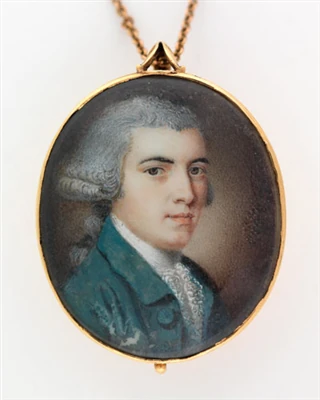
Benjamin Harrison V
| Name | Benjamin Harrison V |
| Title | American planter and merchant (1726-1791) |
| Gender | Male |
| Birthday | 1726-04-05 |
| nationality | United States of America |
| Source | https://www.wikidata.org/wiki/Q387664 |
| pptrace | View Family Tree |
| LastUpdate | 2025-11-17T06:38:39.900Z |
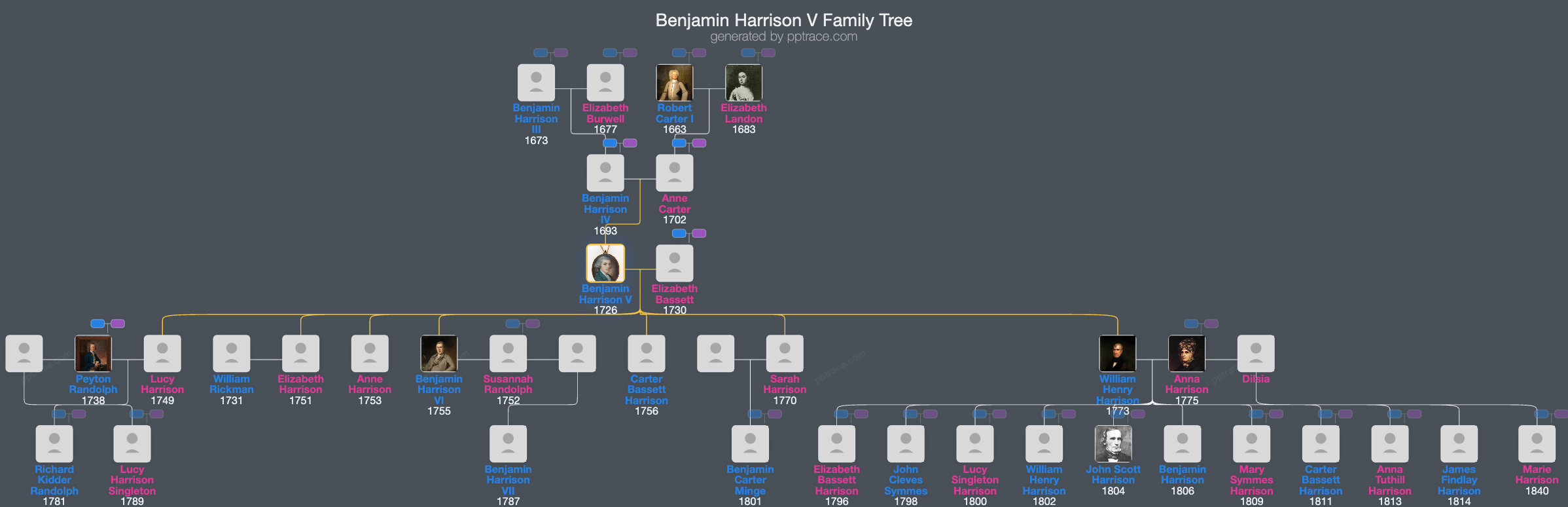
Family Tree
Tap  to expand more relatives
Introduction
Benjamin Harrison V (April 5, 1726 – April 24, 1791) was an American planter, merchant, and politician involved in the early political development of the United States. He served as a delegate to the Continental Congress and was a signer of both the Continental Association and the Declaration of Independence. Additionally, Harrison served as the governor of Virginia from 1781 to 1784.
Harrison was born at Berkeley Plantation in Charles City County, Virginia. Berkeley Plantation was notable for establishing one of the earliest annual observances of Thanksgiving in 1619, and it was also the place where the bugle call "Taps" was composed and first performed in 1862. Harrison was the eldest son of Benjamin Harrison IV (1693–1745) and Anne Carter (1702–1743). His paternal lineage included several generations of Virginia planters and legislators, with ancestors who served as delegates in the Virginia House of Burgesses. The Harrison family maintained a tradition of public service over multiple generations.
Harrison received a limited formal education, spending one or two years at the College of William & Mary. He inherited significant estate holdings upon his father's death, including Berkeley Plantation and extensive acres across Surry County and along the James River. His estate included several plantations, a fishery, a grist mill, and numerous enslaved individuals, with the Harrison family owning as many as 80 to 100 enslaved people during his lifetime. Harrison was known to have owned mulattoes, although records do not specify their parentage.
He married Elizabeth Bassett in 1748, with whom he had eight children. His progeny included William Henry Harrison, who served as a territorial governor, U.S. congressman, and the ninth president of the United States; and Benjamin Harrison, who served as the 23rd president of the United States. Other children included Lucy Bassett Harrison and Carter Bassett Harrison.
Harrison's political career began with his election to the Virginia House of Burgesses around 1749, representing Surry County initially. Throughout the colonial period, he served in the House of Burgesses for over three decades, often representing Charles City County. He was active in opposition to British policies, including protesting taxation measures and other grievances against the Crown. He played a role in drafting complaints against Governor Robert Dinwiddie and was involved in early colonial resistance efforts.
He participated in the first Virginia Revolutionary Conventions and was elected to the Continental Congress, where he presided over the final debate of the Declaration of Independence and signed the document in 1776. His signature contributed to the foundational principles of the United States, including the assertion that "all men are created equal" and endowed with unalienable rights.
Harrison served as Virginia’s governor from 1781 to 1784, during which his administration faced economic challenges stemming from the Revolutionary War's impact on the state treasury. After his tenure as governor, he returned to the Virginia House of Delegates, serving two additional terms. In 1788, he cast a rare vote against the ratification of the United States Constitution due to concerns over the absence of a Bill of Rights.
Harrison's family continued its political legacy through his descendants, notably his son William Henry Harrison and grandson Benjamin Harrison, both of whom became Presidents of the United States.