Thomas Pitt, 2nd Baron Camelford
| Name | Thomas Pitt, 2nd Baron Camelford |
| Title | British noble |
| Gender | Male |
| Birthday | 1775-02-19 |
| nationality | United Kingdom of Great Britain and Ireland |
| Source | https://www.wikidata.org/wiki/Q7793179 |
| pptrace | View Family Tree |
| LastUpdate | 2025-11-26T23:25:57.162Z |
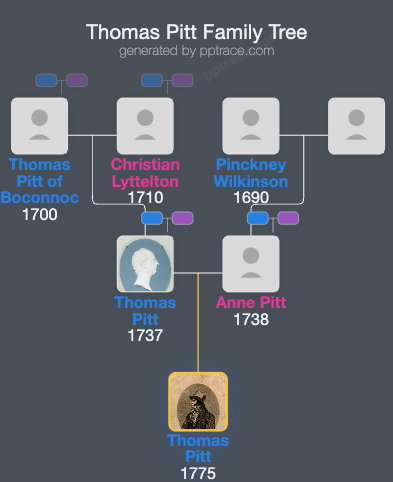
Family Tree
Tap  to expand more relatives
Introduction
Thomas Pitt, 2nd Baron Camelford, was born on 19 February 1775 at Boconnoc, Cornwall. He was the only son of Thomas Pitt, 1st Baron Camelford, and Anne Wilkinson, daughter of the London merchant and politician Pinckney Wilkinson. Pitt had a sister named Anne. During his early years, he resided in Switzerland before being educated at Charterhouse School in England, an institution he regarded as having provided him some of the happiest years of his life.
Pitt developed an affinity for the sea early in life. Despite his father's attempt to transfer him to a different public school, Pitt refused and chose to join the Royal Navy. His naval career began when he was listed under HMS Tobago in the autumn of 1781, although he likely entered service some years later. In 1789-1790, Pitt served aboard HMS Guardian under Captain Edward Riou. During this service, the Guardian struck an iceberg near the Cape of Good Hope; Pitt was among the crew who assisted in bringing the ship into Table Bay.
In 1791, Pitt joined the Vancouver Expedition, serving aboard HMS Discovery as an able seaman. While on this expedition, he was watched over by Lieutenant Zachary Mudge. Pitt's conduct during the voyage was marked by disciplinary issues; he was flogged multiple times for attempting to trade with natives or breaking naval rules and was eventually placed in irons for sleeping on watch. His conduct was indicative of his contentious relationship with the expedition's commander, George Vancouver, a dynamic not publicly recognized at the time due to Pitt's position as the son of a peer of the realm. Unknown to the expedition members, Pitt inherited his father's title after his father's death on 19 June 1793.
Following the departure of HMS Daedalus from the expedition, Pitt left in Hawaii, traveled to Malacca, and joined HMS Resistance as an able seaman in December 1794. He was promoted to acting lieutenant during the campaign and participated in the capture of Malacca in August 1795, leading a boarding party that took the Dutch East Indies Company's ship Constantia. He was discharged in November 1795 and sought passage home, during which he was aboard the ship Union, which was subsequently wrecked on the coast of Ceylon. Pitt eventually made his way back to Europe.
Vancouver returned to England in 1795, while Pitt's relationship with influential figures, including his cousin William Pitt the Younger, was marked by hostility. Pitt wrote a letter to Vancouver in 1796, insulting him and daring him to a duel. He later assaulted Vancouver physically on a London street. Their conflicts resulted in legal charges, although Vancouver's declining health prevented further proceedings. Pitt's brother, Charles Pitt, intervened physically during one altercation to defend their family honor.
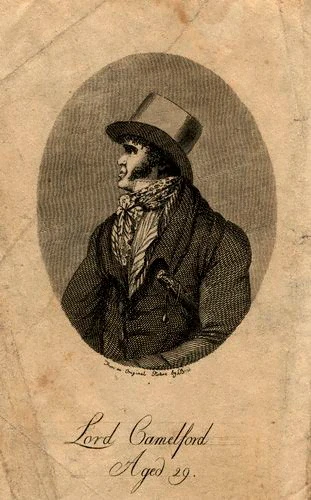
In 1797, Pitt was promoted to lieutenant and appointed acting commander of HMS Favourite, despite being junior to the first lieutenant, Charles Peterson. Accounts describe Pitt's appearance as eccentric, characterized by shabby attire and an oversized hat. In 1798, Pitt shot and killed Commander Peterson following a dispute over rank while both were at Antigua. He was court-martialled but was acquitted, possibly due to the prevailing tensions from recent mutinies.
Pitt's naval career was marred by subsequent incidents, including an attempt to visit France without authorization in January 1799, which led to his resignation from the Navy. He settled in London, where he continued to exhibit aggressive behavior, notably participating in physical altercations and being fined for assault. Pitt contributed to philanthropic causes, including funding a school established by chemist William Nicholson, and was known for discreet charitable acts in London's poorer districts.
His life ended after a duel with Captain Best R.N. on 7 March 1804. Pitt challenged Best over remarks about Pitt's romantic interests, and they met for pistol practice. Pitt missed his shot but was struck by Best, suffering a wound that caused paralysis and ultimately led to his death on 10 March 1804. He was carried to nearby Little Holland House, where surgeon Simon Nickolson treated him. Pitt died from his injuries; subsequent efforts to bury his body on the island of St. Pierre, Lake Biel, in Switzerland, were thwarted by war, leading to his embalmed body being placed in a crypt at St. Anne's Church, Soho. His body was later lost, giving rise to humorous speculation about its whereabouts.
Throughout his life, Pitt was considered temperamental and prone to violence, leading contemporaries to speculate about his mental health. His will specified that his body was not to be charged in his death, and he left a legacy of £1,000 to the city of Berne, Switzerland. With no known heir, the barony became extinct upon his death.