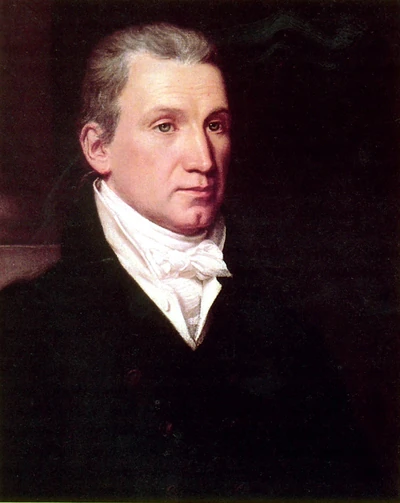
James Monroe
| Name | James Monroe |
| Title | president of the United States from 1817 to 1825 |
| Gender | Male |
| Birthday | 1758-04-28 |
| nationality | United States of America |
| Source | https://www.wikidata.org/wiki/Q11815 |
| pptrace | View Family Tree |
| LastUpdate | 2025-11-17T06:37:55.204Z |
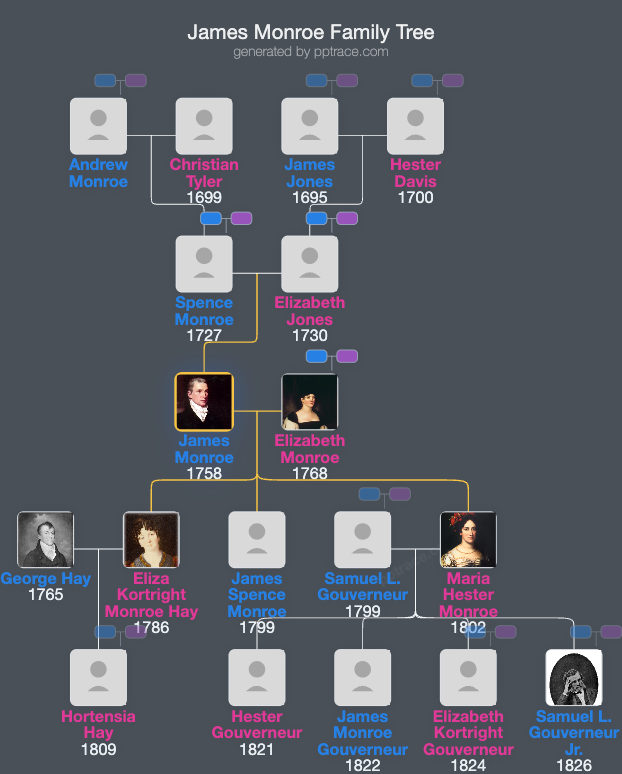
Family Tree
Tap  to expand more relatives
Introduction
James Monroe (April 28, 1758 – July 4, 1831) was an American political figure who served as the fifth president of the United States from 1817 to 1825. He was a member of the Democratic-Republican Party and the last of the Founding Fathers to hold the presidency. Monroe was also the last president associated with the Virginia dynasty. His time in office coincided with the era known as the "Era of Good Feelings," which marked the end of the First Party System in American politics.
Born in Westmoreland County, Virginia, Monroe was the son of Andrew Spence Monroe and Elizabeth Jones. His paternal ancestors included Scottish Royalists from Clan Munro who emigrated to Virginia in the 17th century, and French Huguenots who arrived in the early 1700s. Monroe's father worked as a craftsman and was involved in protests against the Stamp Act, a measure enacted by Britain. His mother, Elizabeth Jones, was the daughter of a Welsh immigrant from one of the wealthiest families in King George County.
Monroe was enrolled at Campbelltown Academy at age 11, completing advanced studies in Latin and mathematics shortly thereafter at the College of William & Mary. His education was interrupted at age 16 after the death of his parents, requiring him to support his younger siblings. His maternal uncle, Joseph Jones, a member of the Virginia House of Burgesses, became a mentor and enrolled Monroe at William & Mary in 1774, where he met prominent Virginians such as Thomas Jefferson, Patrick Henry, and George Washington.
During the American Revolutionary War, Monroe joined the Continental Army in 1776, serving initially as a lieutenant in the 3rd Virginia Regiment. He participated in key campaigns, including the retreat across the Delaware River, the Battle of Trenton, and the Battle of Monmouth. Monroe was promoted to captain and later served as an aide-de-camp and auxiliary officer under General William Alexander, Lord Stirling. He served at Valley Forge and was promoted to major by late 1777. Monroe resigned his commission in December 1778 and returned to Virginia.
After the war, Monroe studied law under Thomas Jefferson from 1780 to 1783 and served as a delegate to the Continental Congress and the Virginia Ratifying Convention. He opposed the ratification of the U.S. Constitution. Monroe was elected to the U.S. Senate in 1790 and became a leading figure within the Democratic-Republican Party. In 1794, he served briefly as the U.S. ambassador to France, but was recalled in 1796. Monroe was elected Governor of Virginia in 1799 and supported Thomas Jefferson’s presidential campaign in 1800.
In 1803, Monroe, as Jefferson’s special envoy, contributed to the negotiation of the Louisiana Purchase, which doubled the size of the United States. He later served as Secretary of State and Secretary of War under James Madison. During the War of 1812, Monroe held both positions simultaneously. His leadership during the war positioned him as Madison’s successor, leading to his election as president in 1816, defeating Rufus King.
Monroe’s presidency was marked by domestic and foreign policy initiatives. He signed the Missouri Compromise in 1820, allowing Missouri to enter as a slave state and prohibiting slavery north of the 36°30′ parallel in new territories. In foreign affairs, Monroe and Secretary of State John Quincy Adams promoted policies of expansionism and diplomatic conciliation, including the 1819 Adams–Onís Treaty with Spain, which resulted in the acquisition of Florida and established the boundary with New Spain. In 1823, Monroe proclaimed the Monroe Doctrine, asserting opposition to European intervention in the Americas.
He was a member of the American Colonization Society, which supported the migration of freed slaves to Africa; the capital of Liberia, Monrovia, is named in his honor. After retiring from the presidency in 1825, Monroe encountered financial difficulties. He died on July 4, 1831, in New York City, sharing the anniversary of American independence with Presidents John Adams and Thomas Jefferson.
Monroe's early life was characterized by involvement in the Virginia militia and education at William & Mary. His military service during the Revolutionary War saw him participate in key battles and campaigns, earning promotions for bravery and leadership.