Kuniaki Koiso
| Name | Kuniaki Koiso |
| Title | Japanese officer, war criminal (1880–1950) |
| Gender | Male |
| Birthday | 1880-03-22 |
| nationality | Japan |
| Source | https://www.wikidata.org/wiki/Q315549 |
| pptrace | View Family Tree |
| LastUpdate | 2025-11-17T10:09:12.106Z |
Family Tree
Tap  to expand more relatives
Introduction
Kuniaki Koiso (小磯 國昭, Koiso Kuniaki), born on March 22, 1880, in Utsunomiya, Tochigi Prefecture, was a Japanese politician and military officer who held various important positions in the Japanese government and military. He died on November 3, 1950, in Sugamo Prison.
Early Life and Education:
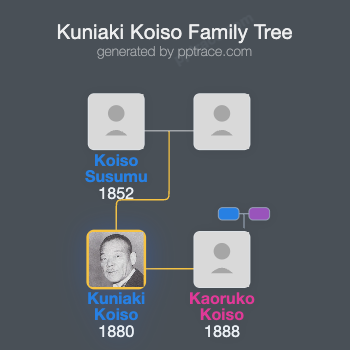
Koiso was the first son of Koiso Susumu, who served as a chief inspector of police, and his family belonged to the shizoku class (former samurai). He attended eight different schools before graduating from Yamagata Middle School (now Yamagata Prefectural Yamagata East High School). In 1898, he was accepted as an officer candidate.
Military Career:
Koiso graduated from the Imperial Japanese Army Academy in 1900 and subsequently attended the Army Staff College. He was commissioned as a Second Lieutenant in June 1901 and was promoted to Lieutenant in November 1903. During the Russo-Japanese War, he served as Battalion Adjutant (September 1904), Company Commander (March 1905), and was promoted to Captain (June 1905).
In November 1910, Koiso graduated from the Army Staff College, ranking 33rd out of 55. He became an instructor at the Imperial Japanese Army Academy in December 1910 and was reassigned to the Kwantung Army General Staff in September 1912. He was promoted to Major and appointed Battalion Commander of the 2nd Infantry Regiment in August 1914.
Koiso returned to the Army General Staff in June 1915, and by July 1918, he was promoted to Lieutenant Colonel. In July 1921, he was seconded to the Imperial Japanese Army Air Service. After his promotion to Colonel in February 1922, he served as a military attaché in Europe starting June 1922. In August 1923, he took command of the IJA 51st Division. He returned to the Army General Staff in May 1925, was promoted to Major General in December 1926, and to Lieutenant General in August 1931.
During the 1920s, Koiso aligned with the moderate Tōseiha faction, which was led by General Kazushige Ugaki. He was involved in various military and administrative roles, including Vice-Minister of War (February 1932), Chief of Staff of the Kwantung Army (August 1932), and command of the IJA 5th Division (March 1934). From December 1935, he commanded the Chōsen Army in Korea. He was promoted to full general in November 1937 and joined the Army General Staff in July 1938.
Colonial and Political Roles:
Koiso left active military duty in July 1938. He served as Minister of Colonial Affairs twice, from April to August 1939 in Prime Minister Hiranuma Kiichirō’s cabinet, and again from January to July 1940 under Prime Minister Fumimaro Konoe’s government.
He was appointed Governor-General of Korea in May 1942, succeeding Jirō Minami, a position he held until 1944. His tenure was marked by continued policies of militarization, including the enforcement of universal military conscription on Koreans, which was unpopular among Koreans. Koiso dismissed independence movements, reportedly saying that the dream of Korean independence was as foolish as plotting independence for Kyushu or Hokkaido.
Prime Ministership (1944–1945):
Following Hideki Tojo’s resignation, Koiso was selected as the 40th Prime Minister of Japan, serving from July 1944 to April 1945. His appointment was supported by some former prime ministers and members of the military, but he faced opposition from some civilian and military factions due to his past associations and political views. His tenure was characterized by the ongoing Pacific War, with Japan suffering significant defeats on multiple fronts.
Koiso’s strategy aimed at negotiating peace through a decisive military action in the Philippines; however, disagreements within the Japanese military hampered unified planning. During his premiership, Japan experienced several losses, including the sinking of the battleship Yamato and defeats at Leyte Gulf. He considered peace negotiations but was unable to broker a ceasefire. Koiso resigned in April 1945 amid escalating military crises, notably the invasion of Okinawa.
Later Life and War Crimes Trial:
After Japan's surrender in 1945, Koiso was arrested by Allied forces. He was tried by the International Military Tribunal for the Far East and convicted as a Class A war criminal on multiple counts, including his role in initiating hostilities in China and against the Allies. The tribunal stated that while he was not directly responsible for war crimes committed by Japanese troops, he failed to take measures to prevent or punish such acts.
Koiso was sentenced to life imprisonment and died in prison on November 3, 1950, from esophageal cancer. His remains are interred at Aoyama Cemetery in Tokyo.
Honors:
He received several Japanese honors, including the Grand Cordon of the Order of the Rising Sun and the Order of the Sacred Treasure.