Koiso Susumu
| Name | Koiso Susumu |
| Title | Japanese politician |
| Gender | Male |
| Birthday | 1852-01-01 |
| nationality | Japan |
| Source | https://www.wikidata.org/wiki/Q66828407 |
| pptrace | View Family Tree |
| LastUpdate | 2025-11-17T09:36:25.652Z |
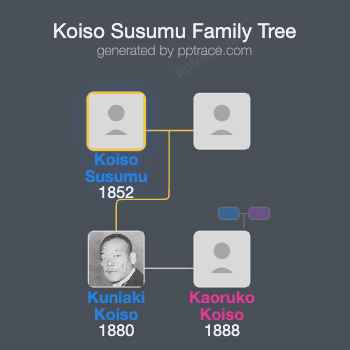
Family Tree
Tap  to expand more relatives
Introduction
Susumu Koiso (born November 1852, Kanei 5, 11th month – November 10, 1927, Showa 2) was a Japanese civil servant in the Home Ministry and a member of the House of Representatives (affiliated with the Yamashita Club). He served in the pre-war Home Ministry, holding various positions as police officials across different regions, and also held local administrative posts such as the chief of Mogami District in Yamagata Prefecture and the chief of Minamimurayama District. Additionally, he ran in the 5th general election for the House of Representatives and was elected.
Born in Shinjo Domain, Koiso’s family income was over 200 koku. After receiving education at the domain school, he worked in various departments of the Home Ministry. Specifically, he served as a police inspector in Tochigi Prefecture, was affiliated with Shimane Prefecture, and worked in the Home Affairs Bureau, eventually becoming the chief of Mogami District and Minamimurayama District in Yamagata Prefecture.
He ran in the 5th general election for the House of Representatives in 1898 (Meiji 31) and was elected. During his term, he belonged to the Yamashita Club. He continued his career as a police officer, serving as the head of the Gunma Prefectural Police, Okayama Prefectural Police, and Mie Prefectural Police. These roles were equivalent to the heads of prefectural police headquarters before the war, overseeing police administration in various regions.
On March 31, 1902 (Meiji 35), he was awarded the Senior Sixth Rank, which was part of his official rank promotion.
In terms of family relations, his eldest son, Kunizo Koiso, was a prominent figure, serving as a Army General and Prime Minister of Japan. His younger brother, Chūnosuke Koiso, was a lawyer and also served as a member of the House of Representatives.
References include Kazuo Yahata’s "Rendada Sōri no Tsūshinbo: Kokka no In’un o Takushita Seijika to wa" (PHP Institute, 2014), "Chigai Seitō Nanajū-nen-shi: Shūgiin Giin Meikan" (Ministry of Finance Printing Bureau, 1962), and Takekuni Suga’s edited volume "Yamagata Meiyo-kan Jōkan" (1891).