Mary Fox, 2nd Baroness Holland
| Name | Mary Fox, 2nd Baroness Holland |
| Title | British noblewoman |
| Gender | Female |
| Birthday | 1746-01-01 |
| nationality | Great Britain |
| Source | https://www.wikidata.org/wiki/Q46152060 |
| pptrace | View Family Tree |
| LastUpdate | 2025-11-26T23:25:15.180Z |
Family Tree
Tap  to expand more relatives
Introduction
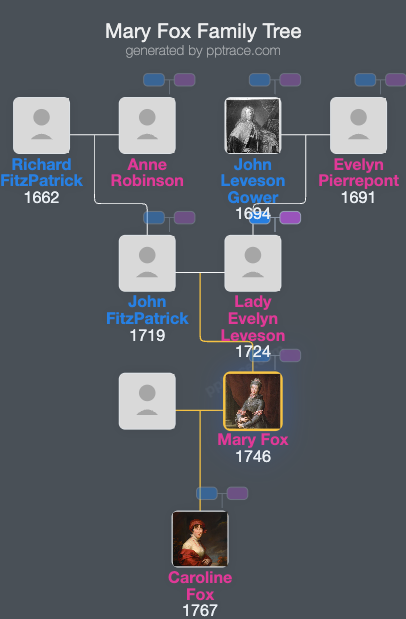
Mary Fox, Baroness Holland (née FitzPatrick), was born on March 16, 1747 (Old Style: March 5, 1746). She was part of the Mac Giolla Phádraig dynasty and the Fox family, prominent aristocratic families of Anglo-Irish descent. Her parents were John FitzPatrick, 2nd Baron Gowran, and Lady Evelyn Leveson-Gower, daughter of John Leveson-Gower, 1st Earl Gower. Her father was created Earl of Upper Ossory in 1751 and passed away in 1758.
Mary FitzPatrick had several notable siblings, including John FitzPatrick, 2nd Earl of Upper Ossory; Hon. General Richard FitzPatrick, who served as Chief Secretary for Ireland and twice as Secretary at War; and Lady Louisa FitzPatrick, who was married to Prime Minister Lord Shelburne.
On April 20, 1766, she married Hon. Stephen Fox. The couple embarked on a wedding tour of Italy during the winter of 1766–67, spending time in Naples with family and friends, and subsequently in Rome in the spring. Following her husband's inheritance of family titles in 1774, she became known as Lady Holland. However, her husband died later that year, a few months after inheriting the titles.
Lady Mary Fox was noted for her personal qualities; her brother, the 2nd Earl of Upper Ossory, described her as "the most amiable person that ever lived," highlighting her manners, understanding, sweetness of temper, and tenderness towards her children.
She and Hon. Stephen Fox had two children. Their son, Henry Fox, became the 3rd Baron Holland; he was a significant figure in Whig politics and lived from 1773 to 1840. Their daughter, Hon. Caroline Fox, was born in 1767 and did not marry; she maintained close contacts with the Shelburne family and lived until 1845.
In 1774, the inherited titles from her husband's parents, Henry, 1st Baron Holland of Foxley, and Caroline, 1st Baroness Holland of Holland, elevated her status. Her husband died shortly afterward in 1774 of dropsy, at a young age.
Lady Mary Fox died from consumption on October 6, 1778.
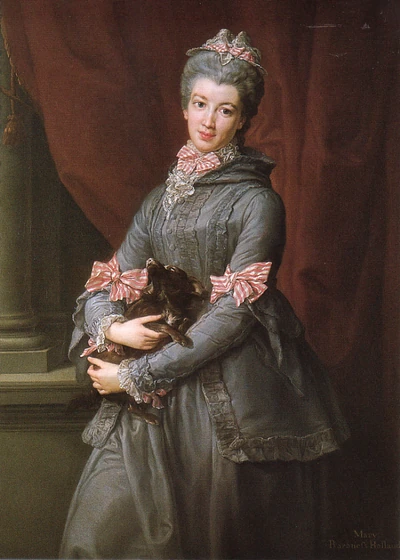
In terms of artistic representations, she was painted by Thomas Gainsborough in the winter of 1764–65 and by Sir Joshua Reynolds between 1766 and 1769. During her travels in Rome in 1767, she was also the subject of an unfinished portrait by Pompeo Batoni, completed and sent to England in 1769. Batoni's portrait depicts her in a grey silk Brunswick gown with striped ribbons and is regarded as a masterwork of his.
While in Rome, she met the engraver Giovanni Piranesi, who dedicated a plate to her in his 1778 collection of engravings, titled "Vasi, candelabri, cippi, sarcofagi, tripodi, Luciferne ed ornamenti antichi." Plate 12 features an etching of three vases with an inscription referencing her: "A Sua Eccellenza Miledi Maria Fox."
A miniature portrait of Lady Mary Fox, based on a work by Reynolds, exists in the Tsarskoye Selo State Museum in Saint Petersburg. This miniature, painted on an oval ivory plate, was attributed to Edward Miles, an English painter and apprentice under Reynolds during 1772–92. Miles brought this miniature to Russia in 1797, along with a letter of recommendation from Count Semyon Vorontsov, the Russian Ambassador.
[End of biography. Word count: approximately 420 words.]