Richard Lee I
| Name | Richard Lee I |
| Title | American politician |
| Gender | Male |
| Birthday | 1617-01-01 |
| nationality | Kingdom of England |
| Source | https://www.wikidata.org/wiki/Q7327313 |
| pptrace | View Family Tree |
| LastUpdate | 2025-11-17T06:39:30.104Z |
Family Tree
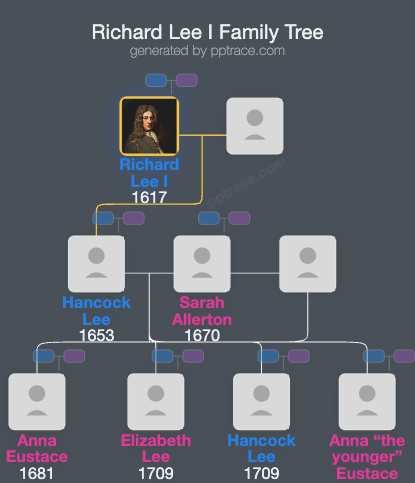
Tap  to expand more relatives
Introduction
Richard Lee I (circa 1618 – 1 March 1664) was an English-born individual who became a merchant, planter, and politician in the Colony of Virginia. He is recognized as the first member of the Lee family to reside in America.
Born around 1618, Richard Lee was christened on 22 March 1618. He was the son of John Lee I (circa 1588–1630) and Jane Hancock. He had at least two brothers, John Lee, a merchant in London, and Thomas Lee. Family tradition suggested that his ancestors owned Coton Hall in Shropshire, England; however, genealogical records link both sides of his family to merchants in Worcester and Worcestershire.
Lee’s father died in February 1630, and his mother remarried but died in 1639, leaving a will that favored her sons John and Thomas over Richard. His brother John apprenticed as a wine merchant in London. Richard Lee sailed to Virginia when he was approximately 21 years old. He married Anne (or Anna), possibly a daughter of London publisher Francis Constable and a ward of Sir John Thorowgood, in a church at Jamestown in late 1641 or early 1642. They had ten children before returning to England in 1663. Richard Lee later made a final return to Virginia, likely accompanied by a son, with his will suggesting that his widow and most of his sons should re-establish themselves in the colony.
Regarding his early career, Lee arrived at Jamestown in 1639 on the same ship as Sir Francis Wyatt, Virginia’s incoming royal governor. Wyatt became a mentor to Lee before departing the colony in late 1641. An additional passenger on the voyage was Anne Constable, known possibly to be associated with the Constable family and related to the circle of prominent English families.
In Virginia, Lee initially managed land records and held various government positions. His first land patent, granted in August 1642, covered 1,000 acres on the north side of the York River, at the head of Poropotank Creek, then part of York County. The land was supposedly acquired through the headrights of thirty-eight immigrants who could not afford passage, though Lee did not formally take title until 1646. He possibly transported these emigrants himself from Breda in the Netherlands in 1650. His earliest residence was likely a log cabin near Capahosic Wicomico, a Native American community, on leased land.
Lee’s settlement was impacted by the 1644 Powhatan attack led by Chief Opchanacanough, which resulted in the massacre of approximately 300 colonists and Native Americans allied with the settlers. Following this, Lee and his family moved to New Poquoson on the Virginia Peninsula, where they occupied a 90-acre plantation for nine years.
In the late 1640s, Lee obtained land patents along the Pamunkey River and nearby areas. He exchanged some of these lands for others, retaining key tracts such as "War Captain’s Neck." His land acquisitions and investments contributed to his substantial holdings, which at his death, encompassed approximately 15,000 acres across Virginia and Maryland, making him among the colony’s largest landholders.
In terms of public service, Lee's first Virginia office was as Clerk of the Quarter Court in Jamestown. He served as Clerk to the Virginia House of Burgesses in 1640 and 1641. In 1643, Governor Sir William Berkeley appointed him as Attorney General of Virginia and continued his role as clerk. He was elected as a Burgess representing York County during 1647–1648 and was appointed to the Virginia Governor’s Council in 1649. As Secretary of State, Lee was the colony’s second-in-command, overseeing colonial affairs during the tumultuous period following the English Civil War.
Lee's political alignment largely supported the Crown; he remained loyal to King Charles I and later to Charles II during the English Commonwealth period. In 1650, he traveled to the Netherlands in support of Virginia’s allegiance to Charles II. He negotiated Virginia's capitulation to the Commonwealth of England and, after the Restoration in 1660, continued to serve on the Virginia Council of State.
Throughout his career, Lee held multiple local offices including Justice of the York County Court, High Sheriff, and colonel of the Northumberland County Militia. He was involved in the colonial trade, becoming a merchant with shipownership interests, and engaged in the tobacco economy and the slave trade, owning at least 90 African slaves and claiming 4,000 acres of headrights in 1660.
Richard Lee I died on 1 March 1664.