John Strutt, 3rd Baron Rayleigh
| Name | John Strutt, 3rd Baron Rayleigh |
| Title | English physicist (1842–1919) |
| Gender | Male |
| Birthday | 1842-11-12 |
| nationality | United Kingdom of Great Britain and Ireland |
| Source | https://www.wikidata.org/wiki/Q83297 |
| pptrace | View Family Tree |
| LastUpdate | 2025-11-26T23:31:09.281Z |
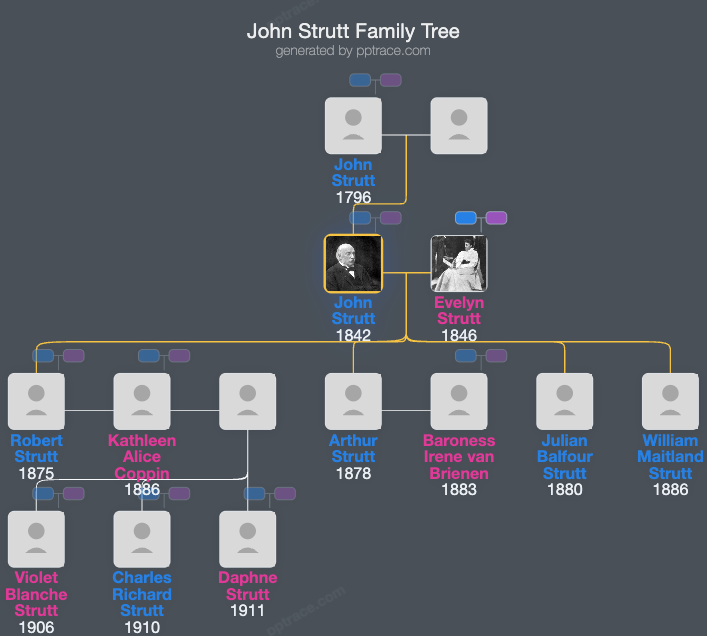
Family Tree
Tap  to expand more relatives
Introduction
John William Strutt, 3rd Baron Rayleigh, was born on 12 November 1842 at Langford Grove, Maypole Road, Maldon, England. He was the son of John James Strutt, 2nd Baron Rayleigh, and Clara Elizabeth La Touche. During his early years, he experienced health issues that limited his physical development.
Rayleigh attended Eton College and Harrow School, though his attendance at each was brief. In 1861, he matriculated at Trinity College, Cambridge, where he studied mathematics. He graduated in 1865 as Senior Wrangler and Smith's Prizeman, and in 1866 was elected a Fellow of Trinity College. He obtained his Master of Arts degree in 1868.
In 1871, Rayleigh resigned his fellowship to marry Evelyn Balfour, daughter of James Maitland Balfour. They had three sons. In 1873, on the death of his father, he inherited the hereditary title of Baron Rayleigh. The same year, he was elected a Fellow of the Royal Society.
In 1879, Rayleigh was appointed Cavendish Professor of Physics at the University of Cambridge, following the death of James Clerk Maxwell. He first described the concept of dynamic soaring in seabirds in 1883. In 1884, he resigned the professorship to focus on experimental work at Terling Place.
From 1887 to 1905, he served as Professor of Natural Philosophy at the Royal Institution. During this period, he conducted precise measurements of atomic masses of oxygen and hydrogen, and later nitrogen, leading to the discovery of a minor inert gas component in air, which he and William Ramsay identified as argon in 1894. For this discovery, Rayleigh was awarded the Nobel Prize in Physics in 1904, shared with Ramsay, who received the Nobel in Chemistry.
He developed multiple scientific concepts, including the Rayleigh number in fluid dynamics, Rayleigh waves in elasticity, and the Rayleigh–Taylor instability. In optics, he established criteria for angular resolution and proposed theories related to sound localization, notably the duplex theory involving interaural phase and level differences. His work extended to the formulation of the Rayleigh–Jeans law for black-body radiation, integral to the development of quantum mechanics.
Rayleigh authored "The Theory of Sound," published in 1877, which remains influential in acoustics. He introduced the Rayleigh test for circular uniformity, and the Rayleigh plot visualizes this statistical measure. His contributions earned him numerous honors including the Copley Medal (1899), the Royal Medal, and the Albert Medal. He received the Nobel Prize in 1904, among other awards, and was appointed to prestigious titles such as the Order of Merit in 1902.
He served as President of the Royal Society from 1905 to 1908 and as Chancellor of the University of Cambridge from 1908 until his death. During the First World War, he was President of the Advisory Committee for Aeronautics at the National Physical Laboratory. In 1919, he was President of the Society for Psychical Research.
Rayleigh died on 30 June 1919 in Witham at the age of 76; he was buried at All Saints' Church in Terling. His son Robert succeeded him as Baron Rayleigh.
Religiously, Rayleigh was Anglican and expressed personal interest in spiritual matters, including parapsychology, but he did not extensively publish on the relationship between science and religion. In a letter, he conveyed his belief in a power beyond the material world, and he admired Jesus Christ as a moral teacher.
His scientific legacy includes numerous honors and named phenomena, such as Rayleigh waves, Rayleigh scattering, and the rayl unit of acoustic impedance. Several craters on the Moon and Mars, as well as the asteroid 22740 Rayleigh, bear his name. The Institute of Acoustics and the Institute of Physics sponsor medals named after him. His publications include "The Theory of Sound" (1877) and extensive collections of scientific papers. A memorial to him, created by Derwent Wood, is located in Westminster Abbey.