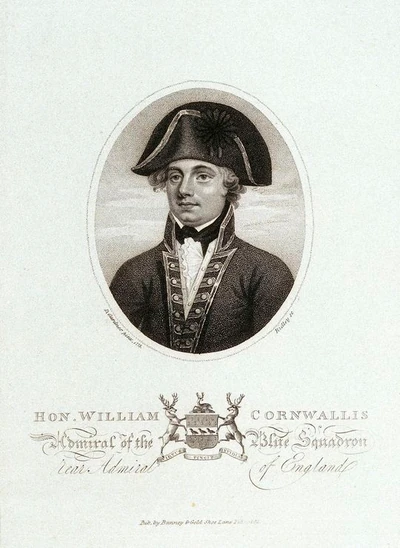
William Cornwallis
| Name | William Cornwallis |
| Title | Royal Navy admiral (1744-1819) |
| Gender | Male |
| Birthday | 1744-02-10 |
| nationality | Great Britain |
| Source | https://www.wikidata.org/wiki/Q1935376 |
| pptrace | View Family Tree |
| LastUpdate | 2025-11-26T23:21:37.507Z |
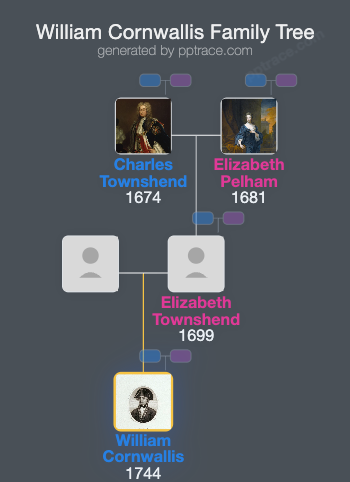
Family Tree
Tap  to expand more relatives
Introduction
Admiral Sir William Cornwallis was born on 20 February 1744. His father was Charles Cornwallis, the fifth Baron Cornwallis and first Earl Cornwallis, and his mother was Elizabeth Townshend, daughter of Charles Townshend, the 2nd Viscount Townshend. Cornwallis had a brother, Charles Cornwallis, who became the 1st Marquess Cornwallis and was a British military and political figure notably involved in the siege of Yorktown. William Cornwallis attended Eton College beginning in 1753.
He entered the Royal Navy in 1755 at the age of 11, serving aboard the 80-gun HMS Newark sailing to North America with Admiral Edward Boscawen's fleet. During the Seven Years' War, Cornwallis was transferred to HMS Kingston and participated in the siege of Louisbourg in 1758, a key engagement that contributed to Britain's dominance in North America. After returning to England in 1759, he was assigned to HMS Dunkirk, which was part of Admiral Edward Hawke's squadron. Dunkirk took part in the Battle of Quiberon Bay in 1759, a decisive British victory against the French fleet under Admiral Conflans.
In April 1761, Cornwallis passed his examination for lieutenant, subsequently being promoted to the rank on HMS Thunderer. During the 1760s, he commanded several ships, including HMS Wasp in 1762, HMS Swift in 1763, and later the HMS Prince Edward until its sale in 1766. During peacetime, he commanded HMS Guadeloupe and engaged in various duties.
With the outbreak of the American Revolutionary War, Cornwallis commanded the 50-gun HMS Lion. In 1778, Britain entered a global conflict following alliances between France and the American colonies. Cornwallis participated in the Battle of Grenada on 6 July 1779, where French Admiral d’Estaing's fleet defeated the British squadron. During this engagement, Cornwallis’s ship, Lion, was separated from the main British force and sought refuge in Jamaica.
While stationed in the West Indies, Cornwallis became associated with Cubah Cornwallis, who later became his mistress and housekeeper in Port Royal, Jamaica. She acquired medical skills and treated notable figures including Captain Horatio Nelson and Prince William Henry, later William IV.
In 1780, Cornwallis commanded a small squadron consisting of HMS Lion, HMS Bristol, and HMS Janus off Saint-Domingue. During the night of 21-22 April 1780, an engagement with a French convoy occurred. Despite damage, Cornwallis’s squadron managed to retreat, and he returned to England in June 1781 aboard Lion.
Subsequently, Cornwallis was appointed to command the 74-gun HMS Canada and returned to the West Indies under Admiral Samuel Hood in 1782. During the Battle of St. Kitts in 1782, Cornwallis’s ship participated in fleet actions involving the French under de Grasse; the British fleet attempted to dislodge the French but ultimately failed. In April 1782, Cornwallis fought in the Battle of the Saintes under Admiral Rodney, where his ship Canada was positioned in the line of battle, suffering 12 fatalities and additional wounded.
Throughout his career, Cornwallis was recognized for his service in multiple significant naval engagements and held the position of commander-in-chief of the Channel Fleet during the Napoleonic Wars. He was known informally among sailors as "Billy Blue," and a sea shanty was written in his honor reflecting the regard of his crew.
William Cornwallis died on 5 July 1819.