
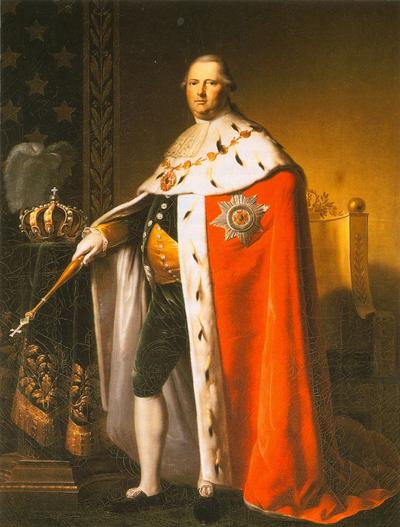
Friedrich I Of Württemberg
| Name | Friedrich I Of Württemberg |
| Title | last Duke of Würtemberg, then briefly Elector of Württemberg, and was later elevated to the status of King of Württemberg, by Napoleon I (1754-1816) |
| Gender | Male |
| Birthday | 1754-11-06 |
| nationality | Q159631 |
| Source | https://www.wikidata.org/wiki/Q170179 |
| pptrace | View Family Tree |
| LastUpdate | 2025-11-12T01:17:03.301Z |
Family Tree
Tap  to expand more relatives
Introduction
Frederick I, born Frederick William Charles (German: Friedrich Wilhelm Karl), was born on 6 November 1754 and died on 30 October 1816. He was a monarch of Württemberg, serving as its ruler from 1797 until his death in 1816.
Early Life
Frederick was born in Treptow an der Rega, present-day Trzebiatów in Poland. He was the eldest son of Frederick II Eugene, Duke of Württemberg, and Sophia Dorothea of Brandenburg-Schwedt. His paternal grandfather was Charles Alexander, Duke of Württemberg. As the nephew of Duke Charles Eugene, Frederick had reason to expect succession, but familial and dynastic circumstances influenced his career trajectory.
Military Career in Prussia
In June 1774, Frederick entered the Prussian Army as an Oberst in the Kürassierregiment Lölhöffel. He was promoted to commander within the same regiment in December 1776. His military service included participation in the War of the Bavarian Succession. In 1780, he assumed command of the 2nd Dragoon Regiment (Krockow). His military service was characterized by several ranks: Honorary Colonel of Infantry (Prussia, 1759), Honorary General Major of Cavalry (1769), Colonel of Cavalry (1774), and General Major of Cavalry (1780). He left the Prussian Army in 1781.
Family and Marriage to Augusta
On 15 October 1780, Frederick married Duchess Augusta of Brunswick-Wolfenbüttel, the eldest daughter of Charles William Ferdinand, Duke of Brunswick-Lunebüttel, and Princess Augusta of Great Britain. Augusta was a niece of King George III of Great Britain and sister to Caroline of Brunswick, the future wife of King George IV. The marriage produced four children: William I of Württemberg, Princess Catharina of Württemberg, Duchess Sophia Dorothea of Württemberg, and Prince Paul of Württemberg. The marriage was reportedly unhappy, and Frederick was rumored to have been bisexual, with associations involving young noblemen.
Time in Russia
In 1782, Frederick resigned from the Prussian Army as a Major General and accompanied his sister, Sophie, and her husband, Paul of Russia, on a journey through Europe. In Russia, Catherine II appointed him Governor of Eastern Finland, based in Viipuri. From June to October 1783, he commanded a corps during the Russo-Turkish War but saw limited combat. His wife Augusta's relationship with Frederick deteriorated, and in December 1786, she sought protection from Empress Catherine II, who granted her asylum and ordered Frederick to leave Russia. Augusta died on 27 September 1788 in Estonia. During this period, Frederick sold his residence in Vyborg called Monrepos.
Ascension to Power
Frederick's prospects of succession in Württemberg became more likely after his father ascended the throne in 1795. His family connections to Russia and Britain proved significant. On 18 May 1797, he married Charlotte, Princess Royal, eldest daughter of King George III of Great Britain. His father, Frederick II Eugene, Duke of Württemberg, died on 23 December 1797, and Frederick succeeded him as Duke of Württemberg, adopting the regnal name Frederick III.
Reign
As Duke and later Elector
Frederick's rule was interrupted by the French occupation in 1800, prompting him and his wife to flee to Vienna. He ceded the enclave of Montbéliard to France in 1801, receiving Ellwangen in return in 1803. The Holy Roman Empire elevated Württemberg to the status of a Prince-elector in 1803, with Frederick assuming the title of Elector of Württemberg.
As King
In 1805, Napoleon allowed Württemberg to be raised to a kingdom, which occurred on 26 December 1805, with Frederick being crowned King Frederick I on 1 January 1806. Württemberg seceded from the Holy Roman Empire and joined Napoleon's Confederation of the Rhine. The elevation resulted in territorial expansions through mediatisation and annexations. Frederick's daughter, Princess Catharina, married Napoleon's brother Jérôme Bonaparte.
During the German campaign of 1813, Frederick switched allegiances, aligning with the Allies. After Napoleon's defeat, he attended the Congress of Vienna, where Württemberg's territorial gains were confirmed. He joined the German Confederation in 1815 and died in Stuttgart in October 1816.
Family Titles and Honors
At his accession as king, Frederick granted his descendants the titles of Princes and Princesses of Württemberg with the style of Royal Highness. He styled his siblings as Dukes and Duchesses of Württemberg. He was notably tall and obese, and was famously nicknamed "The Great Belly-Gerent." King Napoleon remarked on his appearance, and Frederick was known for his skepticism of Napoleon's intelligence.
Honors and Ranks
Frederick received numerous honorary titles and memberships, including honorary memberships of the Academy of Fine Arts Vienna and various British cities such as Portsmouth, Newport, Bath, Oxford, and Windsor. His military ranks ranged from honorary colonel and general major in Prussia to general of cavalry in Württemberg before ascending to the throne.
Ancestry
Frederick's lineage included notable European nobility, connecting him to the House of Württemberg and other royal families.
Sources
The information is compiled from historical sources including Kurt Andermann, Jürgen Honeck, Ina Ulrike Paul, and Paul Sauer, among others.
External Links
Additional resources include entries from the New International Encyclopedia (1905) and the 1911 edition of Encyclopædia Britannica, along with portrait collections at the National Portrait Gallery in London.
