Prince Arisugawa Takehito
| Name | Prince Arisugawa Takehito |
| Title | Japanese admiral (1862-1913) |
| Gender | Male |
| Birthday | 1862-01-13 |
| nationality | Japan |
| Source | https://www.wikidata.org/wiki/Q875481 |
| pptrace | View Family Tree |
| LastUpdate | 2025-11-17T06:48:01.923Z |
Family Tree
Tap  to expand more relatives
Introduction
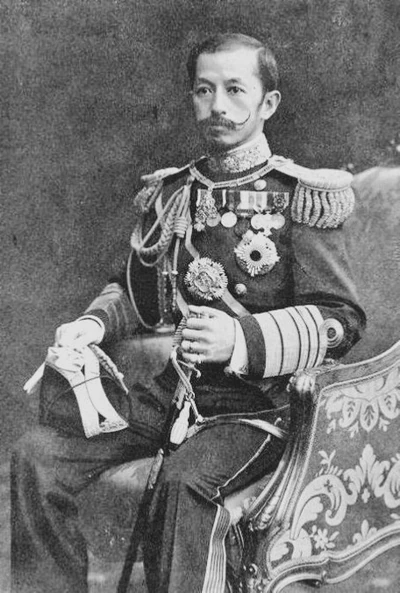
Prince Arisugawa Takehito (有栖川宮威仁親王, Arisugawa-no-miya Takehito-Shinnō) was born on January 13, 1862, in Kyoto. He was a member of the Arisugawa-no-miya house, a cadet branch of the Japanese Imperial Family that was classified as a shinnōke, or princely branch authorized to succeed to the Chrysanthemum Throne if the main line became extinct. His parents were Prince Arisugawa Takahito and Noriko Mori, a concubine.
During his early childhood, Prince Takehito was sent into Buddhist priesthood service at the monzeki temple of Myōhō-in in Kyoto, due to the political circumstances of the Tokugawa Bakufu rule. After the Meiji Restoration, he was recalled to secular life and moved to Tokyo in 1871.
In 1874, under orders from Emperor Meiji, Prince Takehito enrolled in the Imperial Japanese Naval Academy. Despite his young age, he participated as an observer in the Satsuma Rebellion in 1877, arriving in Kagoshima after its initial suppression. In 1879, he was appointed as a military attaché to Great Britain and traveled aboard HMS Iron Duke, the flagship of Britain's Royal Navy in the Far East. He served in the Channel Squadron for approximately a year before returning to Japan as an ensign.
Shortly after his marriage in 1880, Arisugawa was again sent to England to attend the Royal Naval College at Greenwich as a cadet. He returned to Japan in June 1883. In 1889, he and his wife, Maeda Yasuko, conducted an extensive tour of Europe and America.
His first naval command was the corvette Katsuragi in early 1890, followed by the cruiser Takao later that year. In 1891, he was tasked with escorting Russian Crown Prince Nikolai (later Tsar Nicholas II) during his visit to Japan. During this period, Nikolai was wounded in an assassination attempt known as the Otsu Scandal, which negatively impacted diplomatic relations between Japan and Russia.
Prince Takehito was appointed captain of the cruiser Chiyoda in 1892. Upon the death of his half-brother, Prince Arisugawa Taruhito, on January 15, 1895, he succeeded to the head of the Arisugawa-no-miya house. During the First Sino-Japanese War (1894–1895), he commanded the cruisers Matsushima and Hashidate in combat operations. He achieved the rank of rear admiral on November 11, 1896.
In 1896, he traveled to England again as a representative of Emperor Meiji at Queen Victoria’s Diamond Jubilee celebrations. He was promoted to vice admiral on September 26, 1899. In 1902, he was honored as an Honorary Knight Grand Cross of the Order of the Bath (GCB) by King Edward VII.
He attained the rank of full admiral on June 28, 1905, and was awarded the Order of the Golden Kite (3rd Class) for his service during the Russo-Japanese War. In 1905, he and his wife represented the Emperor at the wedding of the German Crown Prince Wilhelm and Duchess Cecile of Mecklenburg-Schwerin, visiting Great Britain on their return trip.
Due to health issues originating in childhood, Prince Takehito frequently took medical leaves. In 1909, he entered semi-retirement and built a summer residence in Kobe. He died on July 3, 1913, at his residence in Kobe. His death was not immediately announced; his body was swiftly transported to his palace in Tokyo, with the official notice issued on July 10, 1913.
Posthumously, he was promoted to the rank of marshal admiral on July 7, 1913, and was awarded the Collar of the Supreme Order of the Chrysanthemum.
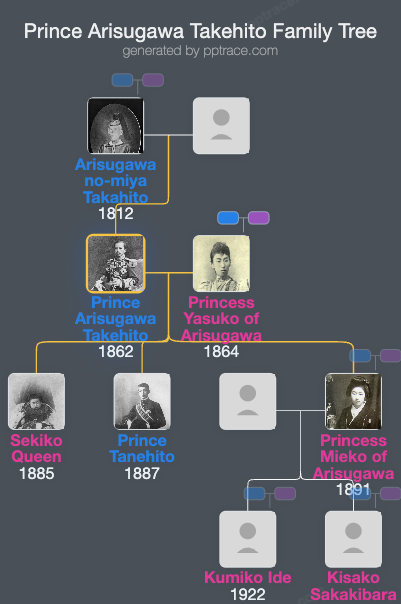
He married Maeda Yasuko on December 11, 1880. They had three children: Princess Isako (October 17, 1885 – September 30, 1886), Prince Arisugawa Tanehito (September 22, 1887 – April 7, 1908), and Princess Mieko (February 14, 1891 – April 25, 1933). His son Tanehito died young, and as a result, the direct house of Arisugawa-no-miya became extinct. The house was later revived by Emperor Taishō in favor of his third son, Prince Takamatsu Nobuhito, who married Kikuko Tokugawa, a granddaughter of Prince Takehito.
The site of his former Tokyo residence is now the Arisugawa-no-miya Memorial Park in Minami Azabu, Minato, Tokyo, featuring public gardens. His former seaside summer estate in Hayama, Kanagawa Prefecture, is the location of the Kanagawa Prefectural Museum of Modern Art's annex. His summer villa in Inawashiro, Fukushima, named Tenkyōkaku, is an Important Cultural Property of Japan and is open to the public as a museum. A bronze statue of Prince Arisugawa was also erected on the grounds of the Naval Staff College in Tsukiji, Tokyo.