Charles Wilkins Short
| Name | Charles Wilkins Short |
| Title | American botanist and physician (1794-1863) |
| Gender | Male |
| Birthday | 1794-10-06 |
| nationality | United States of America |
| Source | https://www.wikidata.org/wiki/Q15474732 |
| pptrace | View Family Tree |
| LastUpdate | 2025-11-29T01:00:15.886Z |
Family Tree
Tap  to expand more relatives
Introduction
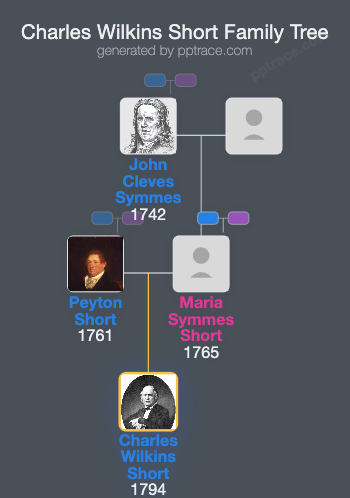
Charles Wilkins Short was born on October 6, 1794, in Woodford County, Kentucky. His parents were Peyton Short and Maria Symmes Short. He had four siblings and four half-siblings. His grandparents included John Cleves and Anna Tuthill Symmes. During early life, he lived on his father's farm and received primary education from Joshua Fry, a well-known teacher.
Short attended Transylvania University, earning a Bachelor of Arts degree in 1810 and a Master of Arts in 1813. In 1813, he studied under Caspar Wistar in Philadelphia. He subsequently attended the University of Pennsylvania, where he obtained a Doctor of Medicine degree in 1815.
In 1815, Short began practicing medicine under his uncle, Frederick Ridgely. His medical practice was based in Woodford County, Kentucky, from approximately 1815 to 1825. Between 1825 and 1837, he served as a professor of medical botany. In 1838, Short helped establish a medical school at the University of Louisville, where he served as a professor until 1849. Upon retiring from teaching, he was designated professor emeritus of Materia Medica and Medical Botany.
Short's botanical pursuits included an expedition along the Ohio River in March-April 1845. He discovered several plant species and is honored by the naming of six taxa: the genus Shortia; the species Vesicaria shortii, Phaca shortiana, Symphyotrichum shortii, Solidago shortii, and Carex shortiana. His contributions to botany positioned him as a prominent botanist west of the Allegheny Mountains during the mid-19th century.
Among the plant species discovered by Short are Stellaria fontinalis (Kentucky pearlwort) and Ludwigia polycarpia (top-pod water lily). He also discovered Carex shortiana and Solidago shortii, named after him. His notable botanical publication was *A Catalog of the Native Phaenogamous Plants and Ferns of Kentucky*, written initially in 1833 with subsequent additions, describing approximately 1,300 species. Short also authored works on plant life near Lexington, Kentucky, written in 1828 and 1829, and a history of western American botany in 1836. A planned illustrated work describing Kentucky's plant life, co-created with Robert Peter and Henry Griswold, was never completed. He was elected an Associate Fellow of the American Academy of Arts and Sciences in 1855.
Besides his botanical work, Short held academic positions at Transylvania University and the University of Louisville, chairing Materia Medica and Medical Botany. He was an associate editor and co-founder of the *Transylvania Journal of Medicine and the Sciences* (1828–1839). Throughout his life, he authored less than 300 pages of published writings.
In November 1815, he married Mary Henry Churchill. They had several children, six of whom were alive at his death in 1863—one son and five daughters. Short owned a vast herbarium of approximately 15,000 plant samples; he intended for it to be donated to the Smithsonian Institution, but it was ultimately given to the Philadelphia Academy of Natural Sciences. His botanical collection was regarded as one of the most valuable private herbaria in the world and among the most complete in the United States.
Following his retirement, Short maintained a garden covering several acres. He corresponded extensively with his uncle William Short, with over 500 letters exchanged. Short held anti-slavery views; in the late 1820s, he inherited several slaves from his uncle and attempted to relocate them to Africa, although he encountered difficulties. He was a lifelong Presbyterian.
In 1849, he retired from medical teaching and moved to the community of Hayfield, after inheriting a substantial fortune from William Short. Charles Wilkins Short died of pneumonia and typhoid fever in Louisville, Kentucky, on March 7, 1863.