Peyton Short
| Name | Peyton Short |
| Title | politician from Kentucky (1761-1825) |
| Gender | Male |
| Birthday | 1761-12-17 |
| nationality | United States of America |
| Source | https://www.wikidata.org/wiki/Q7179635 |
| pptrace | View Family Tree |
| LastUpdate | 2025-11-17T06:38:46.320Z |
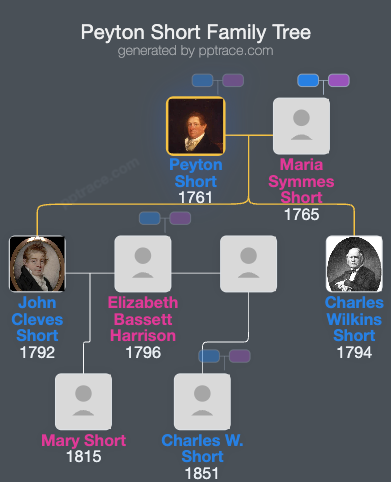
Family Tree
Tap  to expand more relatives
Introduction
Peyton Short was born on December 17, 1761, at Spring Garden, located in Surry County, Virginia. His parents were William Short and Elizabeth (Skipwith) Short. He received early education under the guidance of his brother William Short. Short attended The College of William and Mary, where he was a member of the Phi Beta Kappa Society. He graduated in 1780. Although often referred to with the military title "Major," no verifiable documentation confirms his rank; if legitimate, it was likely in the Virginia or Kentucky militia.
Following the death of his father shortly after the American Revolutionary War, Peyton and his brother William became co-executors of their father’s estate. Due to the war's economic impact in the area near Yorktown, Virginia, and limited family funds, they chose to retain most of their father's assets for future investment rather than immediately settling debts. Peyton Short also served as an aide to Thomas Jefferson in France and later combined much of his brother William's inheritance with his own assets, though the details are not documented.
As a young lawyer, Short resided with a widow in Harrodsburg, Kentucky. During this time, he became acquainted with Rachel Donelson Robards, who later married President Andrew Jackson. Rachel Robards was then married to Lewis Robards, the son of the widow with whom Short was boarding. An incident involving Short and Rachel led to conflict with Robards, who accused Short of breaking up his marriage.
Short traveled to Kentucky with Charles Scott, a future governor of Kentucky. They arrived via the Ohio River and settled in Danville, Lincoln County. While in Danville, Short participated in the Danville Political Club, a debating society active from 1786 to 1790. In 1788, he married Maria Symmes, the daughter of John Cleves Symmes, whom he met at James Wilkinson's house in 1786. Around 1790, he moved to Greenfield in Woodford County. Peyton and Maria had three children: Charles, John, and Anna. His son John married Betsey Basset Harrison, daughter of William Henry Harrison, Peyton’s brother-in-law.
In 1790, Peyton Short partnered with James Wilkinson to open a general store. He became involved in Kentucky’s political and economic activities, serving as the first collector of the port at Louisville in 1789. He was elected to the city of Lexington’s board of trustees in 1791 but resigned in 1792. Short was among the electors chosen to vote for Kentucky’s first governor and served as a representative for Fayette County in the first Kentucky Senate from 1792 to 1796.
In 1793, he became president of the Transylvania Company, a fundraising organization for Transylvania Seminary (later Transylvania University), and served on its board of trustees. He managed a lottery to support the institution and opposed the appointment of Harry Toulmin as president in 1798. Short, along with Caleb Wallace and Christopher Greenup, resigned their positions on the board in protest.
Short’s wife Maria died in 1802. Around 1803, he married Jane Churchill, widow of Armistead Churchill. They had three daughters: Jane, Elizabeth, and Sarah. Jane Churchill-Short died in 1808 or 1809. Peyton Short engaged in land speculation which resulted in significant financial losses. His financial situation declined, and by 1813, he only possessed his own home. He subsequently sold the estate and moved to Christian County near Hopkinsville, Kentucky.
Peyton Short died on September 1, 1825, in Christian County, Kentucky.