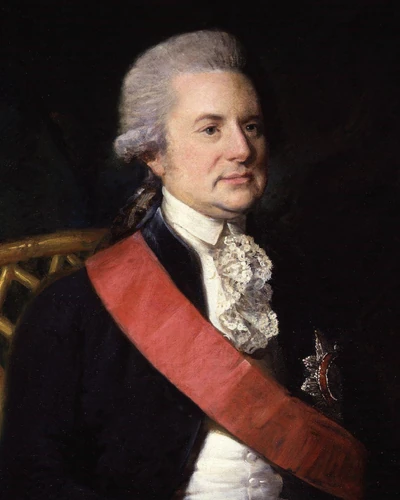
George Macartney, 1st Earl Macartney
| Name | George Macartney, 1st Earl Macartney |
| Title | British statesman, colonial administrator and diplomat (1737-1806) |
| Gender | Male |
| Birthday | 1737-05-14 |
| nationality | Great Britain |
| Source | https://www.wikidata.org/wiki/Q335019 |
| pptrace | View Family Tree |
| LastUpdate | 2025-11-26T23:22:52.522Z |
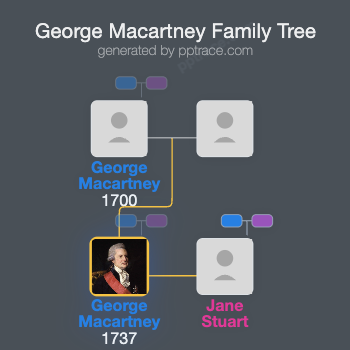
Family Tree
Tap  to expand more relatives
Introduction
George Macartney, 1st Earl Macartney, was born on 14 May 1737 and died on 31 May 1806. He was a British diplomat, politician, and colonial administrator with roles including governor of Grenada, Madras, and the Cape Colony. Macartney is also recognized for leading the first significant British diplomatic mission to Qing China in 1792.
He was born in Lissanoure County Antrim, Ireland, as the only son of George Macartney, High Sheriff of Antrim, and Elizabeth Winder. His family had Scottish origins, with roots tracing back to service under Edward Bruce, brother of Robert the Bruce, which led to land grants in Scotland. The Macartney family of Auchenleck, Kirkcudbrightshire, settled in Ireland, specifically in Lissanoure.
Macartney attended Trinity College Dublin and graduated in 1759. He later studied at the Temple in London. Through the influence of Stephen Fox, brother of Charles James Fox, he gained the support of Lord Holland. His diplomatic career began with his appointment as envoy extraordinary to Russia in 1764, where he successfully negotiated an alliance between Great Britain and Russia with Catherine II.
In 1768, Macartney returned to Ireland to serve as a Member of Parliament for Armagh Borough and also held the position of Chief Secretary for Ireland. Upon resigning this office, he was knighted. The following year, he was appointed governor of the British West Indies and was created Baron Macartney in the Peerage of Ireland in 1776. Between 1780 and 1781, he served as a Member of Parliament for Bere Alston.
From 1776 to 1779, Macartney governed Grenada. During his tenure, the island was attacked by the French fleet led by Comte d'Estaing in July 1779. After losing control of key fortifications on Hospital Hill, Macartney chose to surrender unconditionally and was taken prisoner to France.
He served as governor of Madras from 1781 to 1785. His administration included infrastructure improvements such as the renovation of Fort St. George, which was reinforced after the Siege of 1780. Several buildings and barracks in the western fort were constructed during this period, including the Palace Street, the Arsenal, Hanover Square, and Western Barracks. Pophams Broadway was also developed under his supervision. Macartney was involved in the planning of street lighting, street naming, registration of births and deaths, and licensing of liquor for Madras. During his governorship, he negotiated the Treaty of Mangalore in 1784, ending the Second Anglo-Mysore War. He declined the position of Governor-General of India and returned to Britain in 1786.
In 1792, Macartney was elevated to Earl Macartney in the Irish peerage and appointed as ambassador to Qing China. He led the Macartney Embassy to Beijing, arriving with a naval fleet aboard HMS Lion. The mission sought to establish trade relations, but it did not succeed in these objectives. The primary reason for the failure is debated; it is often misattributed to Macartney’s refusal to perform kowtow to the Qianlong Emperor, but it is more accurately understood as a result of differing diplomatic conventions, with China adhering to a Chinese hegemony that regarded foreign states as tributaries.
The embassy returned to Britain in 1794 without diplomatic concessions. The official account of the expedition was compiled by Sir George Staunton, based on documents from Macartney and Gower. The mission provided detailed observations of China’s empire but was considered a diplomatic setback. Macartney's hopes of visiting Japan post-China were thwarted upon learning of the outbreak of war between Britain and France.
Later in life, after a mission to Italy in 1795, Macartney was ennobled as Baron Macartney of Parkhurst and Auchinleck. He was appointed governor of the Cape Colony in late 1796 but resigned due to ill health in November 1798. He contributed to plans for British military expeditions along South America via New South Wales in 1797. Macartney died in Chiswick, Middlesex, on 31 May 1806; his title became extinct upon his death. His property was inherited by his niece, whose son adopted the Macartney name.