Daisy Greville, Countess Of Warwick
| Name | Daisy Greville, Countess Of Warwick |
| Title | British countess |
| Gender | Female |
| Birthday | 1861-12-10 |
| nationality | United Kingdom |
| Source | https://www.wikidata.org/wiki/Q461429 |
| pptrace | View Family Tree |
| LastUpdate | 2025-11-26T23:33:10.810Z |
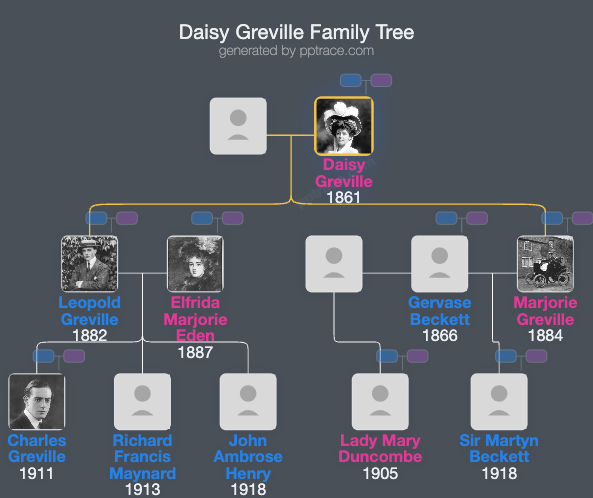
Family Tree
Tap  to expand more relatives
Introduction
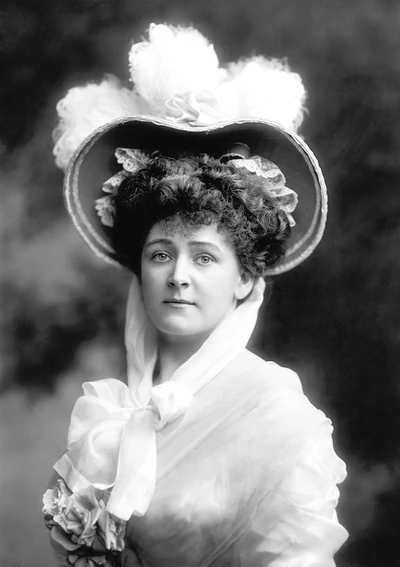
Frances Evelyn "Daisy" Greville, Countess of Warwick (née Maynard), was born on December 10, 1861, at 27 Berkeley Square, London. She was the eldest daughter of Colonel Charles Maynard (1814–1865) and Blanche FitzRoy (1839–1933). Her maternal great-grandfather was Augustus FitzRoy, 3rd Duke of Grafton, a former Prime Minister of Great Britain. Her maternal grandmother was Emily Charlotte Ogilvie, a daughter of Lady Emily Lennox. Her father, Charles Maynard, was the heir apparent to Henry Maynard, 3rd Viscount Maynard. Charles died five months before his father, resulting in Daisy inheriting the Maynard estates, including Easton Lodge in Essex, in 1865.
Her mother remarried after Charles Maynard's death, marrying Lord Rosslyn, a courtier of Queen Victoria, with whom she had five children, including Daisy’s half-sisters Millicent Leveson-Gower, Duchess of Sutherland, Sybil Fane, Countess of Westmorland, and Lady Angela Forbes.
In 1881, Daisy Maynard married Francis Greville, Lord Brooke, the eldest son of George Greville, 4th Earl of Warwick. The family later resided at Warwick Castle following his inheritance of the earldom in 1893. Daisy and Francis had several children: Leopold Guy (1882–1928), who became the sixth Earl of Warwick; Marjorie Blanche (1884–1964); Charles Algernon (1885–1887); Maynard (1898–1960); and Mercy (1904–1968). Some of her children’s paternity has been subject to speculation, with claims that Lord Charles Beresford fathered Marjorie and Charles Algernon.
Daisy was considered a potential match for Prince Leopold, Queen Victoria’s youngest son, but the engagement did not proceed. Instead, she married Francis Greville. As a socialite, she hosted gatherings and was part of the "Marlborough House set," which included Albert Edward, Prince of Wales, later King Edward VII. She became known for her involvement in political and social causes, particularly advocating for education, housing, and employment for the disadvantaged. She established colleges for women in agriculture and market gardening, first in Reading and later in Studley, and founded a needlework school and employment scheme in Essex. She used her ancestral homes to host events benefiting her tenants and workers. For her social activism, she was sometimes referred to as the "Red Countess."
Daisy maintained a close relationship with the Prince of Wales and engaged in numerous affairs, notably with the Prince himself and with Lord Charles Beresford. Her relationship with Lord Charles Beresford involved a scandal in which a letter from him was exposed, leading to her earning the nickname "Babbling Brooke." The incident strained relations between the Prince of Wales and Lord Charles Beresford but ultimately contributed to her standing within aristocratic circles.
Her personal life was marked by her infatuation with Joseph Frederick Laycock, a millionaire army officer, with whom she had two children, Maynard and Mercy. Her relationship with Laycock caused social scandal, especially after he married Katherine Mary, Marchioness of Downshire, following her divorce.
In her later years, Daisy faced financial difficulties due to her generous philanthropy and lavish lifestyle. She sought to sell her inheritance, including the King Edward VII love letters, which could have caused a scandal had they been made public. In 1916, well-connected industrialist Arthur Du Cros paid her debts in exchange for the letters, and he was subsequently made a baronet. Daisy's memoir, titled "Life's Ebb and Flow," was published posthumously, with some censorship, and is regarded as a significant account of Edwardian society.
Daisy Evelyn Greville died on July 26, 1938.