Frederick Sykes
| Name | Frederick Sykes |
| Title | British Army general (1877-1954) |
| Gender | Male |
| Birthday | 1877-07-23 |
| nationality | United Kingdom |
| Source | https://www.wikidata.org/wiki/Q3087169 |
| pptrace | View Family Tree |
| LastUpdate | 2025-11-26T23:31:56.285Z |
Family Tree
Tap  to expand more relatives
Introduction
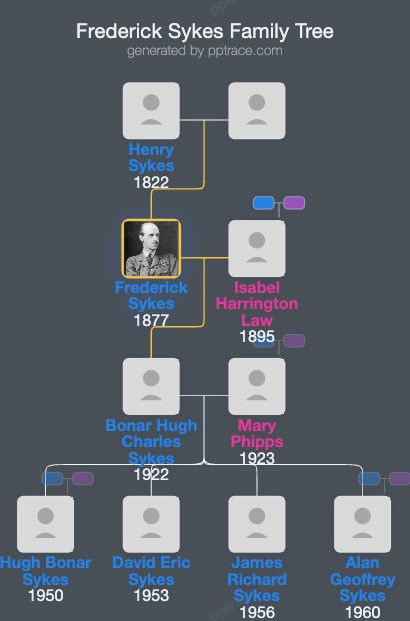
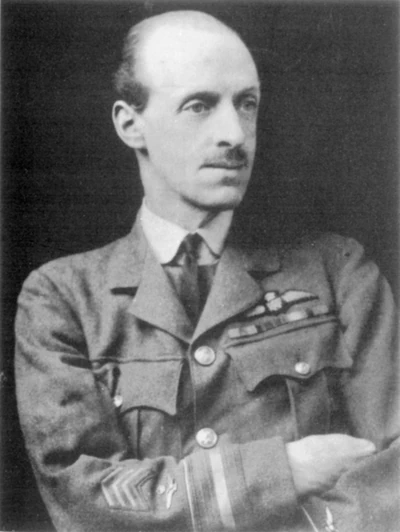
Sir Frederick Hugh Sykes (23 July 1877 – 30 September 1954) was a British military officer and politician. He was born to Henry Sykes and Margaret Sykes (née Sykes). His family included the artist Godfrey Sykes, who was his uncle.
Sykes initially engaged in civilian employment as a clerk and worked on a tea plantation in Ceylon. He enlisted as a trooper in the Imperial Yeomanry Scouts regiment of the British Army at the start of the Second Boer War. Following his capture during the war, he was forcibly marched across South Africa but was later abandoned and returned to British forces. In 1900, he was commissioned into Lord Roberts' Bodyguard but suffered a serious chest wound that resulted in his being invalided back to Great Britain. On 2 October 1901, he received a regular commission as a second lieutenant in the 15th Hussars, and on 7 March 1903, he was granted the local rank of lieutenant while posted to the West African Regiment. He was promoted to the substantive rank of lieutenant on 29 July 1903.
In 1904, Sykes obtained a ballooning certificate while attached to the Balloon Section of the Royal Engineers, indicating his early interest in aviation. He was restored to the establishment of the 15th Hussars on 22 September 1904. He later joined the Intelligence Staff in Simla, India, in 1905. He attended Staff College, Quetta, in autumn 1908, and was promoted to the rank of captain on 1 October 1908.
Sykes began flying lessons at Brooklands in 1910, earning Royal Aero Club certificate No. 96 in June 1911. He served as a staff officer to the Directorate of Military Operations at the War Office from 25 February 1911. He was involved in a sub-committee of the Committee of Imperial Defence that investigated the use of aircraft during wartime.
On 13 May 1912, Sykes was appointed Officer Commanding the Military Wing of the Royal Flying Corps with the temporary rank of major. His responsibilities included the recruitment and training of pilots. He approved the motto "Per Ardua ad Astra," which was subsequently adopted by the Royal Air Force as its motto. His role was later restyled as Commandant of the Military Wing of the Royal Flying Corps, with a temporary rank of lieutenant-colonel, on 9 July 1913.
At the outbreak of the First World War, Royal Flying Corps squadrons were deployed to France in August 1914. Sykes served as chief of staff to General Henderson, who commanded the RFC in the field, until December 1914, when Henderson resumed command of the RFC in the field. During this period, Sykes was promoted to brevet lieutenant colonel on 18 February 1915.
In July 1915, Sykes was appointed as the Officer Commanding the Royal Naval Air Service Eastern Mediterranean Station, becoming the air commander for the Gallipoli campaign. His report on the air situation in the Dardanelles led to the buildup of air forces that sank several Turkish ships. He was awarded the Companion of the Order of St Michael and St George (CMG) on 14 March 1916 and was mentioned in despatches shortly thereafter.
Throughout 1916, Sykes held various roles, including assistant adjutant and quartermaster-general of the 4th Mounted Division, and was awarded the Russian Order of St Vladimir, 4th Class, on 12 April 1916. He became assistant adjutant-general at the War Office on 9 June 1916, with responsibilities relating to organizing the Machine Gun Corps and manpower planning. He was promoted to temporary brigadier general on 8 February 1917 and then served as Deputy Adjutant and Quartermaster-General at the War Office from November 1917.
Sykes was appointed Chief of the Air Staff on 13 April 1918, a role in which he contributed to establishing the Royal Air Force. In June 1918, he received the brevet rank of colonel. After the end of World War I, Sykes proposed a large air force for the future, but his plans did not align with the post-war policy efforts led by Winston Churchill. Consequently, Churchill reinstated Sir Hugh Trenchard as Chief of the Air Staff on 1 January 1919.
Sir Frederick Hugh Sykes retired from active military service on 31 March 1919, with the rank of major general. He was appointed a Knight Commander of the Order of the Bath (KCB) on 1 January 1919, and his international honors included the Belgian Order of Leopold, the American Distinguished Service Medal, the Japanese Order of the Rising Sun, and the French Legion of Honour.
From 1919 to 1922, Sykes served as the Controller of Civil Aviation. In 1922, he published "Aviation in War and Peace," covering the evolution of aviation from pre-war to post-war periods, including civil aviation.
Transitioning into politics, Sykes was elected as the Conservative Member of Parliament for Sheffield Hallam during the November 1922 general election. He retained this seat in 1923 and 1924 elections but resigned in June 1928. Subsequently, he was appointed Governor of Bombay, serving from 1928 to 1933, and was made a Knight Grand Commander of the Order of the Indian Empire and a member of the Privy Council.
After his tenure in India, Sykes returned to Britain and engaged in business and public affairs. During the Second World War, he served as a Member of Parliament for Central Nottingham until 1945. He died on 30 September 1954.