Robert F. Kennedy
| Name | Robert F. Kennedy |
| Title | United States Senator from New York from 1965 to 1968 |
| Gender | Male |
| Birthday | 1925-11-20 |
| nationality | United States of America |
| Source | https://www.wikidata.org/wiki/Q25310 |
| pptrace | View Family Tree |
| LastUpdate | 2025-11-17T06:44:49.265Z |
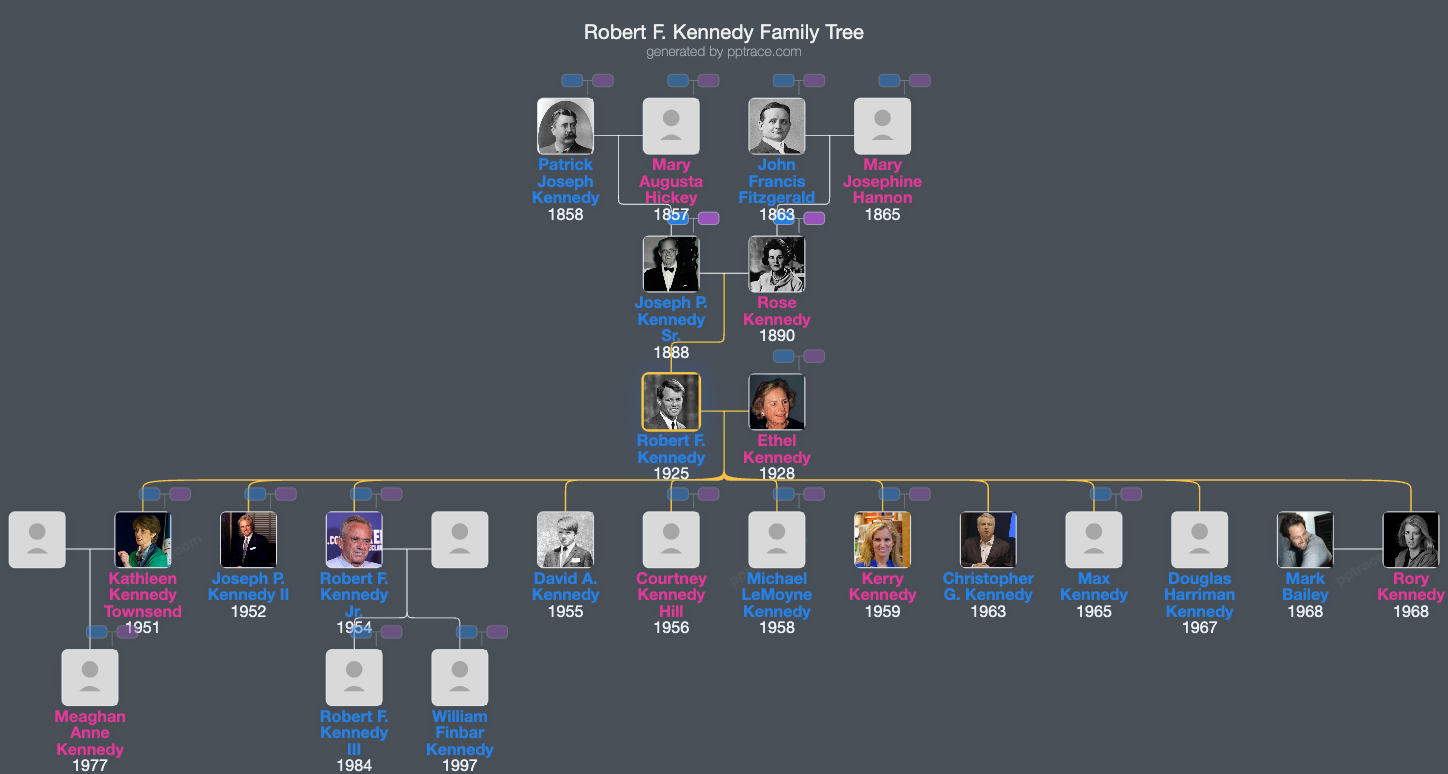
Family Tree
Tap  to expand more relatives
Introduction
Robert Francis Kennedy, born on November 20, 1925, in Brookline, Massachusetts, was the son of Joseph P. Kennedy Sr. and Rose Fitzgerald Kennedy. As a member of the prominent Kennedy family, he was the seventh of nine children. His family had Irish-American roots, with all four grandparents being children of Irish immigrants. Kennedy's early education involved attending various boarding schools in New England, including St. Paul's in Concord, New Hampshire; Portsmouth Priory in Portsmouth, Rhode Island; and Milton Academy near Boston, where he graduated in 1944.
Kennedy served in the United States Naval Reserve beginning in 1943, enlisting as a seaman apprentice shortly before his 18th birthday. He participated in training under the V-12 Navy College Program at Harvard University and Bates College, and served aboard the USS Joseph P. Kennedy Jr. after its commissioning in December 1945. He was honorably discharged from the Navy in May 1946.
Following his military service, Kennedy became involved in political campaigning, supporting his brother John's bid for the U.S. House of Representatives in 1946. He enrolled at Harvard University in 1946, where he studied and engaged in athletic activities, including attempting to make the Harvard Crimson football team. He later received his law degree from the University of Virginia.
Kennedy’s early career included work as a correspondent for The Boston Post and as a lawyer employed by the U.S. Department of Justice. He resigned from the Justice Department to manage his brother John F. Kennedy's successful 1952 Senate campaign. In 1953, Kennedy worked as an assistant counsel for the Senate committee chaired by Senator Joseph McCarthy.
Between 1957 and 1959, Kennedy served as the chief counsel for the Senate Labor Rackets Committee, during which he publicly challenged union leader Jimmy Hoffa regarding corruption within the Teamsters. He resigned from this position to help manage his brother John F. Kennedy's 1960 presidential campaign. Following John's election, Robert Kennedy was appointed the 64th United States Attorney General at age 35, becoming one of the youngest cabinet members in American history. During his tenure from 1961 to 1964, he was known for advocating civil rights, fighting organized crime, and participating in foreign policy issues related to Cuba, including authoring a book titled "Thirteen Days" about the Cuban Missile Crisis. He authorized limited wiretapping of civil rights leader Martin Luther King Jr. and the Southern Christian Leadership Conference.
After his brother John F. Kennedy's assassination in 1963, Robert Kennedy remained in office under President Lyndon B. Johnson for several months. In 1964, he was elected as a U.S. senator representing New York, defeating incumbent Kenneth Keating. His political positions included opposition to U.S. involvement in Vietnam and efforts to combat poverty through legislation aimed at revitalizing impoverished communities, such as the Bedford Stuyvesant Restoration project. Kennedy traveled internationally to promote human rights and social justice, establishing relationships with figures such as Martin Luther King Jr., Cesar Chavez, and Walter Reuther.
In 1968, Kennedy became a leading candidate for the Democratic presidential nomination. His campaign appealed to diverse groups, including impoverished communities, African Americans, Hispanics, Catholics, and young voters. His primary opponent was Senator Eugene McCarthy. After winning the California primary on June 5, 1968, Kennedy was shot by Sirhan Sirhan, a 24-year-old Palestinian, in Los Angeles in retaliation for Kennedy’s expressed support of Israel following the 1967 Six-Day War. Kennedy died on June 6, 1968, approximately 25 hours after the shooting. Sirhan Sirhan was subsequently arrested, tried, and convicted.
Kennedy was born into a family deeply involved in Democratic politics. His father, Joseph P. Kennedy Sr., was a businessman and politician, and his mother, Rose Fitzgerald Kennedy, was a socialite and philanthropist. His siblings included Joseph Jr., John F. Kennedy, Rosemary, Kathleen, Eunice, Patricia, Jean, and Ted. Kennedy’s childhood was characterized by extensive exposure to politics and public affairs, and he was raised in several notable residences, such as the Kennedy Compound in Hyannis Port, Massachusetts, La Querida in Palm Beach, Florida, and in London during his father’s ambassadorship from 1938 to 1940.
Kennedy's education was marked by attendance at various preparatory schools, where he developed a reputation as a shy, introspective, and determined student. His early interest in social issues was influenced by observing economic disparities and poverty during family visits to Hyannis Port. His service during World War II in the Navy, his subsequent studies in law, and his early involvement in political campaigns laid the foundation for his later career in law, politics, and civil rights advocacy.