Grover Cleveland
| Name | Grover Cleveland |
| Title | President of the United States (1885–89; 1893–97) |
| Gender | Male |
| Birthday | 1837-03-18 |
| nationality | United States of America |
| Source | https://www.wikidata.org/wiki/Q35171 |
| pptrace | View Family Tree |
| LastUpdate | 2025-11-17T06:41:27.618Z |
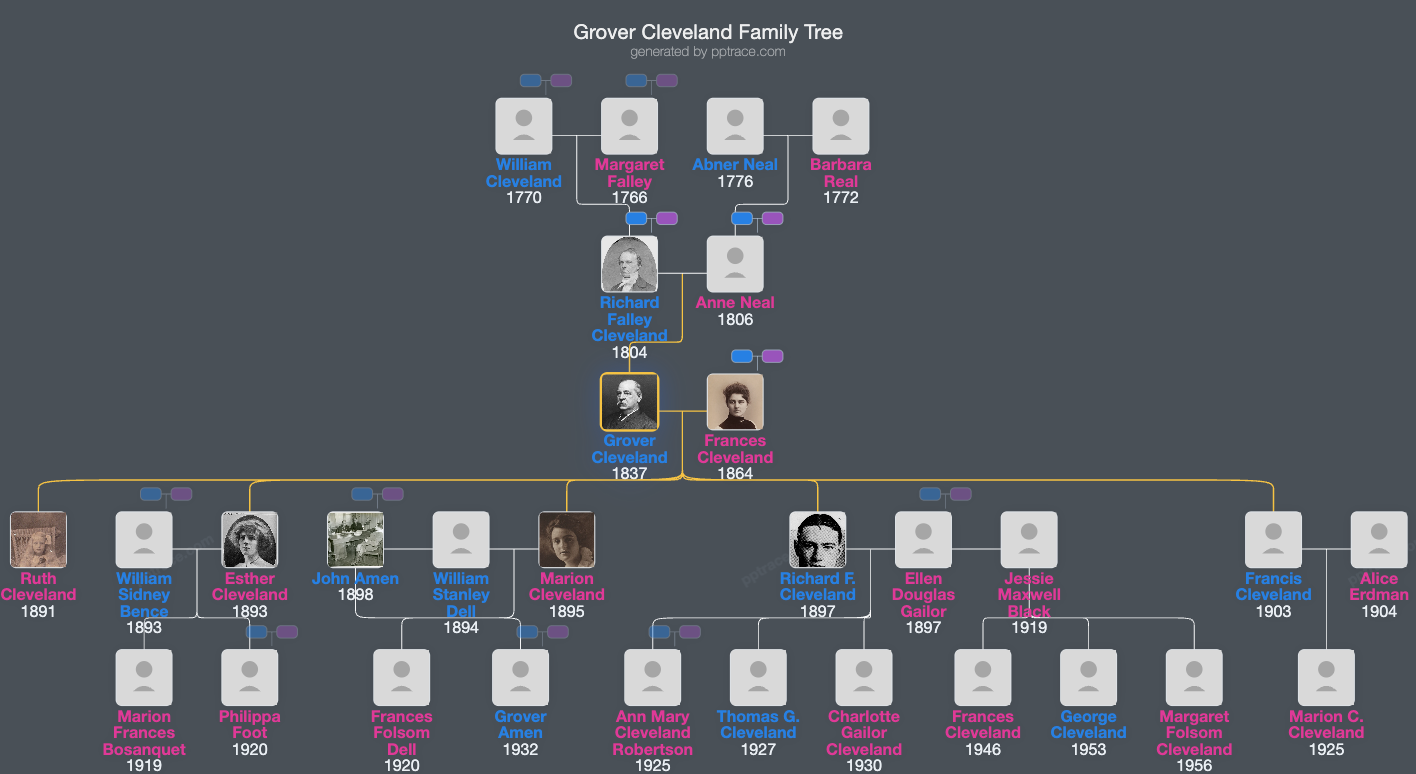
Family Tree
Tap  to expand more relatives
Introduction
Stephen Grover Cleveland was born on March 18, 1837, in Caldwell, New Jersey. His parents were Ann (née Neal) and Richard Falley Cleveland. His father was a Congregational and Presbyterian minister originally from Connecticut, and his mother was from Baltimore, the daughter of a bookseller. Cleveland's paternal ancestors emigrated from Ipswich, England, in 1635, and his maternal lineage included Anglo-Irish Protestants and German Quakers from Philadelphia. He was distantly related to General Moses Cleaveland, for whom the city of Cleveland, Ohio, was named. Cleveland was the fifth of nine children and was named after the first pastor of the First Presbyterian Church of Caldwell, where his father served as pastor. He was commonly known as Grover in his adult life.
In 1841, Cleveland's family relocated to Fayetteville, New York, where he spent much of his childhood. As a child, neighbors described him as lively and fond of outdoor activities. In 1850, the family moved to Clinton, New York, after his father accepted a position as district secretary for the American Home Missionary Society. Following his father's death in 1853 from a gastric ulcer, Cleveland left school to help support his family.
Cleveland's education began at Fayetteville Academy and Clinton Grammar School. After his father’s death, he briefly assisted as a teacher at the New York Institute for the Blind, where his brother William worked. In 1855, Cleveland decided to move west, initially arriving in Buffalo, New York, where he obtained a clerical position through his cousin Lewis F. Allen, an influential resident of Buffalo. Allen connected Cleveland with prominent figures, including the law firm of Rogers, Bowen, and Rogers, which had previously employed Millard Fillmore, the 13th president of the United States. Cleveland began reading law with this firm and was admitted to the New York State Bar in 1859.
He practiced law for three years before establishing his own practice in 1862. In January 1863, he was appointed assistant district attorney for Erie County, New York. During the Civil War, he chose to pay a substitute, George Benninsky, to serve in his place, as permitted by the Conscription Act of 1863. Cleveland gained a reputation for his dedication and effective legal work. Notably, he defended those involved in the Fenian raids without charge and successfully defended a libel suit against a Buffalo newspaper.
Cleveland entered politics as a Democrat, aligning with the party's principles. In 1870, he was elected sheriff of Erie County, serving from 1871 to 1873. His tenure as sheriff included overseeing executions, such as the hanging of Patrick Morrissey in 1872, which Cleveland carried out himself despite reservations. After his term, Cleveland resumed his law practice with partners including Lyman K. Bass and Wilson S. Bissell.
He sought higher political office, running unsuccessfully for District Attorney in 1865. In 1872, he was elected to Congress but soon resigned to focus on his legal career and local politics. Cleveland's early career demonstrated steady involvement in public service and law, setting the foundation for his future roles as mayor of Buffalo, governor of New York, and eventually, the president of the United States.