George Clavering-Cowper, 3rd Earl Cowper
| Name | George Clavering-Cowper, 3rd Earl Cowper |
| Title | British noble |
| Gender | Male |
| Birthday | 1738-01-01 |
| nationality | Great Britain |
| Source | https://www.wikidata.org/wiki/Q5537954 |
| pptrace | View Family Tree |
| LastUpdate | 2025-11-26T23:29:54.589Z |
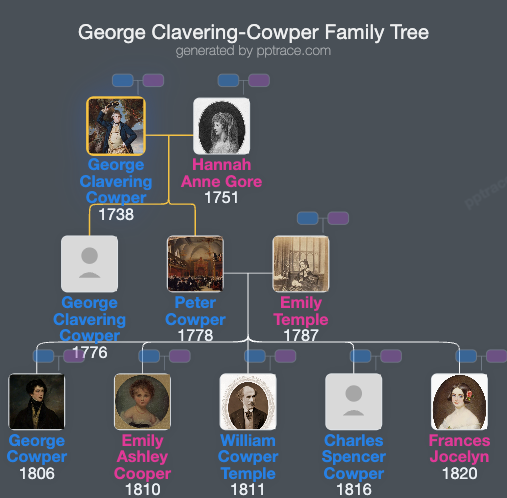
Family Tree
Tap  to expand more relatives
Introduction
George Nassau Clavering-Cowper, 3rd Earl Cowper, Prince of Nassau d'Auverquerque (26 August 1738 – 22 December 1789), was a British nobleman known for his residence and activities in Italy. He was the son of the 2nd Earl Cowper and was born in 1738. He was educated at Eton College, and his early travels involved a Grand Tour across France, the Netherlands, Germany, and Switzerland, accompanied by a tutor. During this journey, he was known as Viscount Fordwich and inherited a substantial estate from his grandfather, the Earl of Grantham, in 1754.
In December 1759, Fordwich was elected as a Member of Parliament for Hertford in the House of Commons. Despite this political role in England, he remained in Florence, establishing social and cultural ties there. His tutor, Jean Chastellain, was granted permission to leave him in 1760. Fordwich married Hannah Anne Gore, daughter of Charles Gore, on 2 June 1775. In 1780, he purchased the Villa Palmieri in Fiesole, overlooking Florence. The couple had three children, with their first two sons becoming the 4th and 5th Earl Cowper.
Cowper sought to strengthen his influence and position in Florence, aiming to serve as the British consul. He attempted to gain favor with the British monarchy by sending art copies and works of Italian art to England. His notable achievements included facilitating the erection of a monument on Machiavelli's tomb in the Church of Santa Croce and obtaining the title of Prince of the Holy Roman Empire (Sacri Romani Imperii Princeps de Cowper) from Emperor Joseph II, through the intercession of Grand Duke Leopold. His mother’s family name, Nassau d'Auverquerque, became part of his princely title, which he was authorized to adopt by royal license from King George III.
Cowper made only one brief return to England during his life, after more than thirty years abroad. His visit drew attention and was documented by Horace Walpole, who remarked on Cowper’s pride in his titles and awards from lesser German states.
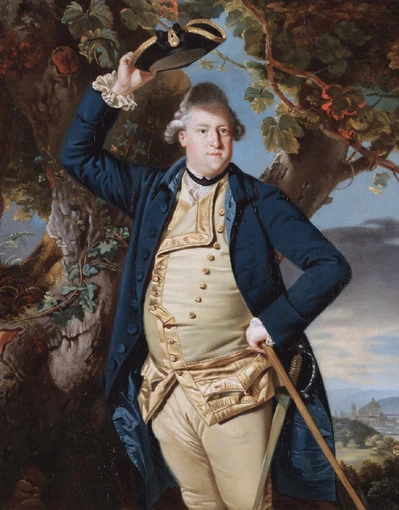
He accumulated a significant art collection, including masterpieces by Raphael—most notably the Small Cowper Madonna and the Niccolini-Cowper Madonna. The latter appears in Johann Zoffany’s painting, Tribuna of the Uffizi, in which Cowper is depicted evaluating the artwork. Zoffany, who was commissioned by the British royal family to paint the Tribuna, also produced portraits of Cowper and his fiancée, and included them in a family commission. Cowper's patronage extended to artists such as Giuseppe Antonio Fabrini, Francesco Zuccarelli, Jakob Philipp Hackert, Hugh Primrose Dean, and others. He acquired works by Fra Bartolommeo, and supported artists including Joseph Plura, Innocenzo Spinazzi, Hugh Douglas Hamilton, and Jacob More.
Cowper was also a benefactor to his relatives; his cousin William Cowper, a poet, received a generous annuity, and Count Volta benefited from a complete laboratory supplied by him, fostering scientific collaboration.
George Nassau Clavering-Cowper died on 22 December 1789 at the age of 51. His body was transported to England for burial in Hertford. His titles passed to his eldest son, George Augustus Cowper, 4th Earl Cowper. The subsequent inheritance of the earldom by his second son, Peter Leopold Louis Francis Nassau Cowper, as 5th Earl Cowper, in 1799, meant the title remained in the family for several decades.
His titles and honors included Earl Cowper, Viscount Fordwich, Baron Cowper of Wingham, Baronet (created in 1764), Fellow of the Royal Society (1777), Prince of the Holy Roman Empire (1778), and Knight of St. Hubert (1785).