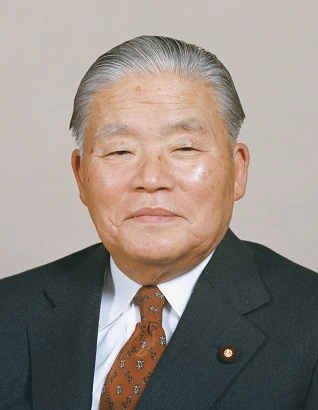
Masayoshi Ōhira
| Name | Masayoshi Ōhira |
| Title | Japanese politician (1910-1980) |
| Gender | Male |
| Birthday | 1910-03-12 |
| nationality | Japan |
| Source | https://www.wikidata.org/wiki/Q315568 |
| pptrace | View Family Tree |
| LastUpdate | 2025-11-17T06:46:50.968Z |
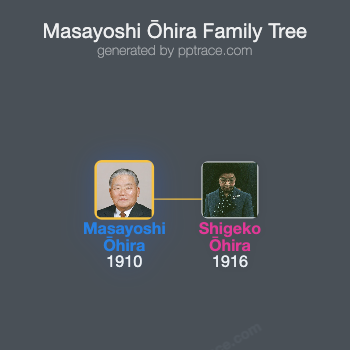
Family Tree
Tap  to expand more relatives
Introduction
Masayoshi Ōhira (大平 正芳, ōhira masayoshi) was born on 12 March 1910 in Wada, Kagawa Prefecture, Japan, which is present-day Kan'onji, Kagawa. He was the third son of Toshiyoshi Ōhira, a farmer and local government representative, and his wife Saku. His family was considered middle-class, though they experienced financial difficulties supporting eight children. Ōhira had two elder brothers, three elder sisters (one of whom died in infancy), a younger brother, and a younger sister.
At age 16, in 1926, Ōhira contracted typhoid fever, which resulted in a near-death experience. This incident contributed to his conversion to Christianity. He attended the Tokyo University of Commerce (now Hitotsubashi University) in 1933, studying economics, after winning two scholarships. Previously, he had assisted with family side jobs from a young age due to economic hardships.
In 1936, Ōhira entered the Ministry of Finance, beginning his career as a bureaucrat. During World War II, he remained in the Ministry of Finance. From 1949 to 1952, he served as the private secretary to Hayato Ikeda, who was then the Minister of Finance.
Ōhira was first elected to Japan's House of Representatives in 1952, representing the Liberal Party, which later became part of the Liberal Democratic Party (LDP). He was elected ten times in total. In 1957, he became a founding member of Ikeda's "Kōchikai" think tank and was considered Ikeda’s close confidant. He contributed to Ikeda's administration by helping to formulate and implement policies such as the Income Doubling Plan.
He served as Japan's Foreign Minister from 1962 to 1964 under Prime Minister Eisaku Satō. During this period, he managed negotiations that led to Japan's normalization of relations with South Korea in 1965. Upon Ikeda's death in 1964, Ōhira inherited control of Ikeda's faction within the LDP.
Between 1968 and 1970, Ōhira served as Minister of International Trade and Industry under Prime Minister Eisaku Satō. In 1972, he ran for the leadership of the LDP but was not successful; he then supported Kakuei Tanaka, who won the election. Following Tanaka's victory, Ōhira was appointed as Foreign Minister until July 1974, after which he was appointed Finance Minister under Prime Minister Takeo Miki.
In late 1978, Ōhira was elected president of the LDP. He was appointed as the 68th Prime Minister of Japan on 7 December 1978, succeeding Takeo Fukuda. His tenure as prime minister lasted until his death in 1980. In the 1979 general election, the LDP narrowly fell short of an majority but remained in power with support from independents, allowing Ōhira to continue as Prime Minister.
A no-confidence vote was passed against his government on 16 May 1980, with 243 votes in favor and 187 against. Despite expectations that the motion would fail, the vote passed, with some LDP members abstaining. Facing a choice between resignation and calling new elections, Ōhira opted to dissolve the Diet and campaign anew.
During the election campaign, Ōhira's health declined; he was hospitalized with exhaustion on 31 May 1980. He died of a heart attack on 12 June 1980, ten days before the scheduled general election. Following his death, Chief Cabinet Secretary Masayoshi Ito served as acting deputy. The LDP benefited from the sympathy vote, and Zenkō Suzuki succeeded Ōhira as Prime Minister after the election.
Personal details include his religious conversion to Christianity during his university years; some reports suggest he was affiliated with the Anglican Church in Japan during the 1970s.
Honors received include the Grand Cordon of the Order of the Chrysanthemum (posthumously awarded on 12 June 1980) and the Golden Pheasant Award from the Scout Association of Japan (1980). An outdoor Japanese garden in Mexico City is named after him. Foreign honors include the Order of Leopold from Belgium (1964), Honorary Grand Commander of the Order of the Defender of the Realm from Malaya (1964), and the Order of the Southern Cross from Brazil (1976).