Montgomery M. Taylor
| Name | Montgomery M. Taylor |
| Title | United States Navy admiral |
| Gender | Male |
| Birthday | 1869-10-13 |
| nationality | United States of America |
| Source | https://www.wikidata.org/wiki/Q6905748 |
| pptrace | View Family Tree |
| LastUpdate | 2025-11-17T06:39:31.705Z |
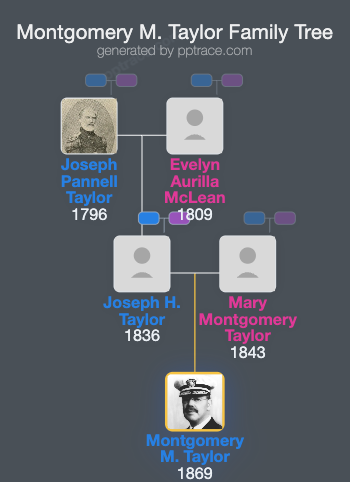
Family Tree
Tap  to expand more relatives
Introduction
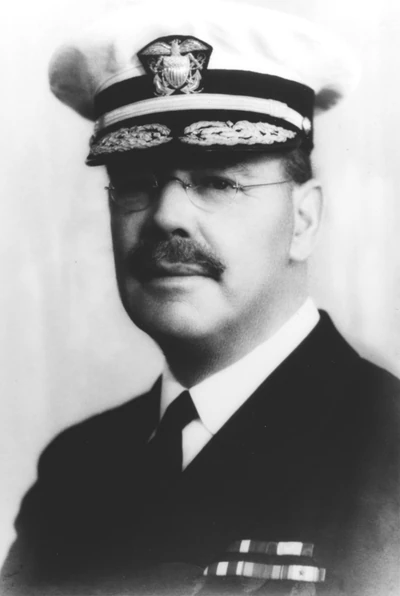
Montgomery Meigs Taylor (13 October 1869 – 21 October 1952) was an admiral in the United States Navy. His service period extended from 1890 to 1933, during which he participated in notable military conflicts and held several command positions in the Navy.
Early Life:
Montgomery M. Taylor was born in Washington, D.C., on October 13, 1869. His parents were Joseph Hancock and Mary Meigs Taylor. He was born in the house of his grandfather, Montgomery C. Meigs, who served as the Quartermaster General of the United States Army during the American Civil War. He was also named after his grandfather. His grand-uncle was President Zachary Taylor. Taylor's brother, John R. M. Taylor, was an officer in the United States Army during the Philippine–American War. Taylor was raised in Washington, D.C., and attended public schools during his early education.
Naval Career:
Taylor was appointed to the United States Naval Academy in 1886, where he was an outstanding halfback on the inaugural football team. He graduated in 1890. His initial training was intended to be aboard the armed steamer USS Galena; however, she was wrecked before he could serve on her. Following this, he served aboard several ships, including the screw sloop USS Richmond, the USS Enterprise, and the protected cruiser USS Chicago.
In 1892, Taylor was commissioned as an ensign. His early assignments included aboard the protected cruiser USS Baltimore, with short stints on the screw sloops USS Monongahela and USS Essex, and the steamer USS Thetis. Around 1900, he joined the gunboat USS Yorktown in Shanghai, China, and participated in the Spanish–American War as a battery commander aboard USS Olympia during the Battle of Manila Bay on May 1, 1898. After the war, Taylor was promoted to lieutenant in 1899.
Subsequent assignments included commanding the USS Pampanga during the Philippine–American War from 1900 to 1902, and later command of the USS Hopkins and USS Siren. He also commanded the 2nd Torpedo Flotilla of the Atlantic Fleet and served as executive officer aboard USS Salem and USS Milwaukee. He was promoted to lieutenant commander on July 1, 1905, and to commander on March 4, 1911.
Rise in the Ranks:
After 21 years at sea, Taylor transitioned to land assignments, becoming aide to the commandant of the Brooklyn Navy Yard from 1911 to 1913. He commanded the auxiliary cruiser USS Buffalo from 1913 to 1915, cruising through the Caribbean and along Central America before heading to Alaska. In 1914, with the outbreak of World War I in Europe, Taylor positioned himself for potential wartime needs.
He attended the Naval War College from 1915 to 1916, then received command of the battleship USS Maine in 1916, shortly before the United States entered World War I. During the war, Taylor commanded the battleship USS Florida and operated in cooperation with the British Grand Fleet. For his service, he was awarded the Navy Distinguished Service Medal.
Post-War Assignments:
After the war, Taylor served on the staff of the Naval War College from 1919 to 1921. In June 1922, he was appointed commander of the 15th Naval District and the Naval Operating Base at Coco Solo in the Panama Canal Zone. He returned to the United States in 1923 and became a member of the Naval Examining and Retiring Board.
Taylor was promoted to rear admiral on October 1, 1922. He served as director of fleet training from 1925 to 1927, commanding the 3rd Battleship Division of the Battle Fleet, with USS Pennsylvania as his flagship. In 1926, he was given command of the Scouting Fleet, operating primarily cruisers, destroyers, and an aircraft carrier, USS Langley. He was promoted to vice admiral in 1928.
In the Office of Naval Operations, Taylor led the War Plans Division and was involved in strategic planning, though with limited influence on wartime policies. He was known for his belief that Japan deserved American friendship and for his distrust of Chinese Nationalist forces. He developed a friendship with Japanese Admiral Kichisaburo Nomura during this period.
Command of the Asiatic Fleet:
Taylor was promoted to admiral and became Commander-in-Chief of the United States Asiatic Fleet (CICAF) on September 1, 1931, with his appointment effective from April 2, 1931. His leadership was marked by a belief in non-intervention and a cautious approach to regional conflicts, including the Japanese invasion of Manchuria initiated in September 1931.
During his tenure, Taylor took several independent actions without prior approval from higher authorities, such as dispatching destroyers to Shanghai and mobilizing Marine forces aboard his ships following the Mukden Incident. His approach aimed to position the United States for potential intervention, although he maintained a policy of sitting tight and not engaging actively in regional conflicts.
Taylor's command faced incidents such as the shelling of an Italian Navy ship and coordination efforts during escalating tensions in the region. His time as CICAF reflected a complex balance of strategic positioning and adherence to non-interventionist policies prevailing in U.S. foreign policy at the time.
Montgomery M. Taylor died on October 21, 1952.