Edward Pellew, 1st Viscount Exmouth
| Name | Edward Pellew, 1st Viscount Exmouth |
| Title | Royal Navy admiral (1757-1833) |
| Gender | Male |
| Birthday | 1757-04-19 |
| nationality | United Kingdom of Great Britain and Ireland |
| Source | https://www.wikidata.org/wiki/Q335338 |
| pptrace | View Family Tree |
| LastUpdate | 2025-11-26T23:25:53.829Z |
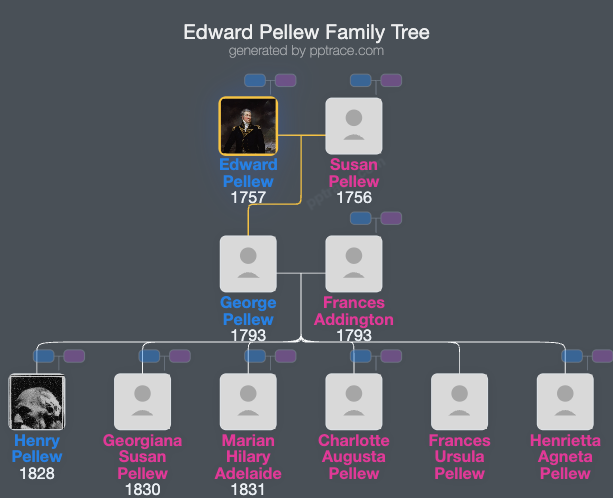
Family Tree
Tap  to expand more relatives
Introduction
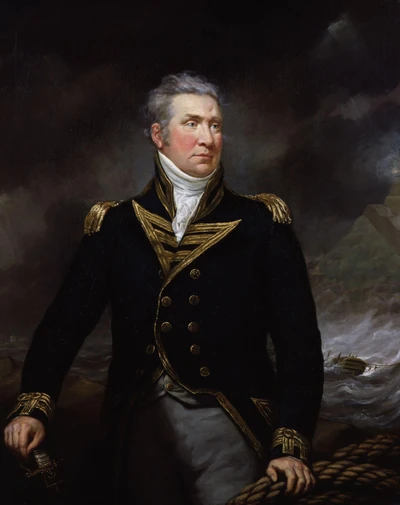
Edward Pellew, 1st Viscount Exmouth, GCB, was born on 19 April 1757 in Dover, England, and died on 23 January 1833. He served as a Royal Navy officer and politician with a career spanning the American War of Independence, the French Revolutionary Wars, and the Napoleonic Wars.
Family Background and Childhood
Pellew was the second son of Samuel Pellew (1712–1764), who commanded a Dover packet, and his wife, Constantia Langford. The Pellew family was of Cornish origin, descending from a family that originally came from Normandy and had resided in Cornwall for several centuries. His grandfather, Humphrey Pellew (1650–1721), was a merchant and ship owner residing at Flushing manor-house in Mylor parish. The family held property and a tobacco plantation in Maryland; part of Annapolis was situated on what was once the Pellew estate. Following his father's death in 1764, the family relocated to Penzance. Pellew was educated at Truro Grammar School for several years.
As a youth, Pellew was known to be pugnacious, which reportedly did not endear him to his headmaster. He ran away to sea at age 14 but shortly deserted due to perceived unfair treatment of another midshipman. Pellew described himself as "pock-marked, ugly, uninteresting and uneducated." Naval historian accounts describe him as "tough, brave, skilful, lucky, and unscrupulous."
Early Naval Career
Pellew entered the Royal Navy in 1770 aboard HMS Juno with Captain John Stott, embarking on a voyage to the Falkland Islands. In 1772, he served on HMS Alarm in the Mediterranean for three years. After a quarrel with his captain, he was put ashore at Marseille, where he obtained passage to Lisbon and returned to England. He later served aboard HMS Blonde under Captain Philemon Pownoll, which carried General John Burgoyne to America in 1776.
During the American campaign, Pellew served on Lake Champlain, participating in the Battle of Valcour Island on 11 October 1776, where he took command of the Carleton tender after its officers were wounded. His actions in the battle led to his immediate appointment to command the vessel. Promises of promotion as lieutenant came from Lord Howe and Lord Sandwich as Pellew advanced his career.
In 1777, Pellew participated in the Saratoga campaign during the American Revolution, where his youngest brother John was killed. Following Burgoyne's surrender, Pellew was taken prisoner but was later repatriated. He returned to England and was promoted to lieutenant on 9 January 1778. Assigned to the Princess Amelia guardship at Portsmouth, he sought seagoing service but was limited by the terms of Saratoga's surrender.
In 1779, Pellew served aboard the HMS Licorne in Newfoundland waters and later in HMS Apollo. Notably, on 15 June 1780, during an engagement with a French privateer off Ostend, Pellew continued the fight after Captain Pownoll was killed, leading to a promotion to command the sloop Hazard on 1 July 1780. His subsequent service included commanding the Pelican and the Artois, with deployments around Brittany and Newfoundland.
Between 1786 and 1789, Pellew commanded the frigate Winchelsea and later the Salisbury as flag captain to Vice-Admiral Milbanke. He briefly attempted farming on property owned by his brother near Helston and declined an offer to serve in the Russian navy.
French Revolutionary Wars and Naval Achievements
With the outbreak of war in 1793, Pellew quickly commissioned the frigate HMS Nymphe. During her service, he engaged and captured the French frigate Cléopâtre on 18 June 1793, an action that resulted in his being knighted by the king. Pellew transferred to HMS Arethusa in December 1793, which participated in notable engagements such as the destruction of the French frigate Pomone in 1794 and operations in the western Atlantic.
In 1795, Pellew assumed command of HMS Indefatigable, becoming closely associated with her during the war. He was recognized for his swimming ability and quick actions in rescuing crew members overboard. One significant incident involved rescuing troops and civilians from the East Indiaman Dutton, which had run aground near Plymouth, during heavy seas on 26 January 1796.
Family and Other Details
Pellew's younger brother, Israel Pellew, also pursued a career in the navy. During his life, Edward Pellew held political roles and was elevated to the peerage as the 1st Viscount Exmouth.
(Note: Certain personal and subjective descriptions from original sources, such as Pellew's appearance and character, have been omitted to maintain an objective tone.)