Susan Pellew
| Name | Susan Pellew |
| Title | (1756-1837) |
| Gender | Female |
| Birthday | 1756-00-00 |
| nationality | — |
| Source | https://www.wikidata.org/wiki/Q28924084 |
| pptrace | View Family Tree |
| LastUpdate | 2025-11-26T12:31:23.765Z |
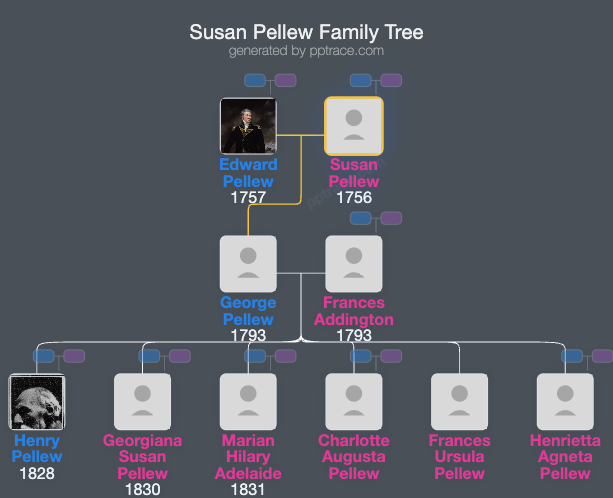
Family Tree
Tap  to expand more relatives
Introduction
Susan, Viscountess Pellew (née Frowde), was born in 1756 in East Knoyle, Wiltshire, England. She was the daughter of James Frowde, Esq. Details regarding her early life are limited in available records.
In 1782, Susan Frowde met Edward Pellew. They married on 28 May 1783, when she was reportedly approximately eighteen years old, and he was twenty-six. Following their marriage, the couple initially resided in Truro, Cornwall. Subsequently, they moved to New Road in Flushing, near Falmouth, where Susan's brother-in-law, Samuel Pellew, served as Collector of Customs.
The marriage produced six children: Emma Mary Pellew (born 18 January 1785, died March 1835); Pownoll Bastard Pellew (later the 2nd Viscount Exmouth; born 1 July 1786, died 2 December 1833); Julia Pellew (born 28 November 1787, died 26 December 1831); Fleetwood Broughton Reynolds Pellew (later an admiral and knight; born 13 December 1789, died 28 July 1861); George Pellew (born 3 April 1793, died 13 October 1866); and Edward William Pellew (later a minister; born 3 November 1799, died 29 August 1869).
Following Pellew's notable naval victory against the French frigate Cléopâtre on 18 June 1793, King George III awarded Susan a £150 annuity from the Privy Purse to help cover additional household expenses related to her husband's knighthood. Pellew was knighted for his role in this naval engagement. In 1814, when Edward Pellew was elevated to the peerage as Baron Exmouth of Canonteign, Susan acquired the title of Lady Exmouth.
In 1797, after Pellew's continued successes, notably the defeat of the French 74-gun ship Droits de l'Homme at the Battle of 13 January 1797, the family moved from their residence in Flushing to Trefusis Manor, which was rented at the time. Throughout her husband's naval career, Susan offered support by managing their estate and caring for their family during his absences at sea. She was known to oppose Pellew's political pursuits; notably, when he was appointed Member of Parliament for Barnstaple in 1802, she chose not to accompany him to London.
When Pellew was appointed Commander-in-Chief of the East Indies Station in 1805, Susan opted to remain in England with their children. Despite the physical separation, they maintained a regular correspondence. During Pellew's service in the East Indies, Susan took in Jane Smith, a young woman of reduced circumstances, whom she and Pellew regarded as their adopted daughter.
In 1804, Susan purchased Hampton House in Plymouth, which she occupied until selling it in 1811 to Reverend Robert Hawker. In 1812, she acquired two other properties: Canonteign House, where her eldest son Pownoll and his wife Eliza resided; and West Cliffe House (now Bitton House) in Teignmouth, where the family lived after Pellew's retirement and until his death in 1833.
Susan was generally opposed to the posthumous biography of Pellew, which was commissioned by his brother Samuel and authored by Edward Osler. She reportedly destroyed most of Pellew's personal correspondence.
She died on 29 October 1837, four years after her husband’s death, and was buried alongside him at Christow in Devon.