Frederick Grey
| Name | Frederick Grey |
| Title | British Royal Navy admiral (1805-1878) |
| Gender | Male |
| Birthday | 1805-08-23 |
| nationality | United Kingdom of Great Britain and Ireland |
| Source | https://www.wikidata.org/wiki/Q5497891 |
| pptrace | View Family Tree |
| LastUpdate | 2025-11-26T22:55:10.809Z |
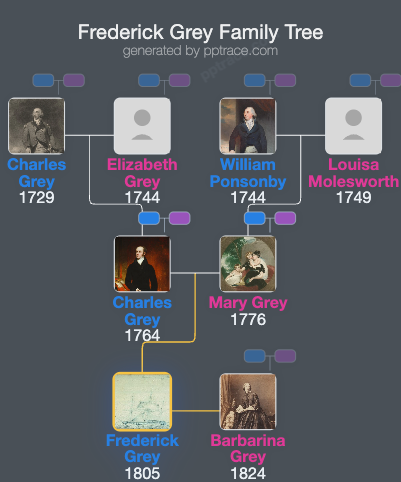
Family Tree
Tap  to expand more relatives
Introduction
Admiral Sir Frederick William Grey GCB was born on 23 August 1805. He was the son of Charles Grey, 2nd Earl Grey, who served as Prime Minister of the United Kingdom during the 1830s, and Mary Elizabeth Ponsonby, daughter of William Ponsonby, 1st Baron Ponsonby. He entered the Royal Navy in January 1819.
Grey's early naval career commenced aboard the fifth-rate HMS Naiad in the Mediterranean Fleet as a midshipman. In 1824, he participated in actions against pirates off Cap Bon, Tunisia. He was promoted to lieutenant on 7 April 1825 and was transferred to the fifth-rate HMS Sybille within the Mediterranean Fleet that same month. Later, he served aboard the sixth-rate HMS Volage on the South America Station beginning in September 1825.
He received a promotion to commander on 17 April 1827 and took command of the sloop HMS Heron on the South America Station. Subsequently, Grey was promoted to captain on 19 April 1828. He commanded several ships, including the sixth-rate HMS Actaeon in the Mediterranean Fleet starting in November 1830, the fourth-rate HMS Jupiter on the East Indies and China Station from August 1835, and the fifth-rate HMS Endymion on the same station from October 1840. During his service aboard HMS Endymion, Grey participated in the First Opium War and was appointed a Companion of the Order of the Bath on 24 December 1842.
In March 1854, Grey assumed command of the second-rate HMS Hannibal, during which he transported 10,000 French troops to Åland off Finland and subsequently deployed to the Bosphorus as the principal agent of transports during the Crimean War. He was promoted to rear-admiral on 22 January 1855. On 2 January 1857, he was advanced to Knight Commander of the Order of the Bath.
In April 1857, Grey was appointed Commander-in-Chief of the Cape of Good Hope and West Coast of Africa Station, commanding from the third-rate HMS Boscawen. He was promoted to vice-admiral on 5 August 1861. In June 1861, Grey became First Naval Lord under the Second Palmerston ministry. During his tenure, he emphasized the professional management of the Navy, prioritizing non-political appointments and promotions, and published a pamphlet titled "Admiralty Administration, 1861–1866," which outlined his proposed reforms. These reforms included the process that senior naval promotions and appointments should be discussed and agreed upon collectively by the Naval Members of the Admiralty Board before recommendations were sent to the First Lord.
Further promotions included reaching full admiral on 24 April 1865 and being advanced to Knight Grand Cross of the Order of the Bath on 28 March 1865. Grey resigned from his position as First Naval Lord in July 1866 following the fall of the second Russell ministry.
He resided at Lynwood House in Sunningdale, Berkshire, where he died on 2 May 1878.
In 1846, Grey married Barbarina Charlotte Sullivan, daughter of Reverend Frederick Sullivan and Arabella Wilmont. She was the sister of Admiral Sir Francis Sullivan, 6th Baronet. The marriage produced no children. Lady Grey died at her residence, Fairmile House in Cobham, on 23 March 1902.