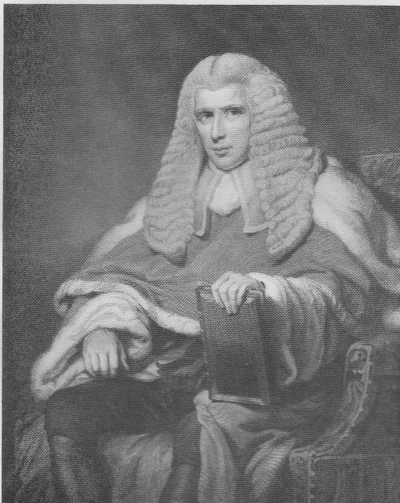
Edward Hall Alderson
| Name | Edward Hall Alderson |
| Title | lawyer and jurist |
| Gender | Male |
| Birthday | 1787-00-00 |
| nationality | United Kingdom of Great Britain and Ireland |
| Source | https://www.wikidata.org/wiki/Q5343278 |
| pptrace | View Family Tree |
| LastUpdate | 2025-11-26T23:30:35.903Z |
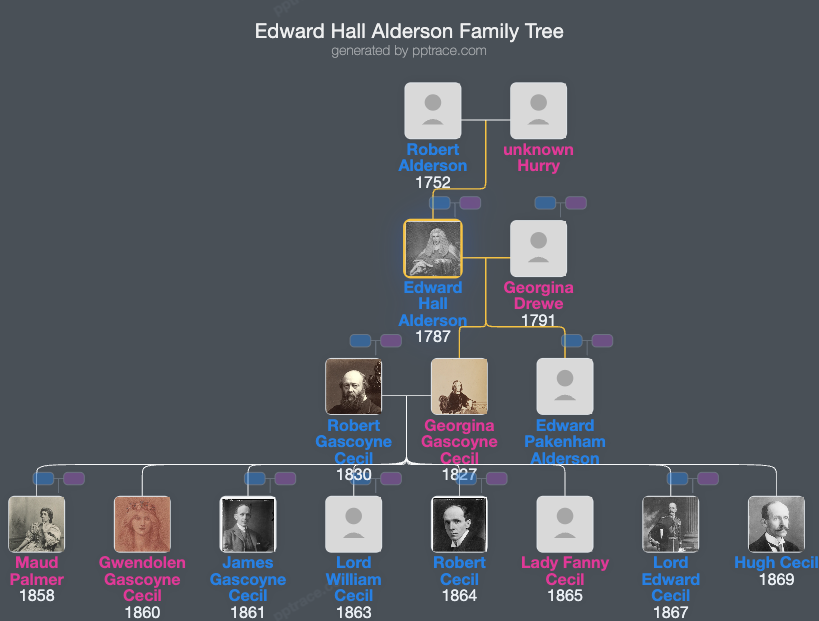
Family Tree
Tap  to expand more relatives
Introduction
Sir Edward Hall Alderson was born in 1787 and baptised on 11 September of that year. He was born in Great Yarmouth, England. His father was Robert Alderson, a barrister and recorder who died in 1833, and his mother was Elizabeth née Hurry, who died in 1791. Alderson's childhood was characterized by instability, as he lived with various relatives and attended Charterhouse School unhappily. He was tutored by Edward Maltby and demonstrated academic aptitude in mathematics and classics during his education at Gonville and Caius College, University of Cambridge. Before taking his final exams, he received the news of his sister Isabella’s death. In 1809, he graduated as senior wrangler, was awarded the First Smith's Prize, First Medallist, and Chancellor’s Gold Medallist. During his studies, he was an active debater and reader, winning multiple prizes including the Middle Bachelors, Latin Prize for Comparison of Ancient Dialogues with Modern, Members Prize, and Senior Bachelors Prize. These achievements led to his election as a fellow of the university.
Alderson was apprenticed under Joseph Chitty and was called to the bar in 1811 at the Inner Temple. He began practicing on the northern circuit, establishing a significant legal practice. Between 1817 and 1822, he worked with Richard Barnewall as a law reporter. On 26 October 1823, he married Georgina Drewe, who died in 1871. The marriage produced numerous children.
In 1825, Alderson gained early recognition as an able advocate when he represented opponents of the proposed Liverpool and Manchester Railway during the committee stage of the private bill. He cross-examined George Stephenson on the railway's designs; his effective questioning contributed to the bill’s defeat and delayed the railway’s construction. Stephenson later expressed regret during the proceedings.
Alderson’s judicial career commenced with his appointment to the Common Law Commission in 1828. In 1830, he became a judge of the Court of Common Pleas, receiving a knighthood. He was appointed a Baron of the Exchequer in 1834 and transferred to the Court of Chancery in 1841. His legal philosophy supported the adaptability of common law to societal changes. He was regarded as a popular, analytical, and direct judge, though he showed little interest in seeking the title of Queen’s Counsel or entering Parliament.
Throughout his career, Alderson was involved in criminal and civil cases. Notably, he contributed to the suppression of reform movements like the Luddites and Chartists and believed in the rehabilitation of offenders. He was a supporter of the Church of England, a close associate of Bishop Charles James Blomfield, and advocated for the legal subjection of the Church of England. He also promoted the use of affirmation as an alternative to oaths for witnesses and opposed the expansion of secular education.
Alderson resided in both London and Lowestoft, where he engaged in poetry writing in English and Latin and maintained correspondence with novelist Amelia Opie. He followed horse racing avidly. In December 1856, while presiding at Liverpool assizes, he learned of a serious injury to one of his sons, which led to his collapse. He died on 27 January 1857 from a brain disease at his London residence. He was buried at St Mary Magdalen’s Church in Risby near Bury St Edmunds.
His daughter Georgina married Robert Gascoyne-Cecil, 3rd Marquess of Salisbury, in 1857. Gascoyne-Cecil's father, the 2nd Marquess, initially opposed the marriage due to Georgina’s lack of wealth and social standing. His grandson, Edward Alderson, served as Clerk to the Parliaments from 1930 to 1934.
Alderson's judicial opinions include cases such as Miller v. Salomons, R v. Pritchard (1836), Hodge’s Case (1838), Winterbottom v. Wright (1842), Wood v. Peel (1844), and Hadley v Baxendale (1854). His rulings contributed to legal doctrines related to oath validity, circumstantial evidence, negligence, the scope of damages, and standards of care.