Morihiro Hosokawa
| Name | Morihiro Hosokawa |
| Title | 50th Prime Minister of Japan |
| Gender | Male |
| Birthday | 1938-01-14 |
| nationality | Japan |
| Source | https://www.wikidata.org/wiki/Q315555 |
| pptrace | View Family Tree |
| LastUpdate | 2025-11-17T06:47:31.253Z |
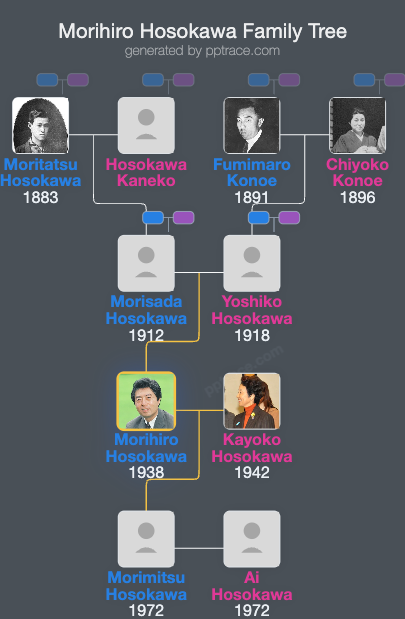
Family Tree
Tap  to expand more relatives
Introduction
Morihiro Hosokawa (細川 護煕, Hosokawa Morihiro) was born on 14 January 1938 in Tokyo, Japan. He is a member of the Hosokawa family, which historically ruled parts of present-day Kumamoto Prefecture from the 17th to the 19th centuries. His maternal grandfather was Prince Fumimaro Konoe, who served as Prime Minister of Japan from 1937 to 1939 and again from 1940 to 1941. Hosokawa is a descendant of Prince Kuni Asahiko, making him a third cousin of Emperor Naruhito. He is also related to Christian heroine Gracia Hosokawa.
He completed his undergraduate education at Sophia University, earning an LL.B. degree in 1961. After graduation, Hosokawa worked as a journalist for the Asahi Shimbun newspaper for five years. His early political career included an unsuccessful run in the 1969 general election. In 1971, he was elected to the House of Councillors as a representative of Kumamoto Prefecture, with campaign funding from Kakuei Tanaka, a prominent member of the Liberal Democratic Party (LDP).
Hosokawa served two terms in the National Diet before resigning in 1983 to become the governor of Kumamoto Prefecture, a position he held until 1991. During his governorship, he highlighted concerns regarding the influence of bureaucracy in Tokyo, pursued economic reforms, and strengthened environmental laws.
In May 1992, amid a campaign contribution scandal, Hosokawa founded the Japan New Party (JNP), a reformist political entity. This party secured four seats in the 1992 House of Councillors election, with Hosokawa himself assuming one of those seats. The 1993 general election resulted in the LDP losing its majority in the House of Representatives for the first time in 38 years. The LDP government led by Kiichi Miyazawa was replaced by an eight-party coalition government led by Hosokawa, which included members from the newly formed JNP, the Japan Socialist Party, the Japan Renewal Party, Komeito, the Democratic Socialist Party, the Socialist Democratic Federation, RENGO, and the New Party Sakigake.
Hosokawa was appointed Prime Minister in July 1993 and served until April 1994. Notable during his tenure were efforts to reform Japan's electoral system, promote diplomatic reconciliation with Asian neighbors, and address Japan’s wartime history. In his first news conference as Prime Minister, he made a notable statement acknowledging Japan's wartime aggression. He subsequently visited South Korea in November 1993, where he publicly apologized for Japan's actions during the war, and in March 1994, he visited China, signing an environmental cooperation agreement. His diplomatic initiatives drew both support and opposition domestically; in May 1994, an extremist attempted to assassinate him during a speech.
Hosokawa also engaged in domestic policy reforms, including efforts to curb political corruption via electoral law changes, measures to support disabled persons, occupational safety regulations, and tax policy adjustments. His administration proposed increasing the consumption tax from 3% to 7% to address economic issues, but this was initially retracted amid internal disagreements, and the tax hike was eventually implemented in 1997 under subsequent leadership.
His resignation in April 1994 was precipitated by the revelation that he had received a 100-million-yen loan from a trucking company linked to organized crime. He defended the loan as a repayment, but allegations persisted, undermining his position and leading to his resignation.
Following his departure from the premiership, Hosokawa remained active in politics to some extent, joining other parties such as the New Frontier Party and the Democratic Party of Japan before retiring from active political life. He also made an unsuccessful bid for Governor of Tokyo in 2014.
Since his father's death in 2005, Hosokawa has served as the 18th head of the main branch of the Hosokawa clan, which held titles including Lord of Higo and marquess. After retiring from politics, he engaged in activities as a potter and tea master.