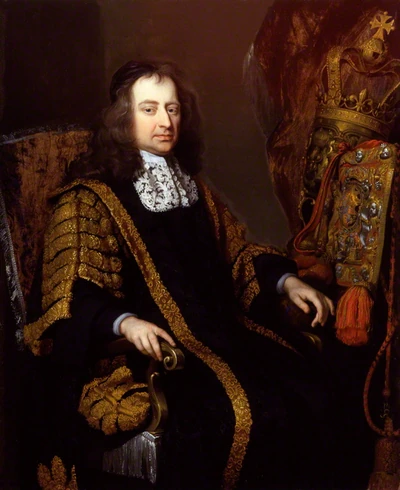
Francis North, 1st Baron Guilford
| Name | Francis North, 1st Baron Guilford |
| Title | English politician and Baron; (1637-1685) |
| Gender | Male |
| Birthday | 1637-01-01 |
| nationality | — |
| Source | https://www.wikidata.org/wiki/Q5868310 |
| pptrace | View Family Tree |
| LastUpdate | 2025-11-26T23:24:57.903Z |
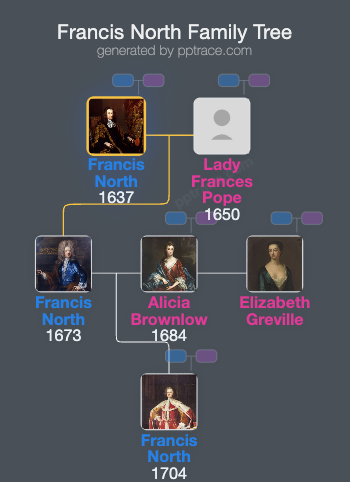
Family Tree
Tap  to expand more relatives
Introduction
Francis North, 1st Baron Guilford, was born on 22 October 1637 and died on 5 September 1685. He was an English politician and judge, the third son of Dudley North, 4th Baron North, and his wife Anne Montagu. Anne Montagu was the daughter of Sir Charles Montagu of Boughton House and Mary Whitmore.
North received his education at St John's College, Cambridge. He was admitted to the Middle Temple on 27 November 1655 and was called to the Bar on 28 June 1661. He held several legal offices throughout his career, including Solicitor-General in 1671, Attorney-General in 1673, and Chief Justice of the Common Pleas in 1675. In 1679, he became a member of the Privy Council Ministry and subsequently joined the Cabinet after the dissolution of the ministry.
In 1682, North was appointed Lord Keeper of the Great Seal, an office equivalent to the Lord Chancellor at that time. In 1683, he was created Baron Guilford. He was known for his wide cultural interests and was a committed royalist, supporting the royal prerogative and its historical precedents. Despite his royalist stance, he opposed some absolutist tendencies of political figures such as Sunderland and Jeffreys.
North participated as a judge in some of the trials related to the Popish Plot, a series of anti-Catholic accusations and trials. Like others involved, he has been accused of credulity towards the informers, notably Titus Oates. Commentary suggests that senior Chief Justice Sir William Scroggs exerted significant influence over the proceedings. During this period, North presided over the trial of Stephen College, accused of high treason, in August 1681, and is noted to have virtually directed the jury to convict him. College was found guilty and hanged; North’s conduct in this trial attracted criticism due to the reliance on evidence considered flimsy and previously dismissed by a grand jury.
Guilford was known to harbor antipathy towards Lord Jeffreys and regarded Sir Robert Wright as unfit for judicial office. Despite his objections, North remained in office after Wright was appointed Chief Justice, a decision that has been subject to scrutiny. Some interpretations suggest that North’s continued tenure was motivated by a desire to prevent Jeffreys from obtaining the Lord Chancellorship.
His reputation was generally of integrity, though critics have sometimes accused him of self-importance and lacking humor. Notably, he was reportedly upset by a rumor suggesting he had been seen riding on a rhinoceros, a charge that he dismissed as foolish. He was a critic of Sunderland, who regarded him with hostility, describing him as partial, unreasonable, corrupt, arbitrary, and ignorant. However, these characterizations are not widely supported, and North's reputation is generally considered respectable in matters of integrity and mental capacity.
North died unexpectedly at his country estate, Wroxton Abbey near Banbury, on 5 September 1685 at the age of 47. It is suggested that stress and overwork contributed to his early death, though the precise cause remains unclear. His final words purportedly were, “It will not do.”
In 1672, North married Lady Frances Pope, daughter and co-heiress of Thomas Pope, 3rd Earl of Downe. She inherited the Wroxton estate. The couple had a son, Francis North, who succeeded him as the 2nd Baron Guilford and lived from 1673 to 1729.
North was also interested in music and musical theory. He authored "A Philosophical Essay on Musick" in 1677, which was praised for its clear explanation of the physical basis of music. His musical notations are among the earliest known examples of synthetic phonograms.