Lord William Russell
| Name | Lord William Russell |
| Title | British politician 1767-1840 |
| Gender | Male |
| Birthday | 1767-08-20 |
| nationality | United Kingdom of Great Britain and Ireland |
| Source | https://www.wikidata.org/wiki/Q3568921 |
| pptrace | View Family Tree |
| LastUpdate | 2025-11-12T01:17:23.908Z |
Family Tree
Tap  to expand more relatives
Introduction
William Russell was born on August 20, 1767, and died on May 5, 1840. He was a member of the British aristocratic Russell family and served as a Member of Parliament. Russell was the posthumous child of Francis Russell, Marquess of Tavistock, who was the eldest son of John Russell, 4th Duke of Bedford. His siblings included Francis Russell, 5th Duke of Bedford, and John Russell, 6th Duke of Bedford. He was the uncle of Francis Russell, 7th Duke of Bedford.
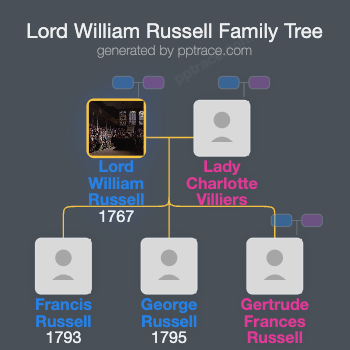
Russell married Lady Charlotte Villiers on July 11, 1789. Lady Charlotte was the eldest daughter of George Bussy Villiers, 4th Earl of Jersey. The marriage produced seven children. Lady Charlotte died in 1808. According to trial evidence following Russell’s murder, he possessed a locket containing some of his wife’s hair, which he valued highly.
In terms of residence, Russell was known to spend considerable time abroad, residing in hotels during his visits to England, according to a 1836 report by The Times. By 1840, he was living in a house in Norfolk Street (now Dunraven Street) in London, where he was ultimately murdered.
His political career was aligned with the Whig party, as with many members of his family. Russell represented Surrey in the House of Commons from 1789 until his defeat in the 1807 election. During the Ministry of All the Talents, he held the position of Lord of the Admiralty from 1806 until 1807. Subsequently, taking advantage of staggered polling dates across constituencies, he was elected for the Russell family pocket borough of Tavistock, serving from 1807 to 1819, and again from 1826 until his retirement in 1831. In 1821, while temporarily staying in Venice, he studied at the San Lazzaro degli Armeni. After leaving Parliament, Russell continued supporting the Whig Party; a 1837 report by The Times noted that few Whigs supported the government during a political gathering, with Russell and his nephew Lord John Russell among the notable exceptions.
Russell’s death was caused by murder in his sleep. On the morning of May 6, 1840, his housemaid Sarah Mancer found the house in disarray and, upon entering Russell’s bedroom, discovered him dead with a throat wound. The murder weapon was a cut-throat, and the scene suggested staged robbery to mislead investigators. The household valet, François Benjamin Courvoisier, was found to have stolen gold articles and banknotes, some of which were later discovered hidden within the house. Marks on the pantry door and the possession of a matching screwdriver linked Courvoisier to the crime scene.
Courvoisier was tried but maintained a plea of not guilty. His defense argued the lack of blood on his clothing and the absence of conclusive evidence. During the proceedings, he confessed to both the thefts and the murder upon receiving legal advice from his counsel. The confession revealed that Russell had confronted Courvoisier over the thefts, leading Courvoisier to kill him to avoid losing his position. Courvoisier’s motive was thus established as concealment of theft.
He was executed publicly outside Newgate Prison on July 6, 1840, attended by an estimated 40,000 spectators, including Charles Dickens and William Makepeace Thackeray. Dickens later expressed moral revulsion at the spectacle, describing his feelings of shame and degradation. The murder scene was also depicted in a peep-show at a traveling fair.