Sylvester Douglas, 1st Baron Glenbervie
| Name | Sylvester Douglas, 1st Baron Glenbervie |
| Title | British politician (1743-1823) |
| Gender | Male |
| Birthday | 1743-05-24 |
| nationality | United Kingdom of Great Britain and Ireland |
| Source | https://www.wikidata.org/wiki/Q7660780 |
| pptrace | View Family Tree |
| LastUpdate | 2025-11-26T23:24:46.215Z |
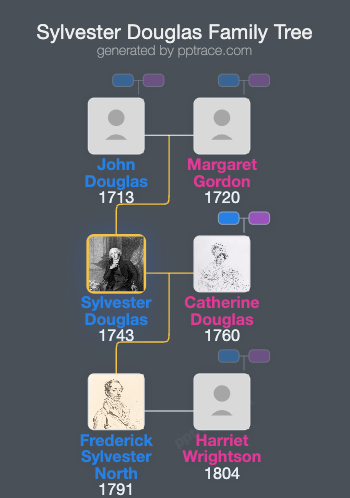
Family Tree
Tap  to expand more relatives
Introduction
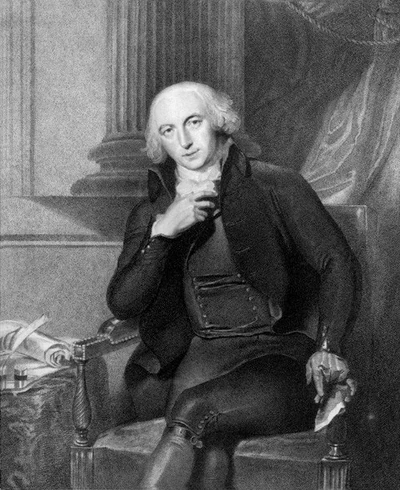
Sylvester Douglas, 1st Baron Glenbervie, PC, KC, FRS, FRSE, FSA, was born on 24 May 1743 and died on 2 May 1823. He was a British lawyer and politician who held the office of Chief Secretary for Ireland from 1793 to 1794.
**Family Background and Early Life**
Douglas was the son of John Douglas and descended from James Douglas, minister of Glenbervie in Aberdeenshire. His paternal lineage included Sir Archibald Douglas and William Douglas, 9th Earl of Angus, making him a member of the Scottish family with notable historical prominence. His mother was Margaret Gordon, the daughter and co-heiress of James Gordon of Fechel. He had a sister named Katherine, who married James Mercer, an army officer and poet.
**Education**
He attended the University of Aberdeen, where he graduated with a Master of Arts degree in 1765. Subsequently, Douglas studied Law and Medicine at the University of Leyden in the Netherlands. He was admitted to Lincoln's Inn in London in 1771, called to the Bar in 1776, and became King's Counsel in 1793.
**Legal and Political Career**
In 1793, upon becoming King's Counsel, Douglas left his legal practice to assume the position of Chief Secretary for Ireland under Prime Minister William Pitt the Younger. In the same year, he was admitted to both the Irish and English Privy Councils. He served as a Member of the Irish House of Commons for St Canice from 1793 until 1796.
In the British Parliament, Douglas represented various constituencies: Fowey from 1795, Midhurst between 1796 and 1800, Plympton Erle from 1801 to 1802, and Hastings from 1802 to 1806.
In 1796, he was asked to accompany Earl Macartney to the Cape of Good Hope and was expected to succeed as governor after 18 months. However, his wife disapproved of the appointment, and Douglas declined the role, even after being offered an Irish peerage. In 1797, William Pitt appointed him as a Lord of the Treasury.
He was twice offered governorship of the Cape of Good Hope: in 1796 and again in 1800. Although he initially accepted the latter offer in October 1800, he later changed his decision and instead received a position as Joint Paymaster of the Forces, a role he held from 1800, with a salary of £2,731 10s., paid from the Cape Treasury, despite never serving in the Cape.
On 29 November 1800, Douglas was created Baron Glenbervie, of Kincardine, Scotland. He served as Joint Paymaster of the Forces (1801–1803), Vice-President of the Board of Trade (1801–1804), Surveyor General of Woods, Forests, Parks, and Chases (1803–1806, 1807–1810), and subsequently as First Commissioner of Woods and Forests from 1810 until 1814, after the department's reorganization merging the Office of the Surveyor General of the Land Revenues of the Crown.
**Marriage and Family**
In 1789, Douglas married Lady Catherine Anne North, the eldest daughter of Frederick North, Lord North, former Prime Minister of Great Britain. They had one son, Frederick Douglas, who served as Member of Parliament for Banbury from 1812 until his early death in 1819. Lady Glenbervie died in February 1817 at age 56. Douglas outlived her by six years, passing away in 1823 at the age of 79. As he had no surviving male heirs, the barony became extinct upon his death.
**Other Achievements**
In 1795, Douglas was elected a Fellow of the Royal Society of London. In 1806, he was elected a Fellow of the Royal Society of Edinburgh, with proposers including Allan Maconochie, Lord Meadowbank; Gilbert Innes; and John Playfair.
**Legacy**
His personal library was auctioned in London in June and July 1823, with catalogues archived at Cambridge University Library.