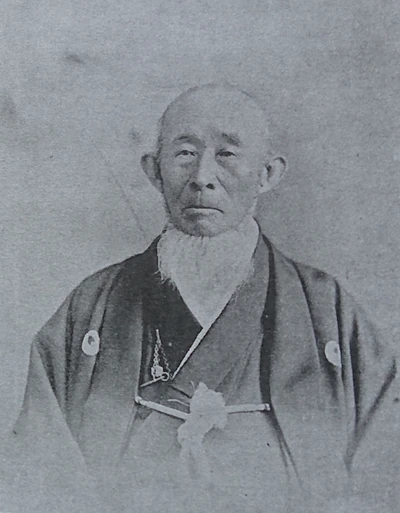
Itō Jūzō
| Name | Itō Jūzō |
| Title | Japanese samurai (1817-1896) |
| Gender | Male |
| Birthday | 1812-12-00 |
| nationality | Tokugawa shogunate |
| Source | https://www.wikidata.org/wiki/Q110982504 |
| pptrace | View Family Tree |
| LastUpdate | 2025-11-27T10:44:16.983Z |
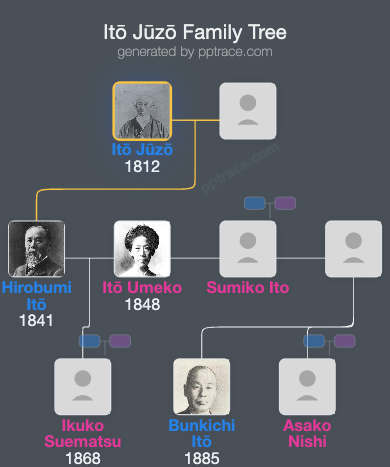
Family Tree
Tap  to expand more relatives
Introduction
Prince Itō Hirobumi (Japanese: 伊藤 博文, いとう ひろぶみ) was born Hayashi Risuke on October 16, 1841, in Tsukari village, Suō Province (present-day Hikari, Yamaguchi Prefecture), within the Chōshū Domain. His father was Hayashi Jūzō, a farmer of modest origins, who was later adopted into the Itō family along with his household, thereby acquiring samurai status. Following the adoption, Risuke's name was changed first to Itō Risuke, then to Itō Shunsuke in 1858, and eventually to Itō Hirobumi around 1869. The name "Hirobumi," meaning "extensive learning," was reportedly suggested by Takasugi Shinsaku and derived from Confucian texts.
In 1856, at the age of approximately 15, Itō was sent for guard duty in Sagami Province. The following year, in 1857, Kuruhara Ryōzō, a relative of Kido Takayoshi, recognized his potential and encouraged his intellectual development. That same year, he enrolled in the Shōka Sonjuku, a private academy operated by Yoshida Shōin, a prominent scholar and activist. Yoshida's influence was significant during this formative period, and Itō became involved in the sonnō jōi movement, which sought to revere the emperor and expel foreigners. After Yoshida Shōin’s execution in 1859 during the Ansei Purge, Itō participated in efforts to retrieve Yoshida's body for burial. He engaged in radical activities, including participation in an unsuccessful plot against Nagai Uta in 1862 and involvement in the burning of the British legation in Edo. He also, along with Yamao Yōzō, assassinated Hanawa Jirō Tadatomi under false pretenses.
Despite his early radicalism, Itō later expressed pragmatic views, criticizing the emotional nature of anti-foreign sentiments and advocating for thoughtful political strategy. Driven by a desire to understand Western developments, Itō was selected as one of the Chōshū Five to study abroad secretly in Britain in 1863, in violation of the Tokugawa shogunate's travel ban. He studied at University College London, lodging with Professor Alexander Williamson and learning English and Western customs. His initial studies lasted about six months before he and Inoue Kaoru decided to return to Japan upon learning of conflicts involving Western powers in Shimonoseki. Itō arrived back in Japan in July 1864, during a tumultuous period, and played a role in negotiations following the Shimonoseki conflict.
Following the Meiji Restoration of 1868, Itō quickly rose within the new government. In February 1868, he was appointed to a role in foreign affairs, and later that year, he became the first governor of Hyōgo Prefecture. His 1869 proposal, "Principles for National Policy" (Kokuze kōmoku), outlined six key policies, including establishing a monarchy, centralizing authority under the emperor, promoting international engagement, abolishing class distinctions, advancing scientific learning, and ending anti-foreign sentiment.
Itō became a leading figure during the early Meiji era, instrumental in drafting Japan’s constitutional framework. He traveled to Europe to study political systems, ultimately advocating for a constitution similar to that of Prussia. In 1885, he replaced the Daijō-kan with a cabinet structure and became Japan’s first prime minister, serving from 1885 to 1888. He played a central role in the development of the Meiji Constitution, which was promulgated in 1889. From then on, he exercised influence as an imperial adviser (genkun) and head of the Privy Council.
In 1900, Itō founded the Rikken Seiyūkai political party, recognizing the importance of party politics. In foreign policy, he worked to strengthen diplomatic relations with Western powers including Germany, the United States, and the United Kingdom. He oversaw the First Sino-Japanese War and negotiated favorable treaties, including the annexation of Taiwan and Korea’s strategic independence from Chinese influence. His diplomatic efforts also included policies aimed at avoiding conflict with Russia, such as the Man-Kan kōkan proposal. However, the failure of diplomacy contributed to the outbreak of the Russo-Japanese War. After Japan’s victory, Itō became the first Resident-General of Korea in 1905, a position established following Japan's annexation of Korea. Initially supporting a protectorate arrangement, he ultimately acquiesced to full annexation under mounting military and political pressure.
Itō Hirobumi resigned as Resident-General in June 1909. On October 26, 1909, he was assassinated by Korean nationalist An Jung-geun in Harbin, Manchuria.