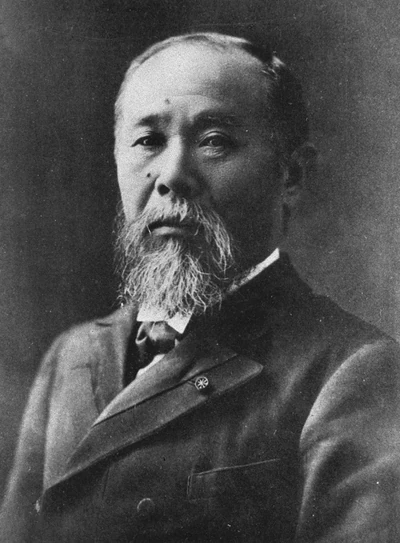
Hirobumi Itō
| Name | Hirobumi Itō |
| Title | 1st, 5th, 7th and 10th Prime Minister of Japan (1841–1909) |
| Gender | Male |
| Birthday | 1841-10-16 |
| nationality | Japan |
| Source | https://www.wikidata.org/wiki/Q174971 |
| pptrace | View Family Tree |
| LastUpdate | 2025-11-17T10:07:27.089Z |
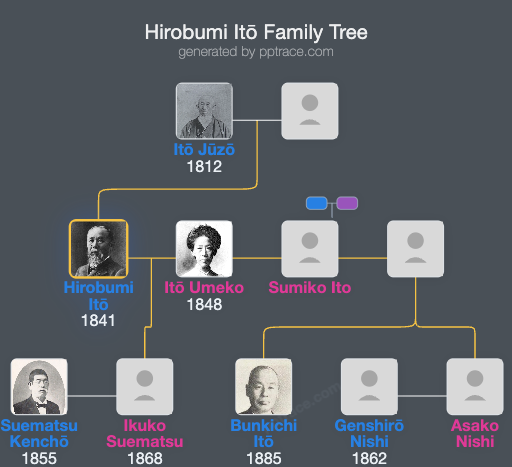
Family Tree
Tap  to expand more relatives
Introduction
Prince Itō Hirobumi (Japanese: 伊藤博文 [i.toː (|) çi.ɾoꜜ.bɯ.mʲi]; born Hayashi Risuke [林利助], 16 October 1841 – 26 October 1909), was a Japanese statesman. He served as the first prime minister of Japan, holding office from 1885 to 1888, and subsequently from 1892 to 1896, from January to June 1898, and again from 1900 to 1901. Itō was also a prominent member of the genrō, a group of senior courtiers influential in policy formulation during the Meiji era. He played an integral role in drafting the Meiji Constitution, establishing the Japanese Diet, and developing the modern cabinet system.
Born in Tsukari village, Suō Province (present-day Hikari, Yamaguchi Prefecture), Itō was the son of Hayashi Jūzō, a farmer of modest background. His family was adopted into a low-ranking samurai family associated with the Itō lineage, which resulted in his name change from Hayashi Risuke to Itō Risuke, then to Itō Shunsuke in 1858, and finally to Itō Hirobumi around 1869. The name "Hirobumi" was suggested by Takasugi Shinsaku and means "extensive learning."
During the late Edo period, Itō was involved in nationalist movements, including the sonnō jōi ("Revere the Emperor, Expel the Barbarians"). He received early education at the Shōka Sonjuku academy run by Yoshida Shōin and participated in radical activities such as plots against officials and the burning of the British legation in Edo, reflecting his initial engagement with anti-foreign sentiments.
In 1863, Itō was selected as one of the Chōshū Five to study abroad in Britain, a decision made to acquire Western knowledge necessary for Japan’s modernization. He studied at University College London while lodging with Professor Alexander Williamson. His study period was brief; after about six months, he and fellow student Inoue Kaoru returned to Japan upon learning of the Shimonoseki bombardment by Western forces. This overseas experience contributed significantly to his understanding of Western politics and diplomacy. He developed proficiency in English and engaged in negotiations in subsequent years.
Following the Meiji Restoration in 1868, Itō held various governmental roles, including a junior councilor for foreign affairs and the first governor of Hyōgo Prefecture. In 1869, he proposed a comprehensive policy known as the "Principles for National Policy" (Kokuze kōmoku), which advocated for centralization of power under the emperor, active foreign engagement, abolition of strict social hierarchies, and promotion of scientific knowledge.
Itō was appointed to oversee the drafting of the Meiji Constitution in 1881 after traveling to Europe to study constitutional systems. His model was inspired by the Prussian constitution, designed to preserve significant imperial authority while establishing a parliamentary government. When the constitution was promulgated in 1889, Itō established a Privy Council to deliberate on its implementation.
As prime minister, Itō introduced representative political institutions and founded the Rikken Seiyūkai political party in 1900, recognizing the importance of party politics. His foreign policy efforts included strengthening diplomatic relations with Western powers such as Germany, the United States, and the United Kingdom. He directed Japanese military campaigns during the First Sino-Japanese War, resulting in territorial gains including Taiwan and Korea's independence from Chinese suzerainty.
In the international arena, Itō aimed to avoid conflict with Russia through diplomacy, notably advocating for the Man-Kan kōkan policy, which proposed ceding Manchuria to Russia in exchange for recognition of Japanese hegemony in Korea. This policy failed, leading to the Russo-Japanese War (1904–1905). After Japan’s victory, Itō became the first Resident-General of Korea, overseeing its governance. His support for gradual annexation faded under military and political pressure, leading to Japan's formal annexation of Korea.
Itō resigned as Resident-General in June 1909. He was assassinated four months later in Harbin, Manchuria, by Korean independence activist An Jung-geun.
== Early Life and Education ==
Itō Hirobumi was born as Hayashi Risuke on October 16, 1841, in Tsukari village, Suō Province. His family was of humble farming origins; his father served as a low-ranking samurai. After his family's adoption into the Itō family, his name was changed multiple times, with "Hirobumi" meaning "extensive learning," reportedly suggested by Takasugi Shinsaku.
In 1856, Itō was assigned guard duty in Sagami Province. Influenced by Kuruhara Ryōzō, he enrolled in Shōka Sonjuku, a private academy run by Yoshida Shōin. The execution of Yoshida in 1859 deeply affected him, fueling his involvement in the sonnō jōi movement. He participated in early attempts to revolt against foreign influence, including a failed assassination plot and the burning of the British legation, although he later distanced himself from radical anti-Western sentiment.
In 1863, Itō was chosen to study abroad in Britain as part of the Chōshū Domain's secret program. Arriving in London in November 1863 to study at University College London, his studies were cut short after six months when he returned to Japan in July 1864 following the Shimonoseki conflict, intending to apply Western knowledge to Japan’s national development. His stay in Britain helped shape his future diplomacy, giving him a functional command of English and a broader international perspective.