Robert Grant
| Name | Robert Grant |
| Title | British army officer |
| Gender | Male |
| Birthday | 1837-01-17 |
| nationality | — |
| Source | https://www.wikidata.org/wiki/Q18954538 |
| pptrace | View Family Tree |
| LastUpdate | 2025-11-26T12:47:59.581Z |
Family Tree
Tap  to expand more relatives
Introduction
Sir Robert Grant (10 August 1837 – 8 January 1904) was a British lieutenant-general and royal engineer. He was born at Malabar Hill, Bombay, as the younger son of Sir Robert Grant, who served as governor of Bombay. His maternal grandfather was Sir David Davidson of Cantray, Nairnshire, and his maternal grandmother was Margaret, daughter of Sir David Davidson. His family had connections to Lord Glenelg and Lord Josceline William Percy, the second son of the Duke of Northumberland.
Grant received his education at Harrow School, where he studied alongside his elder brother Charles Grant. At the age of seventeen, he successfully passed first in a competitive examination for vacancies in the Royal Artillery and Royal Engineers, which were available due to the Crimean War. He was gazetted as second lieutenant in the Royal Engineers on 23 October 1854 and promoted to first lieutenant on 13 December 1854. Following six months of training at Chatham, he was stationed in Scotland.
In February 1857, Grant was transferred to the Jamaica command in the West Indies. At the end of 1858, he served as a staff fort adjutant at Belize in British Honduras. He excelled academically, passing first in the examination for the newly established Staff College, although his attendance was limited, and he attended only from January to May 1859. Subsequently, he served as aide-de-camp to Lieutenant-General Sir William Fenwick Williams, the North American commander of British forces, for six years.
Grant was promoted to second captain on 8 August 1860. He demonstrated academic excellence by passing first again in the Staff College final examinations, despite his limited classroom attendance. Between January and June 1861, he was attached to the cavalry and artillery at Aldershot. After returning from Canada in June 1865, Grant served at Chatham, Dover, and Portsmouth. He achieved promotion to first captain on 10 July 1867 and to major on 5 July 1872.
From 1871 to 1877, he served as deputy assistant adjutant-general for the Royal Engineers at the War Office. In 1877, Grant was appointed commander of Royal Engineers troops at Aldershot, overseeing pontoon, telegraph, equipment, and depot units. He was promoted to lieutenant colonel on 1 July 1878. Subsequently, he held commands as the commanding royal engineer of the Plymouth Subdistrict (May 1880) and the Woolwich District (December 1881). Promoted to colonel in the army on 1 July 1882, he was placed on half pay in 1883 and remained unassigned until 1884, when he assumed command of Scottish Royal Engineers at Edinburgh with the rank of colonel on the staff.
In March 1885, Grant was called to Egypt to join Lord Wolseley during the Nile expedition, serving as colonel on the staff and commanding royal engineer of the expeditionary force. He served in the headquarters staff and in command of the Abu Fatmeh district during the evacuation. He fell seriously ill with fever and was invalided home in August 1885. For his service, he was mentioned in dispatches on 13 June 1885.
On 1 July 1886, Grant was appointed deputy adjutant-general for royal engineers at the War Office. He was created Companion of the Order of the Bath (C.B.) on 25 May 1889 and was temporarily promoted to major-general on 23 October 1889. In April 1891, he was appointed inspector-general of fortifications with the temporary rank of lieutenant-general, a position he held with significant responsibilities, including overseeing defence works and barrack construction financed by government loans. His service was extended two years beyond the customary term due to his valuable contributions.
Grant was promoted to knight Commander of the Order of the Bath (K.C.B.) on 20 May 1896. Upon leaving the War Office in April 1898, his work was praised by the secretaries of state for war and the colonies. He was awarded a distinguished service pension of £100 annually. Later, he was elevated to Knight Grand Cross of the Order of the Bath (G.C.B.) on 26 June 1902 and retired from active service on 28 March 1903 due to failing health.
Sir Robert Grant died on 8 January 1904 at his residence at 14 Granville Place, Portman Square, London, and was buried in Kensal Green Cemetery. He was known for his composed demeanor, sound judgment, and good memory. A portrait of him by C. Lutyens, painted in 1897, is displayed at the Royal Engineers officers' mess at Aldershot, with a replica also in possession of Lady Grant, who also owned a portrait by Henty painted in 1887.
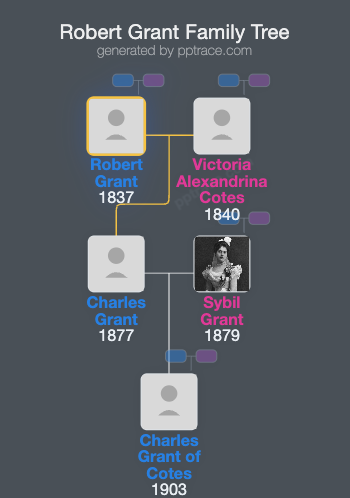
He married Victoria Alexandrina, daughter of John Cotes of Woodcote Hall, Shropshire, on 24 November 1875. Victoria was widowed from T. Owen of Condover Hall prior to their marriage. They had three children: a daughter who died young, and twin sons, both serving in the army. The younger twin, Robert Josceline, was killed at the Battle of Spion Kop on 24 January 1900.
His elder brother, Sir Charles Grant (1836–1903), was born in 1836 and was educated at Harrow, Trinity College, Cambridge, and Haileybury. Charles Grant served in the Bengal civil service, holding positions such as commissioner of the central provinces, acting chief commissioner, secretary to the government of India, and foreign secretary of the government of India. He was appointed Companion of the Star of India (C.S.I.) in 1881 and Knight Commander of the Star of India (K.C.S.I.) in 1885. Sir Charles Grant died suddenly in London on 10 April 1903.