John Williamson Nevin
| Name | John Williamson Nevin |
| Title | American theologian |
| Gender | Male |
| Birthday | 1803-02-20 |
| nationality | United States of America |
| Source | https://www.wikidata.org/wiki/Q6264409 |
| pptrace | View Family Tree |
| LastUpdate | 2025-11-17T06:43:26.552Z |
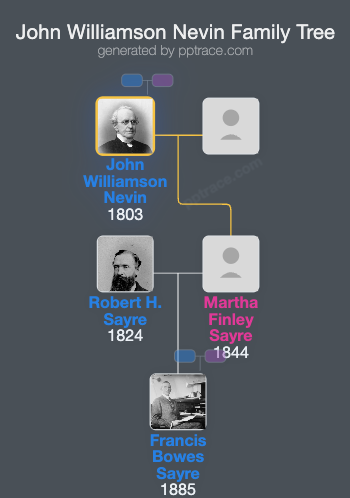
Family Tree
Tap  to expand more relatives
Introduction
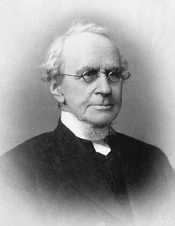
John Williamson Nevin (February 20, 1803 – June 6, 1886) was an American theologian and educator. He was born in the Cumberland Valley near Shippensburg, Franklin County, Pennsylvania. Nevin was of Scottish descent and received Presbyterian religious training.
Nevin graduated from Union College in 1821. He studied theology at Princeton Theological Seminary between 1823 and 1828, during which time he was responsible for the classes of Charles Hodge from 1826 to 1828. He was licensed to preach by the Carlisle Presbytery in 1828.
Between 1830 and 1840, Nevin served as a professor of Biblical literature at the Western Theological Seminary, located in Allegheny, Pennsylvania, which is now known as Pittsburgh Theological Seminary. In 1840, influenced by Neander, he began to diverge from strict "Puritanic Presbyterianism." He resigned his position in Allegheny and was appointed a professor of theology at the German Reformed Theological Seminary in Mercersburg. This change marked his transition from the Presbyterian Church to the German Reformed Church.
Nevin gained prominence through various contributions, including articles in the church's organ, the Messenger. He authored "The Anxious Bench—A Tract for the Times" in 1843, which critiqued revivalist methods that he regarded as excessive. He also defended the inauguration address delivered by his colleague Philip Schaff, titled "The Principle of Protestantism," which proposed that Pauline Protestantism was not the final stage of ecclesiastical development but that Johannine Christianity would emerge as a future stage. The address also acknowledged Petrine Romanism as part of church evolution.
In addition, Nevin developed his own interpretation of the mystical union between Christ and believers, complementing Schaff's theses. Both were accused of having "Romanizing tendencies." Nevin characterized some critics as pseudo-Protestants. He supported the validity of Roman Catholic baptism, aligned with Charles Hodge in this view, and defended the doctrine of the "spiritual real presence" of Christ in the Eucharist in his work "The Mystical Presence" (1846), which led to condemnation from Hodge and others.
In 1849, the Mercersburg Review was founded as the publication representing Nevin's theological perspective, known as "Mercersburg Theology," to which he contributed until 1883. He resigned from the Mercersburg Seminary in 1851 to reduce its expenses. From 1841 to 1853, Nevin served as president of Marshall College at Mercersburg. He was part of the committee that prepared the liturgy for the German Reformed Church, which was published in provisional form in 1857 and as "An Order of Worship" in 1866.
From 1861 to 1866, Nevin was an instructor of history at Franklin and Marshall College, into which Marshall College had merged. He served as the college's president from 1866 to 1876. Nevin died in Lancaster, Pennsylvania, on June 6, 1886.
Among his published works are several pieces in the Mercersburg Theology Study Series. Additionally, his collection is preserved in a thirteen-volume series held by Faithlife.