Hisaichi Terauchi
| Name | Hisaichi Terauchi |
| Title | Japanese general (1879-1946) |
| Gender | Male |
| Birthday | 1879-08-08 |
| nationality | Japan |
| Source | https://www.wikidata.org/wiki/Q168339 |
| pptrace | View Family Tree |
| LastUpdate | 2025-11-17T10:08:15.713Z |
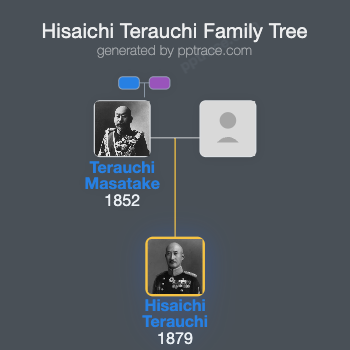
Family Tree
Tap  to expand more relatives
Introduction
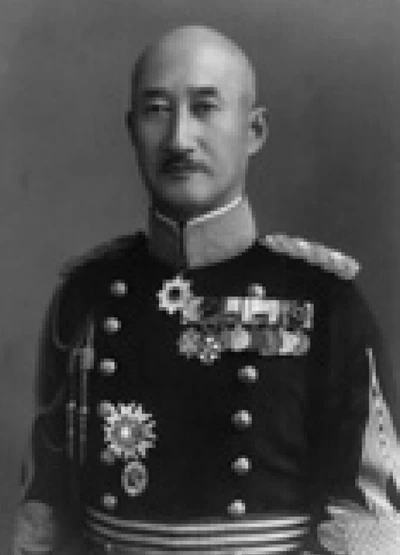
Count Hisaichi Terauchi (寺内 寿一, Terauchi Hisaichi) was born on 8 August 1879 and died on 12 June 1946. He held the rank of Gensui (Field Marshal) in the Imperial Japanese Army and served as the commander of the Southern Expeditionary Army Group during World War II.
He was born in Tokyo Prefecture as the eldest son of Gensui Count Terauchi Masatake, who was the first Governor-General of Korea and the 9th Prime Minister of Japan. At the age of four, Terauchi was sent to live with his maternal aunt in Yamaguchi Prefecture due to his father's overseas assignment in France. The family moved back to Tokyo after his father's return.
Terauchi graduated from the 11th class of the Imperial Japanese Army Academy in 1899. During the Russo-Japanese War, he served as a junior officer with the Guards 2nd Infantry Battalion. After the war, he returned to the Army Staff College, graduating from the 21st class in 1909.
In July 1912, he was appointed as a military attaché to Austria-Hungary, and in July 1914 to Germany. He was promoted to lieutenant colonel in November 1916, and in September 1917, he was attached to the IJA 2nd Infantry Regiment. From September 1918, he held various administrative roles within the Imperial Japanese Army General Staff.
In early November 1919, upon the death of his father, he inherited the hereditary title of hakushaku (count) under the kazoku peerage system and was promoted to colonel. He commanded the 3rd Guards Infantry Battalion starting in September 1920 and served as chief of staff of the Imperial Guard from September 1923.
Terauchi was promoted to major general in February 1924 and served on the staff of the IJA 1st Division in 1926. In September 1926, he was involved in an incident when the train he was riding derailed, resulting in 34 casualties; he was uninjured. In August 1927, he became Chief of Staff of the Chosen Army in Korea.
Promoted to lieutenant general in August 1929, Terauchi took command of the IJA 5th Division based in Hiroshima. In January 1932, he was transferred to command the IJA 4th Division in Osaka. During this period, he was involved in the "Go-Stop Incident," a notable confrontation between military personnel and police authorities, which resulted in the Osaka police refusing to apologize and maintaining that military personnel were above civilian law.
In August 1934, he assumed command of the Taiwan Army of Japan. He achieved the rank of full general in October 1935. Following the February 26th Incident in 1936, Terauchi briefly served as interim Army Minister under Prime Minister Kōki Hirota. During this time, he engaged in purges of the Imperial Way Faction within the military and supported the Control Faction. His rhetoric contributed to the collapse of the Hirota administration in January 1937.
Terauchi was appointed head of the Inspectorate General of Military Training in February 1937. With the escalation of the Second Sino-Japanese War, he commanded the North China Area Army starting in August 1937 and was awarded the Grand Cordon of the Order of the Rising Sun in 1938.
In November 1941, he was appointed commander of the Southern Expeditionary Army Group, coordinating plans with Admiral Yamamoto Isoroku for the Pacific War. He oversaw the conquest of Southeast Asia from his headquarters in Singapore and received the Order of the Golden Kite, 1st class, in March 1942. Promoted to Gensui (Field Marshal) on 6 June 1943, he was stationed in the Philippines beginning in May 1944 and later moved to Saigon in French Indochina as the Allied threats increased.
During the final stages of the war, Terauchi suffered a stroke on 10 May 1945, which incapacitated him. He was among the Japanese military leaders who surrendered in Southeast Asia; he personally surrendered to Lord Mountbatten on 30 November 1945 in Saigon. He was transferred to a prisoner of war camp but died of a second stroke on 12 June 1946 at Renggam, Johor Bahru, Malaya.
He was buried at the Japanese cemetery in Singapore. His family heirloom wakizashi sword, dating from 1413 and now housed at Windsor Castle, was surrendered to Mountbatten in 1945. The sword was the subject of a diplomatic controversy when Queen Elizabeth The Queen Mother considered displaying it during a dinner with Crown Prince Akihito, but Queen Elizabeth II vetoed the decision.
Terauchi's involvement in war crimes included his command responsibilities for the Southern Expeditionary Army and actions such as the mistreatment of laborers on the Burma-Siam Railroad and the order for the massacre of Allied prisoners of war if Japan was invaded. However, he was never tried for war crimes prior to his death.